Getting ahead, feeling behind: life in the shadow of the 0.01%...
Why does a decade of real middle‑class gains feels like loss in our age of Instagram plutocracy, anyway?
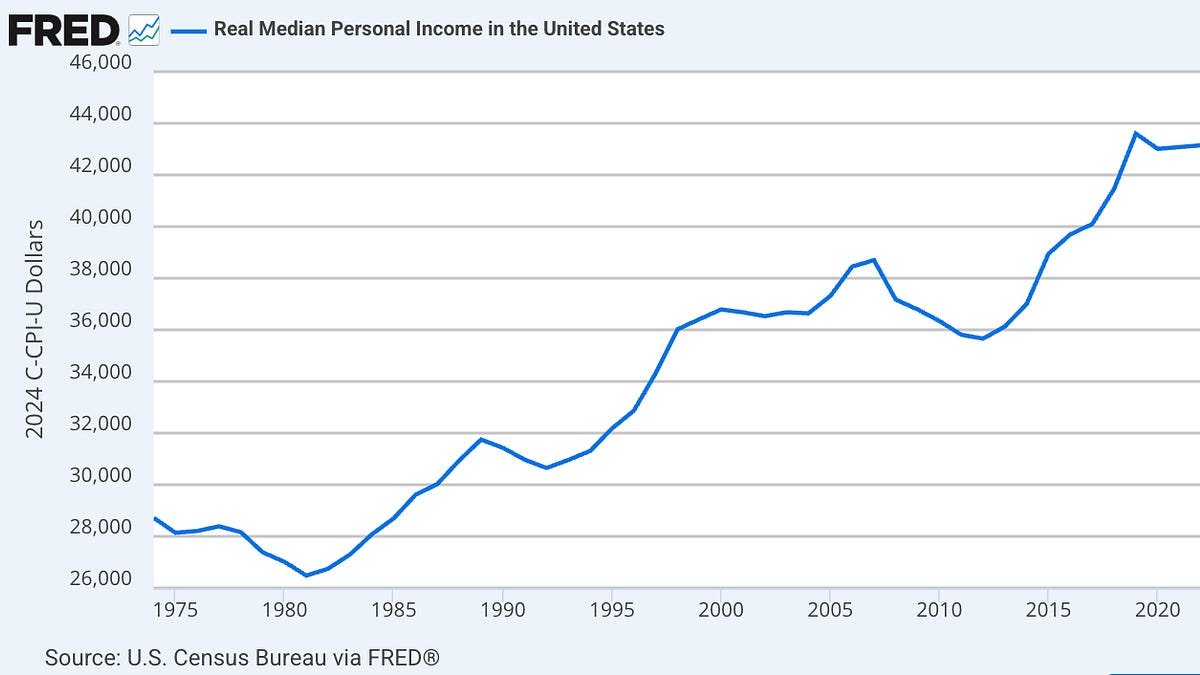
Noah Smith notes that America’s middle class has in fact been getting ahead—but that it does not feel that way to people who live, work, and now scroll in the shadow of the superrich. The moral? Economic truth is not the same as sociological truth here:
And Noah Smith writes:
Noah Smith: <https://twitter.com/Noahpinion/status/2074405332181209147> ‘The middle class actually isn't falling behind, they're getting ahead. But everyone thinks they're falling behind because they're constantly interacting with super-rich people online, and seeing rich people's lifestyles on Instagram…
Not just online, Noah! In person, too. And, in fact, this has been building since the coming of television, if not of the movies. and it has been massively reinforced by the rise in income and wealth inequality since the coming of Ronald Reagan to national office. And this overshadows the fact that the American middle class still feels as though it is losing ground even as it has quietly booked a decade of very substantial real income growth.
A world in which the average member of the top 0.01% has 0.05/0.0001 = 500 rather than merely (“merely”!) 100 times the average income is different.
No, I do not how much of the difference is that the superrich are more salient in relative terms in America today than they were fifty years ago, and how much of it is just that to the average person they seem more salient than they were fifty years ago. And no, I do not know how much of the zeitgeist today is still ruled by a culture that has absorbed the 1998-2014 income stagnation as the glasses through which it views the very different economy we have had since then. $37,000 to $45,000 in measured median real income in a decade is 2% per year. That is a very acceptable rate of real growth indeed, especially when one considers the amount of time devoted to and the improvement in entertainment and information and communications services that are essentially free that we have had over the past decade.
Noah's analysis is seriously lacking. It doesn't help if I make more dollars, if everything I have to buy also costs more dollars, and there is no question that major items like housing and transportation and education and healthcare have gone up much, much faster than income. It's not "wealth envy", it's slow but real impoverishment.
I'm not sure that familiarity with the ultra-rich is anything new. It probably dates back to mass literacy: the mid 19th century or thereabouts. Many Victorian novels were set in splendid drawing rooms. Think of Père Goriot, or Tale of Two Cities. "Society pages" were common.
IIRC, Adam Smith observed that people tend to extend sympathy upward. And, as the socialists knew, resentment as well.
Sentinel — Human
The text reads as a subjective, argumentative essay that weaves personal reflection with economic data and philosophical references, displaying the uneven rhythm characteristic of human critical writing.