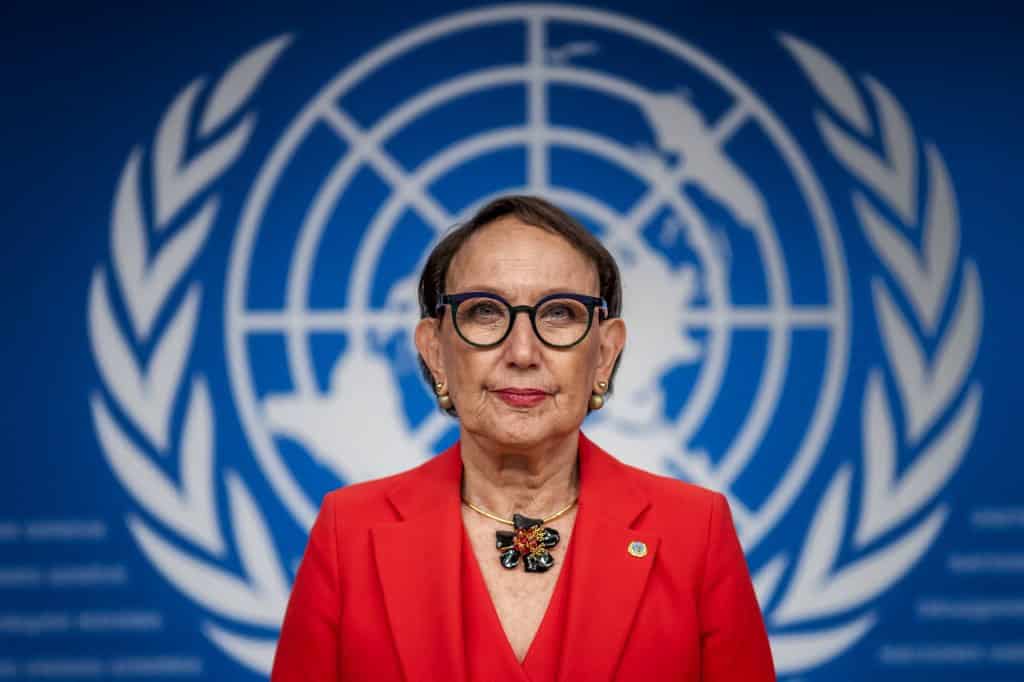
Argentine diplomat Virginia Gamba has been removed from the race to become the next secretary-general of the United Nations after the Maldives withdrew her nomination, trimming the field just weeks before the first public candidate dialogues are scheduled to begin. Gamba, a former U.N. special representative for children and armed conflict, had been formally nominated on March 12.
For Costa Rica, the move could offer a modest political opening. Rebeca Grynspan, Costa Rica’s nominee and a former vice president who now leads UN Trade and Development, entered the race on March 3. With Gamba out, there is one less Latin American candidate competing for attention, support and the broader push among many member states to finally choose the first woman to lead the United Nations.
Still, Gamba’s departure does not suddenly clear the path for Grynspan. Argentina’s official candidate, Rafael Grossi, remains in the contest, and Michelle Bachelet is also still running despite Chile withdrawing its backing earlier this week. Bachelet continues to have support from Brazil and Mexico, while Grossi is widely seen as a serious contender with a strong technical and diplomatic profile.
That means the practical effect for Costa Rica is limited but real. Grynspan may now find it slightly easier to present herself as one of the main female Latin American options in the race, especially at a moment when the U.N. General Assembly has openly encouraged member states to consider women candidates after eight decades without a female secretary-general. But any advantage from Gamba’s exit is likely to be marginal unless it translates into backing from influential governments beyond Costa Rica.
The larger math of the race has not changed. The next U.N. chief will be chosen through Security Council straw polls and backroom negotiations later this year, and any eventual winner must avoid a veto from the United States, Russia, China, Britain or France before being approved by the General Assembly. Diplomats and analysts also continue to debate whether 2026 should belong to Latin America, which last held the post in 1991, or to Africa, which argues it has an equally strong claim.
That broader contest may matter more to Grynspan than Gamba’s exit alone. Latin America still has multiple names in play, and the region has not yet unified behind a single candidate. At the same time, Grynspan’s résumé gives Costa Rica a credible standard-bearer: she has led UNCTAD since 2021 and has long experience in multilateral diplomacy, development policy and regional politics.
The next near-term test comes quickly. Countries have been asked to submit nominations by April 1 for participation in the first round of interactive dialogues, which are scheduled for the week of April 20. Those sessions will give candidates a public platform, but the decisive phase will still come later, inside the Security Council, where public momentum often matters less than private acceptability to the major powers.
For now, Gamba’s removal gives Costa Rica a cleaner field than it had a day ago, but not an easy one. Grynspan may benefit from reduced competition on the margins. The harder task remains the same: turning a respected candidacy into one that the world’s most powerful governments are willing to live with.
Facts Only
Virginia Gamba, an Argentine diplomat and former UN special representative for children and armed conflict, was nominated for UN secretary-general on March 12.
The Maldives withdrew Gamba’s nomination, removing her from the race.
Rebeca Grynspan, Costa Rica’s nominee and former vice president, entered the race on March 3.
Grynspan currently leads UN Trade and Development (UNCTAD).
Argentina’s official candidate, Rafael Grossi, remains in the contest.
Michelle Bachelet continues to run despite Chile withdrawing its backing; she retains support from Brazil and Mexico.
The UN General Assembly has encouraged member states to consider female candidates for secretary-general.
The next UN secretary-general will be chosen through Security Council straw polls and negotiations later in 2026.
The selection requires avoiding a veto from the United States, Russia, China, Britain, or France.
Countries have been asked to submit nominations by April 1 for participation in interactive dialogues scheduled for the week of April 20.
Latin America last held the UN secretary-general post in 1991, while Africa argues it has a strong claim to the position.
Grynspan has led UNCTAD since 2021 and has experience in multilateral diplomacy and development policy.
Executive Summary
Virginia Gamba, an Argentine diplomat and former UN special representative for children and armed conflict, has been removed from the race for UN secretary-general after the Maldives withdrew her nomination. This development leaves Costa Rica’s nominee, Rebeca Grynspan, as one of the prominent female Latin American candidates in a field that still includes Argentina’s Rafael Grossi and Chile’s Michelle Bachelet, despite Chile withdrawing its official backing. The race remains competitive, with multiple Latin American candidates vying for support amid broader debates over whether the next secretary-general should come from Latin America or Africa. The selection process will involve Security Council straw polls and negotiations, with the decisive phase occurring later this year. Grynspan’s credentials, including her leadership of UN Trade and Development, position her as a strong contender, but the ultimate decision will hinge on the preferences of the five permanent Security Council members. The first public candidate dialogues are scheduled for April, providing an early platform for candidates to present their visions.
The withdrawal of Gamba slightly reduces competition for Grynspan, but the race’s dynamics remain complex. Latin America has not yet coalesced around a single candidate, and the region’s claim to the post is contested by Africa, which argues it has an equally strong case. The next secretary-general will be chosen through a process that prioritizes acceptability to major powers over public momentum, making backroom diplomacy and veto avoidance critical. While Grynspan may benefit from a cleaner field, her success will depend on securing support from influential governments beyond Costa Rica. The broader contest over regional representation and gender equity in the UN’s leadership continues to shape the race, with no clear front-runner yet emerging.
Full Take
The strongest version of this narrative highlights the fluid and politically charged nature of the UN secretary-general selection process. The withdrawal of Virginia Gamba simplifies the field for Rebeca Grynspan, but the race remains highly competitive, with multiple Latin American candidates and broader geopolitical considerations at play. The article credibly frames the tension between regional claims (Latin America vs. Africa) and the push for gender equity, while acknowledging the outsized role of the Security Council’s permanent members in the final decision. It avoids overt emotional manipulation or distortion, presenting the facts with a focus on procedural and diplomatic realities.
Pattern scan: The narrative does not exhibit clear manipulation patterns, though it subtly reinforces the framing of the race as a contest between regions and genders, which could oversimplify the complex dynamics at play. The emphasis on "first female secretary-general" and regional representation may appeal to identity-based advocacy, but the article does not weaponize these themes. The focus on backroom diplomacy and veto power serves as a reminder of the structural constraints in UN governance, which could be interpreted as a form of systemic realism rather than distortion.
Root cause: The narrative assumes that the UN secretary-general selection is primarily a geopolitical negotiation, where regional representation and gender equity are secondary to the interests of major powers. This reflects a long-standing paradigm in international relations, where institutional leadership is often determined by power dynamics rather than merit or symbolic progress. The unstated assumption is that the UN’s credibility hinges on balancing these competing claims, even if the process itself is opaque and undemocratic.
Implications: The selection process underscores the limitations of multilateralism when constrained by great-power politics. While the push for a female secretary-general is framed as progressive, the reality is that the decision will be shaped by the strategic interests of the P5, potentially sidelining broader calls for reform. For candidates like Grynspan, the challenge is not just to appeal to member states but to navigate the preferences of a small group of powerful actors. This dynamic raises questions about the UN’s ability to reflect global diversity and equity in its leadership.
Bridge questions: How might the emphasis on regional representation and gender equity obscure other qualifications or visions for UN leadership? What would it take for the selection process to become more transparent and inclusive, beyond the current power dynamics? If the next secretary-general is chosen primarily for acceptability to the P5, what does that say about the UN’s ability to address global challenges independently?
Counterstrike scan: If this narrative were part of a coordinated influence campaign, the playbook might involve amplifying regional rivalries (Latin America vs. Africa) to distract from deeper structural issues in UN governance, or framing the race as a zero-sum game between gender and regional representation to polarize support. However, the article does not align with this pattern; it presents the facts without overt manipulation, focusing on procedural realities rather than inflammatory framing. The content appears clean, with no signs of a structured disinformation effort.
Sentinel — Human
This text shows signs of a human writer, with natural variations in sentence length, personal emphasis, and no evidence of fabricated claims or convenient sources. However, the analysis is probabilistic, and it's important to note that some formal journalism can exhibit similar traits.