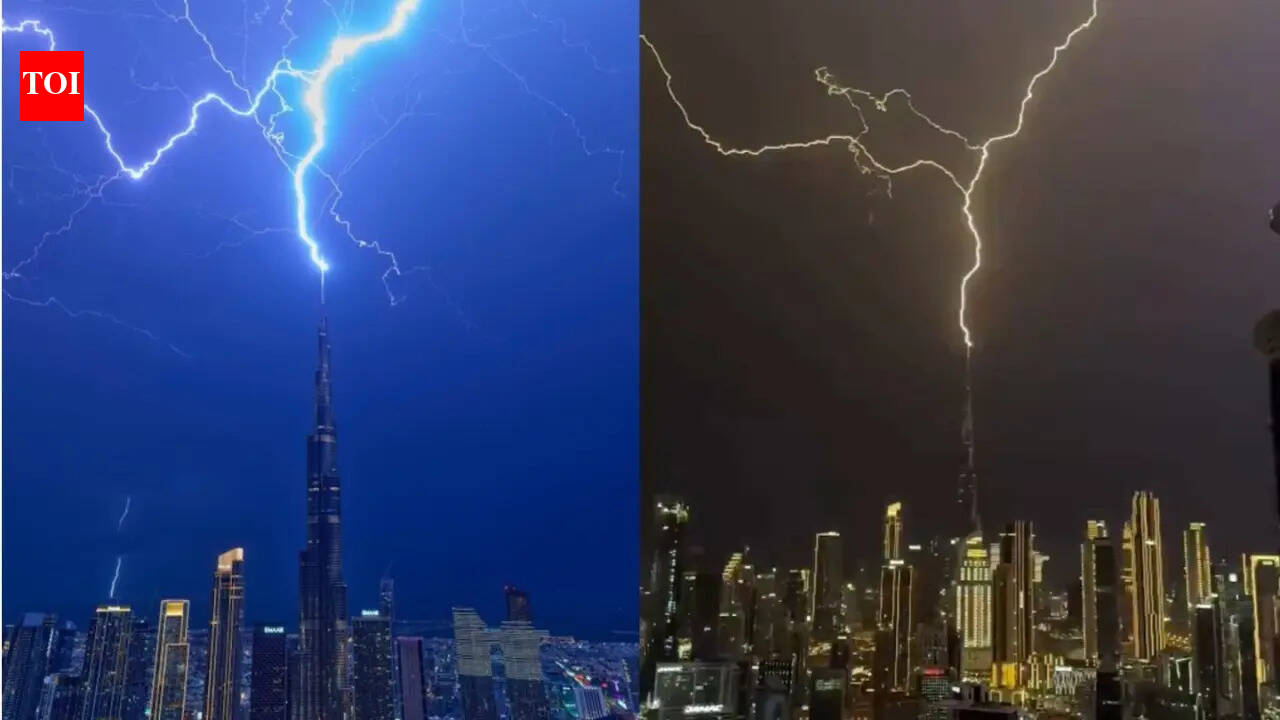
The recent thunderstorms and rainfall in the UAE have flooded social media platforms with dramatic visuals of lightning striking the iconic Burj Khalifa in Dubai and as a result, many viewers were left asking the same question: How can the world’s tallest building survive a direct lightning strike?
The answer lies not in luck but in cutting-edge engineering designed precisely for moments like these. Read on if you too wonder what really happens when lightning hits Dubai’s most famous skyscraper and why it is completely safe.
Dubai Crown Prince Hamdan bin Mohammed Al Maktoum’s viral Burj Khalifa pic breaks the Internet
Amid dramatic thunderstorms sweeping across the city, Sheikh Hamdan bin Mohammed Al Maktoum, the Crown Prince of Dubai, Deputy Prime Minister and Minister of Defence of the UAE took to his
Instagram handle to share a now viral picture of the moment. Widely known as “Fazza”, he captured a moment that instantly resonated across social media as he shared a striking image of the Burj Khalifa illuminated by lightning and thunder.
The prince captioned it, “A moment worth pausing for #Dubai” and punctuated it with lightning bolt and glitter emojis. The post quickly went viral, blending Dubai’s signature grandeur with the raw power of nature. More than just a photograph, it reflected the city’s ability to turn even turbulent weather into a visual spectacle, where engineering marvels meet fleeting but awe-inspiring moments.
Lightning strikes Burj Khalifa in Dubai, UAE: Why it is not dangerous
The viral clips may look terrifying with bolts of electricity tearing through the sky and striking the 828-metre tower but experts say that this is exactly what the building is designed for.
In fact, lightning striking Burj Khalifa is normal, expected and engineered. Tall structures naturally attract lightning and Burj Khalifa, being the tallest in the world, effectively acts like a giant lightning rod.
The science: How the Burj Khalifa in Dubai, UAE handles lightning
- A powerful lightning arrester at the top: At the very peak of the tower sits a lightning arrester system. It detects electrical activity in the atmosphere, intercepts lightning before it spreads and directs the energy safely into the building’s protection system. Think of it as a controlled entry point for lightning.
- The “Faraday cage” effect: One of the most important safety features is something called a Faraday cage. The building’s steel structure, metal façade and reinforced framework work together to create a protective shell that channels electricity around the exterior, not inside. This ensures that people inside are safe and electrical systems remain protected.
- Down conductors - the escape route: Once lightning hits the building, the energy does not stay there. It travels through conductive pathways, metal frameworks and is safely guided down to the ground through specialised systems. This prevents fire hazards, structural damage and power surges inside the building.
- Advanced earthing system: At the base of the tower lies a sophisticated earthing system that absorbs the electrical charge and disperses it safely into the ground. Without this, the energy would have nowhere to go, making the system incomplete.
- Smart sensors that “anticipate” lightning: What makes Burj Khalifa even more advanced is its sensor-based system that detects atmospheric changes, identifies lightning conditions and adjusts electrical polarity to attract and control strikes.
In simple terms, the building does not just react to lightning; it predicts and manages it. Recent unstable weather across the UAE made lightning more noticeable due to strong storms and cloud buildup, dust and humidity affecting atmospheric charge and increased rainfall events. This combination leads to more visible, dramatic lightning, especially around tall structures. As seen in recent footage, the strikes are often brighter, longer-lasting and more photogenic but not more dangerous.
What actually happens during a lightning strike on Burj Khalifa in Dubai, UAE
Despite the dramatic visuals, the real impact is minimal. When lightning hits Burj Khalifa, the strike is absorbed at the top, energy flows along the exterior and it dissipates into the ground within seconds. There is no explosion, no fire and no danger to occupants. In fact, the system ensures that the interior remains completely unaffected.
Burj Khalifa is not unique in having lightning protection but it is among the most advanced. All major skyscrapers include lightning rods, grounding systems and surge protection but Burj Khalifa’s height and prominence required a far more sophisticated, multi-layered system. This makes it a lightning target but also one of the safest structures during storms.
The reason these strikes go viral is not danger, it is spectacle. Recent clips show lightning bolts illuminating the skyline, strikes hitting the spire dramatically and storm clouds intensifying the visual effect. As one recent report described, the lightning was “safely diverted through the tower’s system” despite the chaos caused by storms across the city. This contrast, between visual drama and actual safety, is what fascinates audiences worldwide.
The real risks during UAE storms
While Burj Khalifa is safe, the broader weather conditions still pose risks of flooded roads, reduced visibility, traffic accidents and flight disruptions. Authorities often advise residents to:
- Avoid unnecessary travel
- Stay indoors during storms
- Follow official weather updates
This is because the danger is not the building but the environment around it. The lightning strike is a reminder of nature’s power that is unpredictable, dramatic and awe-inspiring and also of human engineering that is capable of anticipating and controlling that power. Burj Khalifa stands at the intersection of both. Yes, lightning can strike Burj Khalifa but no, it does not pose a threat because behind every dramatic flash is a system designed to catch it, control it and safely send it back into the earth.
Facts Only
The Burj Khalifa, located in Dubai, UAE, is the world’s tallest building at 828 meters.
Recent thunderstorms in the UAE caused lightning to strike the Burj Khalifa, with footage and images circulating widely on social media.
Sheikh Hamdan bin Mohammed Al Maktoum, Crown Prince of Dubai, shared a viral image of the Burj Khalifa illuminated by lightning on Instagram.
The Burj Khalifa is equipped with a lightning arrester system at its peak to detect and intercept lightning strikes.
The building’s steel structure and metal façade create a Faraday cage effect, channeling electricity externally to protect occupants.
Down conductors and an advanced earthing system safely dissipate lightning energy into the ground.
Smart sensors in the Burj Khalifa detect atmospheric changes and adjust electrical polarity to manage lightning strikes.
Lightning strikes on the Burj Khalifa are normal and expected due to its height, which acts as a giant lightning rod.
The building’s protection system ensures no internal damage, fire, or danger to people inside during strikes.
Authorities in the UAE advise residents to avoid unnecessary travel and stay indoors during storms due to risks like flooding and reduced visibility.
The viral nature of lightning strike footage is driven by its dramatic visual spectacle, not actual danger.
Executive Summary
Full Take
The narrative around the Burj Khalifa’s lightning strikes is a compelling intersection of natural spectacle and human ingenuity, but it also invites deeper scrutiny. At its strongest, the story highlights the marvels of modern engineering—how a structure can not only withstand but *manage* one of nature’s most unpredictable forces. The emphasis on safety systems, from Faraday cages to smart sensors, steelmans the idea that human innovation can harmonize with natural phenomena, turning potential threats into controlled events. This framing is both awe-inspiring and reassuring, reinforcing trust in technological progress.
However, the pattern scan reveals subtle elements of *emotional exploitation* (ARC-0012) and *spectacle over substance* (ARC-0031). The viral imagery, amplified by Sheikh Hamdan’s social media post, leans heavily on the dramatic contrast between nature’s fury and human control. While the article clarifies that the strikes are safe, the repeated emphasis on "dramatic visuals" and "awe-inspiring moments" risks overshadowing the actual engineering explanation. This could inadvertently cultivate a passive admiration for technology rather than a critical understanding of how it works—a classic *authority game* (ARC-0022) where complexity is simplified into a spectacle of human triumph.
The root cause of this narrative is a broader cultural fascination with extremes—tallest buildings, most powerful storms—and the assumption that such feats are inherently worthy of celebration. Yet, the article barely touches on the environmental costs of such megastructures or the broader vulnerabilities of urban infrastructure during storms. Who benefits from this framing? Tourism and national pride, certainly, but also a narrative that positions technology as an infallible shield against nature’s unpredictability. The second-order implications include a potential desensitization to real storm risks (like flooding) and an overreliance on engineering solutions without questioning their long-term sustainability.
Bridge questions: How might this narrative change if the focus shifted from the Burj Khalifa’s resilience to the broader ecological impact of such storms? What perspectives are missing—perhaps from urban planners or climate scientists—about the trade-offs between architectural ambition and environmental resilience? Would your view of this story differ if the lightning strikes were framed as a warning rather than a spectacle?
Counterstrike scan: If this were part of a coordinated influence campaign, the playbook would likely emphasize national pride, technological superiority, and visual spectacle to distract from broader systemic vulnerabilities (e.g., climate change, urban planning flaws). The actual content aligns partially with this pattern—celebrating engineering while downplaying risks—but stops short of outright manipulation. It’s more a case of selective framing than deliberate deception.
Sentinel — Human
This article is likely human-written, with a casual tone, personal voice, and localized references that suggest an author familiar with the UAE. However, stylometric signals show some variance in sentence length, which may be indicative of automated assistance.