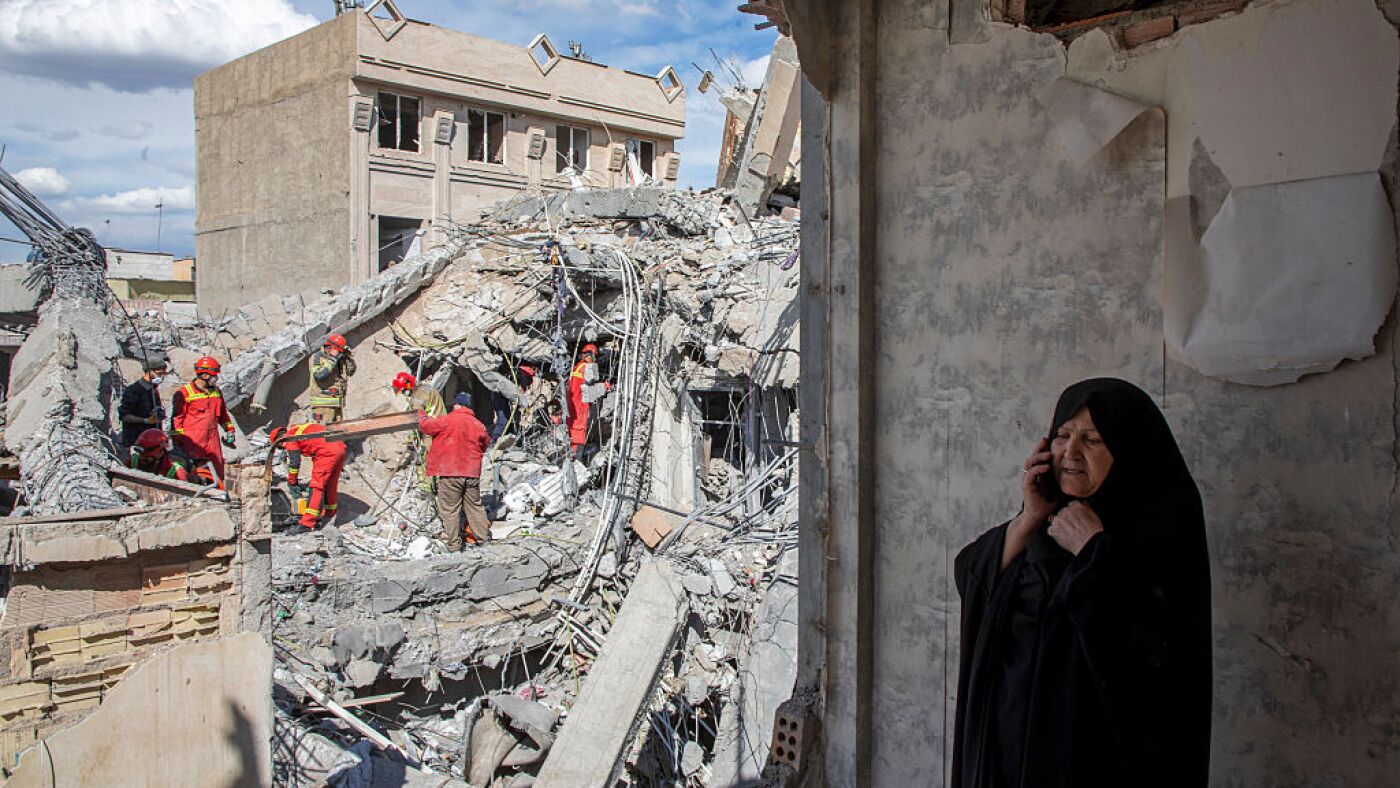
Iran fired ballistic missiles and drones at Saudi Arabia's Prince Sultan air base on Friday. The base, shared by Saudi and U.S. forces, is outside the capital Riyadh. At least 12 U.S. service members were wounded, according to the Associated Press and multiple news organizations, including several in serious condition.
A U.S. official, who was not authorized to speak publicly, told NPR that some aircraft were apparently damaged as well.
Iran released Chinese satellite photos of what they say are burning aircraft at the base. It said one of the tankers, which refuel fighter jets in the air, was destroyed and three others damaged.
Iran has targeted U.S. service members at bases throughout the region since the war began a month ago, in retaliation for the U.S. attacks and seeking to drive troops out of the region. Overall, the Pentagon has put the U.S. casualty toll at 13 killed and more than 300 injured.
The attack on Prince Sultan air base in Saudi Arabia comes as the war reaches its one-month mark, and as the Israeli military announced it had intercepted a missile launched from Yemen toward Israel.
Here are more updates on Day 29 of the Iran war.
Strikes on Israel and Iran continue
Strikes were reported in Israel early Saturday, with a total of eight impact sites in Tel Aviv, including a university. One person was killed, and two people were injured.
Iranians also reported strikes hit multiple industrial production facilities, as U.S. and Israeli strikes continue on Iran.
Residents managing to overcome Iran's internet black out sent videos to Iranian diaspora websites showing strikes hitting several steel and cement factories all over Iran, including in southern and central Iran as well as central Isfahan.
Earlier on Friday, Israel's military said it had struck a heavy water reactor in Iran, which it said was part of Iran's nuclear enrichment program.
Iran has been firing back in retaliation against Israel, and neighboring countries in the Gulf. Bahrain and the UAE said they intercepted Iranian drones overnight. A worker in Oman was injured after being hit by a drone.
Israel says it intercepted a missile launched from Yemen
On Saturday, Israel's military said it had intercepted a missile launched from Yemen toward Israel. This marks the first time during the Iran war that Israel has faced fire from that country. The Iranian-backed Houthi rebels have claimed responsibility for the attack.
The Houthis control a vast region of Yemen, including the capital, Sanaa, and Western Yemen, from where they have launched attacks on vessels navigating the Red Sea during the Israel-Hamas war.
The Houthi rebels attacked over 100 merchant vessels with missiles and drones from November 2023 until January 2025, upending shipping in this waterway in the western side of the Arabian Peninsula, key for the passage of goods through the region.
Israeli troops move northward into Lebanon
Israeli attacks on Lebanon's south and capital continued overnight. Israel says it's intensifying its assault and moving thousands of troops northward across the border into Lebanon, to fight Hezbollah militants there.
Israeli officials say they'll take territory up to Lebanon's Litani River, 10 to 20 miles north of the Israeli border. But now they've ordered residents out of a zone another ten miles beyond that.
Lebanese health officials say the Israeli invasion has displaced about a fifth of the country's population, and killed more than 11-hundred people. Thousands more are fleeing, sleeping in a soccer stadium in southern Beirut.
Israel has been bombing highways, bridges, homes and gas stations. Its military released video of a top commander surveying troops in southern Lebanon.
Hezbollah released its own video, showing what it says is a guided missile hitting an Israeli tank.
Hezbollah is backed by Iran, and Israel says it's killed several of Iran's Revolutionary guard members inside Lebanon. Iran's Foreign Ministry says six Iranian diplomats have been killed here as well.
A third of Iran's missiles are destroyed
The Trump administration has claimed progress in destroying Iran's missiles and call it one of the war objectives. But the government has not released figures.
A U.S. official, who spoke on condition of anonymity because they were not authorized to speak publicly, told NPR that the U.S. has only been able to confirm the elimination of around one-third of Iran's missile capabilities.
The intelligence assessment on missiles destroyed was first reported by Reuters.
Iran's missile program consists of multiple elements: factories that make the weapons, launchers that fire them, and the missiles themselves.
Speaking to reporters about the administration's war aims Friday, Secretary of State Marco Rubio said: "We are going to basically destroy their ability to make missiles and drones in their factories. And we're going to substantially — and I mean dramatically — reduce the number of missile launchers so that they cannot hide behind these things to build a nuclear weapon and threaten the world."
Rubio repeated what others in the administration had been saying for weeks — that the operation is "ahead of schedule."
The U.S. military has said Iranian missile attacks have dropped dramatically since the early days of the war. Still, the missiles, along with drones, remain Iran's most effective weapons.
Rubio says war will not be a prolonged conflict after G7 meeting in Paris
U.S. Secretary of State Marco Rubio discussed the war in Iran with foreign ministers from leading European nations and Japan in France on Friday.
Despite differences over the war, the Group of Seven (G7) issued a joint statement calling for the "immediate cessation of attacks against civilians and civilian infrastructures" and the restoration of "safe and toll free freedom of navigation in the Strait of Hormuz." Iran has effectively blocked the safe passage of ships and large oil tankers through the Strait.
After the G7 meeting in Vaux-de-Cernay, France, Rubio warned that Iran may try to set up a toll system in the strait.
Loading...
About a fifth of the world's oil typically passes through the Strait of Hormuz, a narrow waterway off Iran's coast, but most ships have been blocked from transiting it during the war.
The meeting came a day after President Trump again slammed NATO — a military alliance that includes most of the G7 — for failure to help secure the strait.
Rubio told reporters Friday "this is not going to be a prolonged conflict" and he said the objectives could be achieved "without any ground troops."
His remarks came as thousands of Marines and Army troops are headed to the Middle East.
Jane Arraf in Amman, Emily Feng in Van, Turkey, Lauren Frayer in Beirut, Greg Myre and Alex Leff in Washington, Carrie Khan in Tel Aviv, and Miguel Macias in Seville, contributed to this report.
Facts Only
Iran attacked Saudi Arabia's Prince Sultan air base on Friday
At least 12 U.S. service members were wounded, several seriously
Some aircraft were reportedly damaged
Israel intercepted a missile launched from Yemen towards Israel for the first time during the conflict
Israel has been striking industrial facilities in Iran
Lebanon's population has been displaced and over 1,000 people killed due to Israeli attacks
The U.S. claims to have destroyed around one-third of Iran's missile capabilities
A G7 meeting was held in France on Friday with the participation of foreign ministers from leading European nations and Japan
Secretary of State Marco Rubio stated that this conflict will not be prolonged and can be achieved without ground troops
Executive Summary
Full Take
This article provides a snapshot of the ongoing conflict between Iran, Israel, and various regional actors. The U.S. and Iran are at odds due to Iranian attacks on American service members stationed in the region, while Israel is engaging in military actions against both Iran and Lebanon. It is unclear what specific goals each party aims to achieve or how the conflict will ultimately end. The U.S.'s claim of destroying around one-third of Iran's missile capabilities should be approached with skepticism due to the lack of transparency in military operations and the nature of asymmetrical warfare. The G7 meeting serves as a reminder of international efforts to address regional conflicts and maintain stability, but the effectiveness of such meetings is questionable given the complexities and deep-seated tensions at play.
Patterns detected: ARC-0024 Ambiguity (regarding the specific goals of each party), ARC-0037 Mysterious Black Box (lack of transparency in military operations)
Sentinel — Human
The article appears to be written by a human journalist, with consistent variations in sentence length, an idiosyncratic emphasis, and specific attribution of sources for claims.