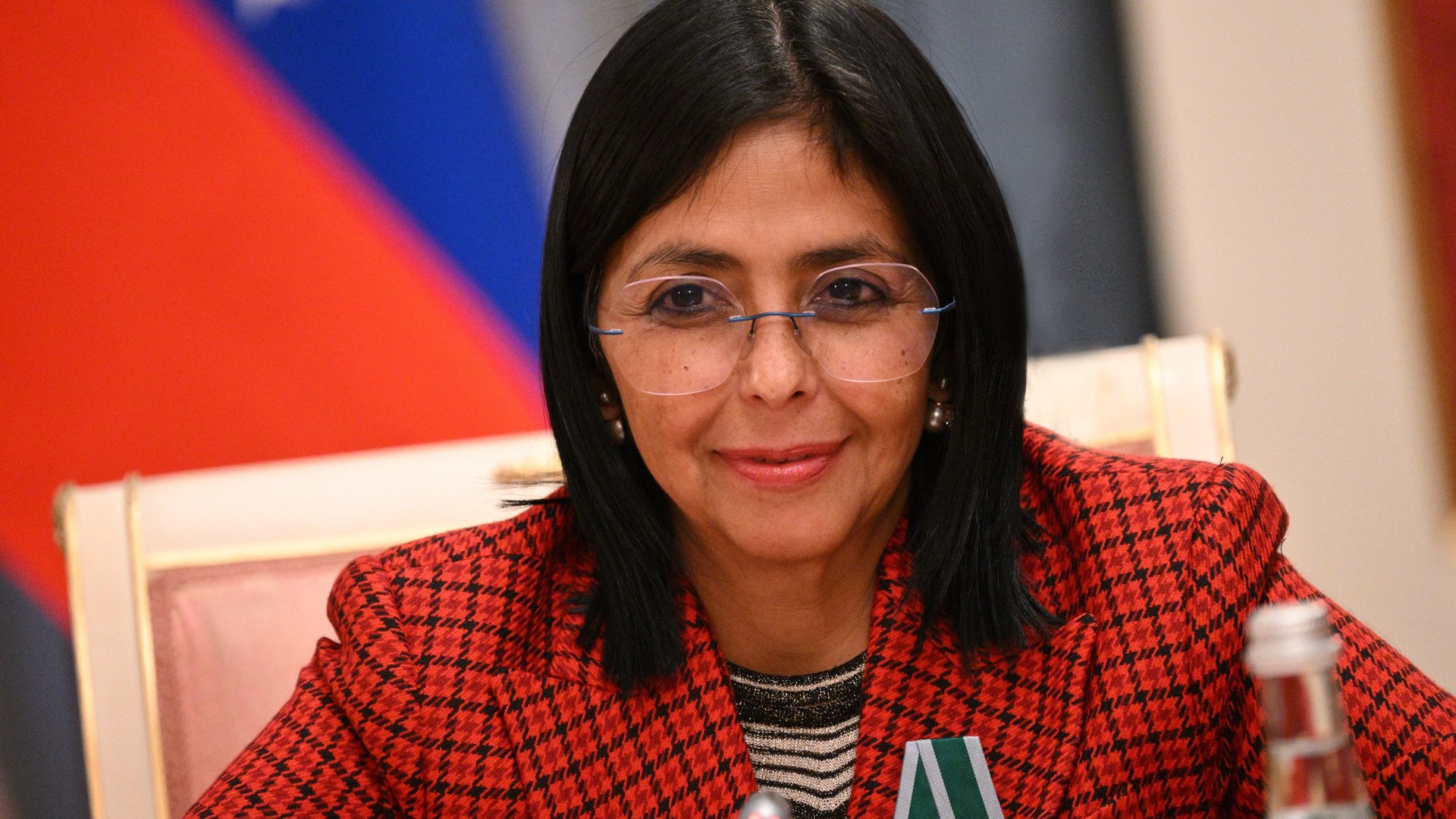
Caracas, Venezuela — Delcy Rodríguez, Venezuela’s acting president, has been removed from the U.S. Treasury Department’s Office of Foreign Assets Control sanctions list.
Her name had been on the list since 2018, when as vice president, authorities identified her as one of the figures who contributed to undermining democracy in the South American country.
The decision was made nearly three months after Nicolás Maduro’s capture in an operation carried out in Caracas by U.S. military personnel.
Her removal represents another sign of rapprochement between Rodríguez and the Trump administration in their attempts to normalize relations between the two countries. Just this week, the U.S. announced it had reopened its embassy in Caracas after nearly seven years.
In the post on X, Rodríguez applauded the action taken by Trump and said she hopes future sanctions against the country will be lifted. “This will allow for rapid economic development, investment, and an effective bilateral cooperation agenda for the benefit of our peoples. Let’s keep working for a prosperous Venezuela for all!” she said.
How did the sanctions affect Delcy Rodríguez?
Sanctions against the Chavista leader functioned as a personal blockade that paralyzed her ability to interact with the Western financial system.
Because she was included on the Specially Designated Narcotics Traffickers, also known as the Clinton List, she was prohibited from conducting any type of commercial or financial transaction with U.S. citizens or companies.
This meant not only the freezing of any accounts or properties under U.S. jurisdiction, but also the inability to use basic services such as international credit cards or U.S.-based software platforms.
Furthermore, the sanctions affected her in the diplomatic and mobility spheres, as they barred her from entering U.S. territory and restricted her travel through other countries that have law enforcement cooperation agreements with Washington.
Sanctions are a hot-button issue among Venezuelans.
The government claims they have been the main cause of the crisis in the country due to the restrictions they have imposed. However, many citizens and NGOs believe that even before the sanctions were imposed, the nation was already facing serious problems due to mismanagement by the authorities.
Featured image: Delcy Rodriguez.
Image credit: Government of Russia via Wikimedia Commons
Facts Only
Delcy Rodríguez was removed from the U.S. Treasury Department’s Office of Foreign Assets Control sanctions list.
She had been on the list since 2018, identified as a figure undermining democracy in Venezuela.
The removal occurred nearly three months after Nicolás Maduro’s capture by U.S. military personnel in Caracas.
The U.S. reopened its embassy in Caracas after nearly seven years.
Rodríguez was included on the Specially Designated Narcotics Traffickers list, also known as the Clinton List.
Sanctions prohibited her from conducting commercial or financial transactions with U.S. citizens or companies.
Her accounts and properties under U.S. jurisdiction were frozen.
She was barred from entering U.S. territory and faced travel restrictions in countries cooperating with Washington.
Rodríguez praised the U.S. decision and expressed hope for further sanctions relief.
The Venezuelan government claims sanctions are the main cause of the country’s crisis.
Many citizens and NGOs believe the crisis predated sanctions due to government mismanagement.
Executive Summary
Full Take
The strongest version of this narrative presents a diplomatic thaw between the U.S. and Venezuela, framed as a pragmatic step toward normalization. The removal of sanctions on Delcy Rodríguez is positioned as a gesture of goodwill, with potential economic benefits for Venezuela. However, the narrative also acknowledges competing perspectives on the root causes of Venezuela’s crisis, balancing government claims against critiques of pre-sanction mismanagement.
Pattern scan: The article avoids overt emotional exploitation but leans into a framing that could imply sanctions as the primary driver of Venezuela’s woes, a common simplification in geopolitical narratives. The inclusion of counter-perspectives (NGOs, citizens) mitigates this, but the structure still risks a subtle "false equivalence" by presenting two sides without deeper interrogation of power dynamics. The focus on Rodríguez’s personal relief from sanctions, while factually accurate, could serve as a distraction from systemic issues.
Root cause: The paradigm here is one of diplomatic realpolitik, where sanctions are leveraged as tools of pressure and then relaxed as bargaining chips. The unstated assumption is that economic liberalization will follow, though historical patterns (e.g., post-sanction transitions in Cuba or Iran) suggest mixed outcomes. The narrative echoes Cold War-era "carrot-and-stick" diplomacy, where concessions are tied to behavioral changes.
Implications: For human agency, the lifting of sanctions may restore Rodríguez’s mobility and financial access, but broader economic recovery depends on structural reforms. The primary beneficiaries appear to be political elites, while ordinary Venezuelans may see limited immediate relief. Second-order consequences could include increased foreign investment but also potential backlash from hardliners in both countries.
Bridge questions: How might the removal of sanctions on Rodríguez affect Venezuela’s internal power dynamics? What evidence would be needed to determine whether sanctions or mismanagement played a larger role in the crisis? What safeguards could ensure that economic benefits reach ordinary citizens, not just elites?
Counterstrike scan: A coordinated influence campaign might amplify the "sanctions as root cause" narrative to shift blame from Venezuelan leadership while downplaying pre-existing governance failures. The actual content avoids this trap by including dissenting views, though it stops short of deeper analysis. No structural alignment with a hypothetical attack playbook is detected.
Sentinel — Human
The text shows signs of a human writer, demonstrating human-like inconsistency in sentence length variance and the presence of a personal voice. However, it is important to note that this analysis does not assess the claims made in the article.