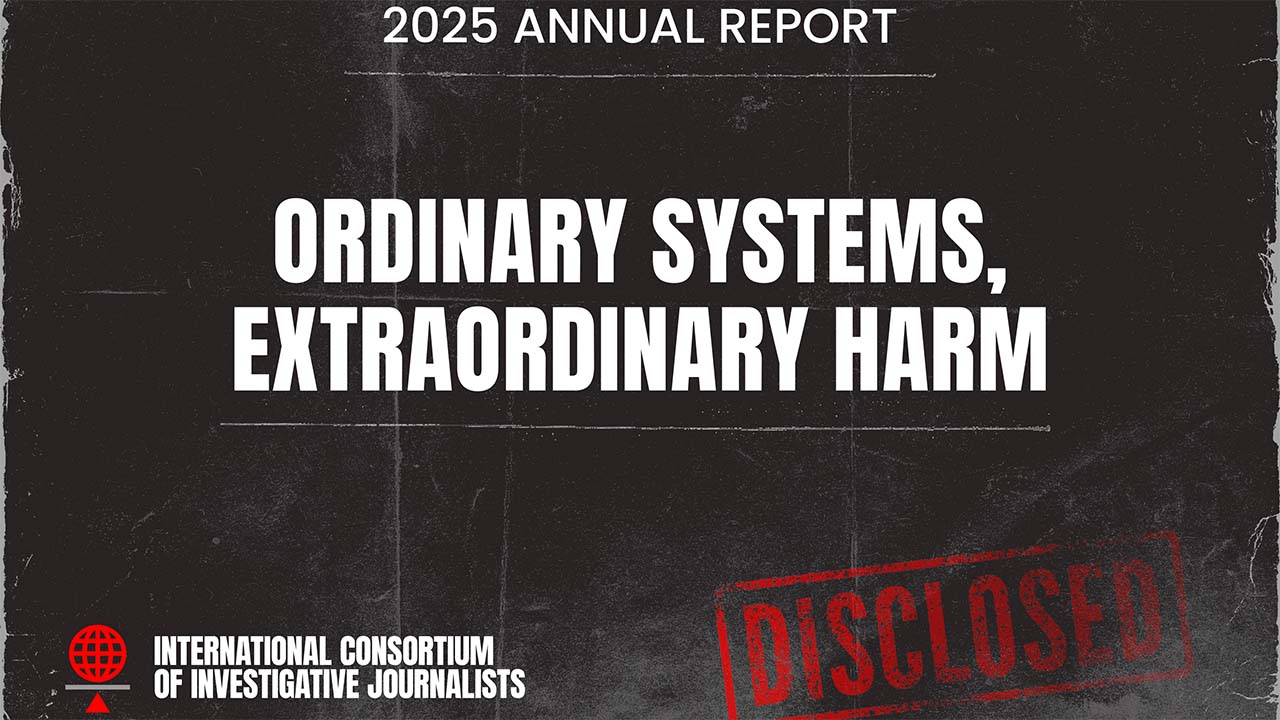
The systems that shape our world — financial rules, sanctions regimes, international policing networks — are supposed to prevent abuse, promote accountability and protect the public.
Our reporting in 2025 showed how often they don’t — and who pays the price when they fail.
Across investigations that spanned continents, ICIJ and its partners found that the harm we exposed didn’t come from broken systems alone. In many cases, ordinary processes worked exactly as intended. Paperwork was processed, transactions were approved and rules were followed — even as they enabled human suffering, repression, financial crime and sanctions evasion.
Read ICIJ’s 2025 annual report
In our China Targets investigation, we documented how Beijing authorities aggressively pursued its perceived enemies across borders, following them into countries that the dissidents had thought would protect them. We examined Interpol notices, United Nations forums and law enforcement requests that appeared routine on paper but carried devastating consequences for victims, who described relentless threats, pressure and intimidation that jeopardized their safety, livelihoods and families.
In The Coin Laundry, reporters exposed how cryptocurrency platforms and payment processors became gateways for scams and money laundering. Victims lost their life savings through systems designed for speed and profit, where warnings were weak, oversight was fragmented and accountability was optional. The exchanges processed vast volumes of high-risk transactions while both public and private safeguards failed to keep pace with the scale and speed of abuse.
And in Damascus Dossier, we traced how Syria’s bureaucratic detention system reduced mass murder to routine paperwork — and how international sanctions and accountability mechanisms failed to disrupt it.
Together, these ICIJ investigations show how ordinary systems that citizens rely on for protection — financial, institutional and governmental — were manipulated and exploited to help the powerful and malfeasant avoid accountability.
That’s what makes the issues we uncovered so difficult to confront — and so necessary to examine.
In this environment, accountability does not arrive on its own. Investigative journalism is the catalyst for change.
What distinguishes ICIJ’s work isn’t just what we uncover, but what happens next.
In some cases, consequences follow quickly. Courts and lawmakers confronting transnational repression are already citing reporting from China Targets. Findings from The Coin Laundry accelerated regulatory scrutiny and enforcement actions.
In other cases, change takes time. In 2025, courts handed down sentences and accepted guilty pleas in cases tied to investigations that ICIJ published years ago — including 2016’s Panama Papers and 2019’s Bribery Division. Regulators imposed sanctions and levied record fines. Governments recovered assets, launched new enforcement units and strengthened oversight. Lawmakers moved to strengthen sanctions enforcement and transparency rules after sustained pressure rooted in our reporting.
These outcomes did not arrive overnight, and they did not emerge from a single story. They happened because our work endures.
That long view matters now more than ever. Around the world, authoritarian governments are refining the tools they use to silence critics, hide wealth and evade scrutiny. At the same time, independent newsrooms like ours face shrinking resources, rising legal threats and coordinated efforts to discredit factual reporting. Accountability systems are under strain, and so is the journalism meant to test them.
The systems we examined this year were not failing in obvious ways. They were functioning, processing, authorizing and normalizing. And harm is easy to ignore when it arrives quietly with a stamp and a signature.
Our job is to interrupt the silence that lets harm pass unnoticed.
What happens next depends on who is willing to listen.
Facts Only
ICIJ and its partners conducted investigations in 2025 exposing systemic failures in global accountability mechanisms.
*China Targets* documented Beijing’s pursuit of dissidents abroad using Interpol notices, UN forums, and law enforcement requests.
Victims described threats, pressure, and intimidation jeopardizing their safety and livelihoods.
*The Coin Laundry* exposed cryptocurrency platforms and payment processors enabling scams and money laundering.
Victims lost life savings through systems with weak warnings, fragmented oversight, and optional accountability.
*Damascus Dossier* traced Syria’s bureaucratic detention system, showing how international sanctions failed to disrupt mass murder.
Investigations revealed that ordinary processes—paperwork, transactions, rule-following—enabled harm while appearing routine.
Reporting from *China Targets* was cited in courts and lawmakers addressing transnational repression.
*The Coin Laundry* findings accelerated regulatory scrutiny and enforcement actions.
In 2025, courts handed down sentences and guilty pleas tied to earlier ICIJ investigations, including the 2016 Panama Papers and 2019 Bribery Division.
Regulators imposed sanctions, levied fines, and governments recovered assets and strengthened oversight.
Authoritarian governments are refining tools to silence critics, hide wealth, and evade scrutiny.
Independent newsrooms face shrinking resources, legal threats, and efforts to discredit factual reporting.
Executive Summary
Full Take
The strongest version of this narrative is that investigative journalism serves as a critical corrective to systemic failures, exposing how bureaucratic and financial systems—designed to prevent abuse—often function as intended while enabling harm. The ICIJ’s work demonstrates that accountability is not self-executing; it requires sustained pressure, often over years, to produce tangible outcomes like legal consequences or policy reforms. The reporting highlights a paradox: systems that appear neutral or procedural can normalize repression, financial crime, and human rights violations when their design prioritizes efficiency or state interests over justice.
Pattern scan: The narrative avoids emotional exploitation or distortion, focusing on documented cases and institutional responses. However, it implicitly critiques a *ARC-0024 Ambiguity* in how "routine" processes mask harm—paperwork and compliance become tools of oppression when wielded by bad actors. The framing also risks a *ARC-0043 Motte-and-Bailey* dynamic: while the article rightly condemns systemic failures, it could be misused to argue that all systems are inherently corrupt, ignoring cases where they do work. The emphasis on authoritarian regimes refining tools of control echoes historical patterns of state surveillance and transnational repression, from Cold War-era operations to modern digital authoritarianism.
Root cause: The paradigm here is institutional capture—where systems designed for public protection are co-opted by powerful actors. The unstated assumption is that accountability requires external pressure (e.g., journalism) because internal safeguards are inadequate or complicit. This echoes the "banality of evil" concept, where harm arises from bureaucratic indifference rather than overt malice.
Implications: For human agency, this narrative underscores the fragility of protections we take for granted. The cost is borne by victims—dissidents, scam targets, detainees—while the powerful evade consequences. Second-order effects include eroded trust in institutions and the normalization of abuse as "business as usual." The tension between systemic inertia and reform raises questions about whether incremental changes (fines, new units) are sufficient or if deeper structural overhauls are needed.
Bridge questions: What would it take for these systems to self-correct without external pressure? How do we distinguish between systemic failures and systemic design flaws? If journalism is the catalyst for change, what happens when it’s under attack?
Counterstrike scan: A bad-actor playbook would amplify the narrative to undermine trust in all institutions, framing them as irredeemably corrupt. The actual content resists this by focusing on specific failures and solutions, not wholesale condemnation. No structural alignment with manipulation detected.
Sentinel — Human
This text shows signs consistent with a human author. The writing exhibits inconsistent sentence length variance and a personal voice that is not typically found in synthetic content.