Part of the Series
Struggle and Solidarity: Writing Toward Palestinian Liberation
Honest, paywall-free news is rare. Please support our boldly independent journalism with a donation of any size.
Gaza has long been described as an “open-air prison.” The more I reflect on the term, the more it feels like a painful truth rather than mere hollow rhetoric. A suffocating blockade has been imposed for decades, with two border crossings sealed shut depending on the political climate and circumstances, often leaving no feasible exit for patients seeking medical referrals or students hoping to travel, while insufficient commercial supplies are allowed in. Yet in the middle of it all, Palestinians’ gleaming and enduring minds keep innovating passionately, frantically renovating what has been broken, and exploring new forms of survival that seem to be unlocked only in Gaza. All of it is an attempt to cope, to reclaim a life that, quite simply, we have been coercively denied.
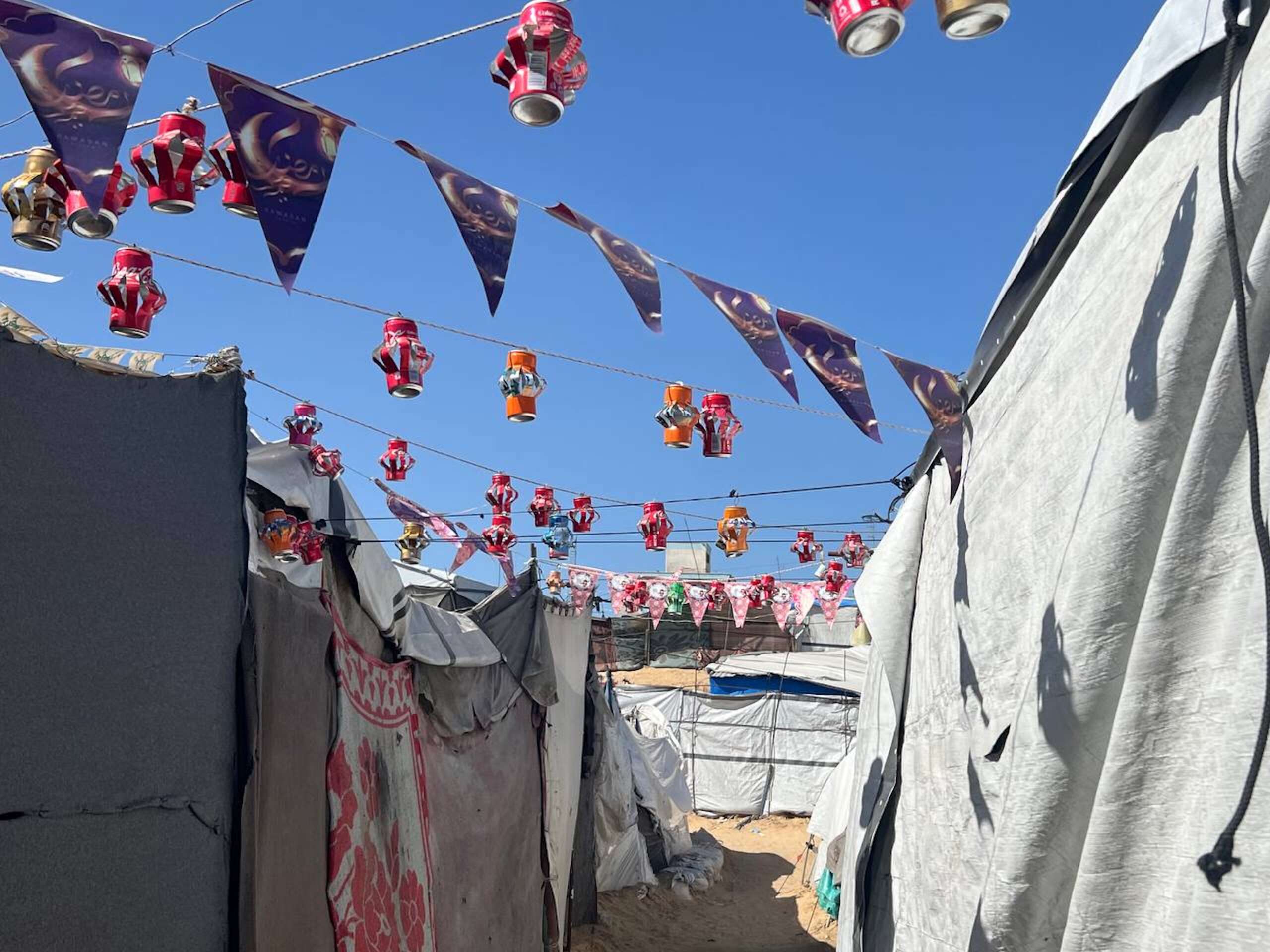
In the Al-Taghreba shelter in Khan Younis, the displaced refused to let the rituals of Ramadan die. But lavish lanterns and colorful decorative garlands were distant dreams for many, given the financially draining ramifications of two years of genocidal war, which have left most people in Gaza unable to create the traditional festive ambience of the holiday. Yet they made their own, shadowed by a stark reminder of how fragile the status quo remains, nonetheless still glowing with a certain joy amid the relative calm. Slicing through the surfaces of piled-up cola cans, people have turned them into decorations that mimic the shape of lanterns, recycling environmentally harmful waste into simple yet radiant lanterns that hung between the tents. Seeing them, I was astonished. The people there, who had been stripped of everything but their hospitality and dignity, immediately offered to make me one too.
Recycling in Gaza is not pursued mainly for the sake of environmental sustainability. It is an obligatory necessity, forced on us by harsh living conditions. During the genocide, when cooking gas severely dwindled and wood for cooking was running critically low, one innovative man in our neighborhood devised another practical, energy-saving tool from discarded food tins. He used a large tin can, cutting a circular opening in its surface to create a space to insert pieces of wood, and another on the side connected to a fan that helped the flames spread faster. It was powered by an external source of energy — a battery. To operate it, one would first strike a flame and place it on the wood, then turn on the battery to run the fan. My father has bought us many, one after the other, as the fan would eventually melt down from intensive use.
One displaced Gazan, Dalia Alafifi, managed to turn heaps of cans into a shelter that protected her and her family from the scorching sun and the frost of winter, following a sketch drawn by a brilliant Gazan architect. Meanwhile, Motaz Barzaq, a Palestinian who once lived in a smart home in northern Gaza supported by cutting-edge technologies that facilitated his life, was forcibly displaced and found himself stranded on the seashore, like hundreds of thousands of others in Gaza. Barzaq decided to defy all odds and return to the traditional ways of living once adopted by our ancestors. He took advantage of the sea sand, filling it into sacks to serve as the scaffolding of his hut, layered the sacks with mud, and created a roof covered with tiles. Barzaq mentioned that it took him 2,000 sand-filled sacks and one month to finish it. Yet later on, I learned that his striking innovation could not withstand the sea waves.
Many Palestinians in Gaza, if not all, are stitching the fragments of life, belongings, homes, and memories together. I passed by a damaged house in Khan Younis where only the second floor is half-intact, hanging in the air, while the third and ground floors are hollowed out and the stairs are broken. But there is nowhere for the home’s inhabitants to flee, so they improvised an outside ladder to reach the second floor after clearing away the rubble. A recent report showed that more than 60 million tons of rubble still clog Gaza’s war-ravaged streets, including neighborhoods like mine, where many of my brother’s friends live. Their journey starts here. They filter through the rubble with their bare hands — as reconstruction equipment has generally not been allowed to enter Gaza yet — separating concrete, plastic, and wood from one another. They extricate metal for remodeling and crush concrete and stones into gravel, which can be reused in the reconstruction of other buildings.
Fuel — benzene, solar, and kerosene — has been largely unavailable, compounding our people’s suffering in urgent situations of displacement or medical emergencies. As fuel is a pillar of life, Gazans have been forced to produce alternative sources of energy that are often crude and harmful to their health, mainly by burning plastic. The available means of transportation are also far from sufficient to meet the needs of such densely populated areas. Many vehicles have been damaged, burned, or rendered unusable. Drivers have turned to improvisation, attaching wooden pallets with wheels to vehicles, or relying on animal-drawn carts to accommodate the ever-growing demand for transport.
With Gaza’s medical infrastructure obliterated, recycling has become a lifeline for patients with life-threatening conditions. A pharmacist named Khalid Aouda, along with his wife, who is a physician, turned their tent and their kitchen tools into a makeshift medical laboratory. Relying on standard medical guidelines and a kitchen blender, they transform oral pills into liquid drugs to best fit children, disabled people, and the elderly, as their requisite medications were not accessible. For Ibrahim Said, a 33-year-old man who lost his leg as a result of an Israeli shooting while he was desperately seeking humanitarian aid, life became an endless loop of struggle with no salvation in sight as prosthetic limbs remained inaccessible. So he made his own. Using sewage pipes and aluminum pieces, he crafted an ingenious way to stand again and provide for his family. Elsewhere, Dr. Fadel Naim, an orthopedic surgeon and current acting head of Al-Ahli Hospital, has created a remarkable breakthrough: a 3D-printed external fixator device for complicated fracture cases that have become common due to the genocide. It was innovated from recycled simple materials — metal rods, nuts, and bolts — and powered by solar panel energy.
Even clothes have been fashioned from recycled old blankets to offer warmth in displaced tents when temperatures plummeted. Meanwhile, much of the footage circulating on social media from Gaza was not captured using professional equipment, but by innovative minds — reporters and content creators — who improvised with simple means, replacing camera drones, which are prohibited from entering Gaza, with their phones mounted on boom handles.
Recycling is not only spawned out of genocide. It is a decades-long coping mechanism, imprinted in our souls, and renewed each time we recycle the remnants of our lives after every aggression unleashed on our home. Recycling has become a part of our identity as Palestinian Gazans. Our resilience and creativity should be etched in history to offer a model for conflict-zone areas, disaster-affected regions, and climate-vulnerable communities — not just for Gaza, but for the world.
Urgent Appeal for Your Support
Truthout relies on individual donations to publish independent journalism, free from political and corporate influence. In fact, we’re almost entirely funded by readers like you.
Unfortunately, donations are down. At a moment when independent journalism is urgently needed, we are struggling to meet our operational costs due to increasing political censorship.
Truthout may end this month in the red without additional help. We still need to raise $7,000. Please make a tax-deductible one-time or monthly donation if you can.
Facts Only
Gaza has been under a suffocating blockade for decades, with border crossings often sealed.
Displaced Palestinians in Khan Younis created lanterns from cola cans during Ramadan due to financial constraints.
A man in Gaza invented a makeshift stove from food tins, powered by a battery and fan, to address cooking gas shortages.
Dalia Alafifi built a shelter from recycled cans to protect her family from extreme weather.
Motaz Barzaq constructed a hut using 2,000 sand-filled sacks and mud after being displaced.
Over 60 million tons of rubble remain in Gaza’s streets, with residents manually sorting materials for reuse.
Fuel shortages have led to the burning of plastic for energy and the use of animal-drawn carts for transportation.
Pharmacist Khalid Aouda and his wife turned their tent into a makeshift lab to convert pills into liquid medications.
Ibrahim Said crafted a prosthetic leg from sewage pipes and aluminum after losing his limb.
Dr. Fadel Naim developed a 3D-printed external fixator device from recycled materials for fracture cases.
Clothing has been made from recycled blankets to provide warmth in displaced tents.
Footage from Gaza is often captured using phones mounted on boom handles due to drone restrictions.
Executive Summary
Gaza has endured decades of blockade, with border crossings frequently sealed, severely restricting movement and supplies. Despite these conditions, Palestinians in Gaza have demonstrated remarkable resilience through innovative recycling and repurposing of materials. During Ramadan, displaced individuals in shelters like Al-Taghreba in Khan Younis created lanterns from cola cans due to financial constraints. Energy shortages led to the invention of makeshift stoves from food tins, while displaced families built shelters from sand-filled sacks and mud. The destruction of infrastructure has forced Gazans to salvage materials from rubble, with over 60 million tons of debris clogging streets. Medical shortages have spurred creative solutions, such as pharmacists blending pills into liquid medications and a surgeon developing 3D-printed medical devices from recycled materials. Transportation and fuel shortages have led to the use of animal-drawn carts and wooden pallets attached to vehicles. These adaptations reflect a long-standing coping mechanism, deeply embedded in Gazan culture, as a response to repeated aggression and resource scarcity.
The article highlights both the suffering and the ingenuity of Gazans, framing their resilience as a model for other conflict zones and climate-vulnerable communities. It underscores the human cost of the blockade and war while emphasizing the resourcefulness of those affected. The narrative blends descriptions of hardship with examples of innovation, presenting a nuanced view of life in Gaza under extreme conditions.
Full Take
The strongest version of this narrative highlights the resilience and creativity of Gazans in the face of systemic oppression and resource scarcity. It credibly documents how individuals have adapted to extreme conditions, turning waste into survival tools and medical solutions. The framing of recycling as a "decades-long coping mechanism" underscores the cyclical nature of conflict and recovery in Gaza, positioning Gazans as agents of innovation rather than passive victims. The narrative effectively humanizes the crisis by focusing on individual stories of ingenuity, from makeshift stoves to prosthetic limbs, while also contextualizing these efforts within broader structural constraints.
Pattern scan: The article employs emotional appeals through vivid descriptions of hardship and resilience, which could be seen as a form of "rage bait" or "weaponized anger" to provoke sympathy and action. However, the focus on individual agency and practical solutions mitigates this, avoiding outright manipulation. The narrative does not engage in distortion or bad faith tactics; instead, it presents a coherent, fact-based account of adaptation under duress. The call for support at the end introduces a potential "mission drift" from reporting to advocacy, but this is transparently framed as a plea for operational funding rather than ideological coercion.
Root cause: The paradigm driving this narrative is one of resistance through resourcefulness, rooted in the assumption that systemic oppression breeds innovation. It echoes historical patterns of marginalized communities developing parallel systems to survive, from underground economies to DIY infrastructure. The unstated assumption is that external aid is unreliable, forcing Gazans to rely on their own ingenuity.
Implications: This narrative reinforces the dignity of Gazans by emphasizing their agency, but it also risks romanticizing suffering if taken out of context. The second-order consequence is the potential for these adaptations to be co-opted as "inspiration porn" rather than a call to address root causes. The beneficiaries of this narrative are Gazans themselves, whose stories are amplified, while the costs are borne by those who continue to endure the blockade and war.
Bridge questions: How might these innovations be scaled or supported without reinforcing dependency? What structural changes would be needed to shift from survival-based recycling to sustainable development? How do narratives of resilience intersect with calls for political solutions?
Counterstrike scan: A coordinated influence campaign might exploit these stories to either glorify suffering as a form of resistance or to deflect attention from systemic issues by focusing on individual heroism. However, the article does not match this pattern; it balances descriptions of hardship with calls for structural change, avoiding both exploitation and deflection. The content remains grounded in factual reporting and human-centered storytelling.