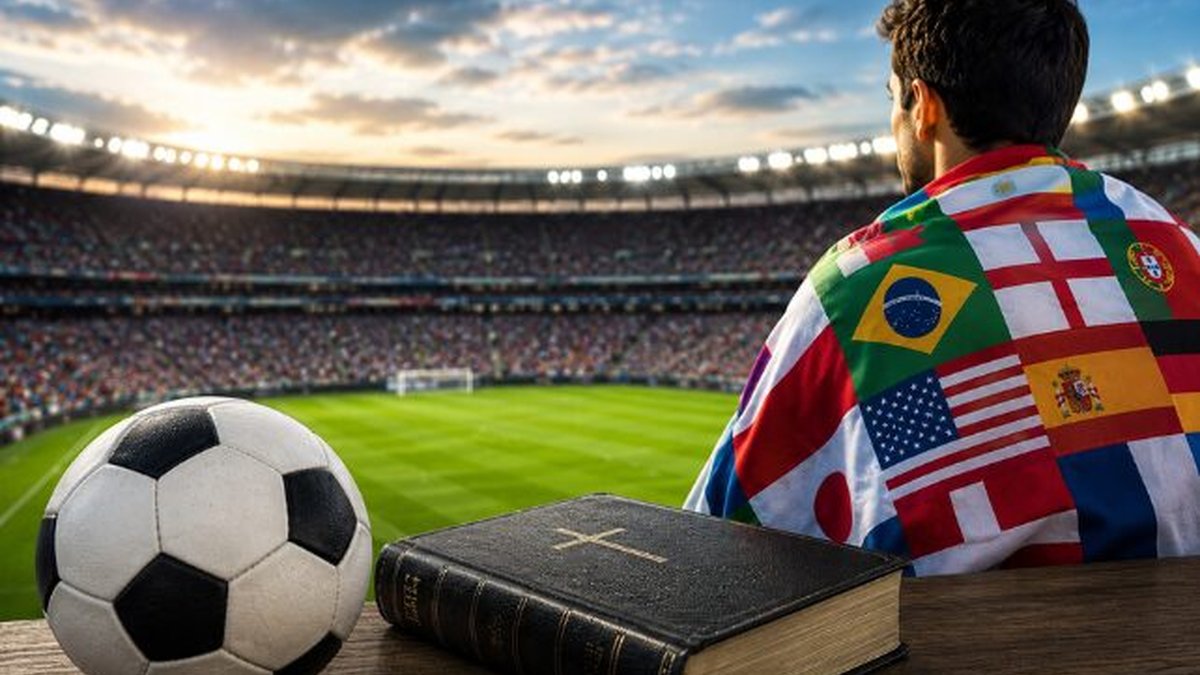
Somewhere right now, a grown man is crying over a penalty kick. A bar in Seattle just went silent, then exploded, all in the space of four seconds. Someone in your church skipped small group tonight because Belgium and the USMNT kicked off at the wrong time.
The 2026 World Cup has reached the Round of 16, and the whole world is watching. Fans have painted their faces, flown across oceans, and screamed themselves hoarse for teams they’ll never meet in person. Morocco just knocked out co-host Canada. Argentina is still alive. So are England, Spain, France, Norway, Switzerland, Colombia, and Belgium. The knockout rounds have a way of making a game feel like it matters more than almost anything else in your week.
For most fans, that’s just what a great tournament does.
For Christians, it raises a quieter question. Can something this good, this exciting, this genuinely fun, still end up taking a place in your heart that only God was ever meant to hold?
This isn’t really a question about soccer. Football might be an idol just as easily, and so might March Madness brackets or a fantasy league you check more than your Bible app. The World Cup just makes the pattern easier to see, because it puts a magnifying glass over something that’s already living in the human heart.
The issue was never whether sports are wrong. The issue is whether one of them has quietly become an idol.
Sports Are One of God’s Good Gifts, Not a Trap to Avoid
Scripture never treats competition as something shameful. Paul reached for athletic imagery again and again because his readers already loved sports. He described the discipline of runners chasing a prize and pointed believers toward running their own race with endurance, and near the end of his life he described finishing well, the way a competitor crosses a line.
Competition isn’t the problem. Neither is loving a good match.
God is the one who built beauty, creativity, strength, and teamwork into the world in the first place. Watching an athlete do something remarkable can genuinely point back to how much ability God wove into human beings. There’s nothing unspiritual about yelling at a screen when your team scores in stoppage time.
But Scripture keeps circling back to one warning. Good gifts turn dangerous the moment they become ultimate things.
There’s a real, constructive way to worship God through sport instead of just policing your own fandom, and it starts with gratitude rather than guilt.
How Do I Know If Sports Have Become an Idol?
Most people don’t need a theologian to tell them whether they’ve crossed a line. They need better questions.
What actually makes you angrier, a bad referee call or your own sin? What do you think about more before bed, tomorrow’s match or God’s Word? What changes your mood faster, a loss on the pitch or distance from Christ? What are you more willing to sacrifice for, a ticket or generosity toward God’s kingdom?
None of these questions prove anything on their own. But they’re honest enough to show you where your heart keeps drifting. Jesus put it more plainly than any checklist could. He said that wherever a person’s treasure is, that’s where their heart will end up too. That wasn’t a rule about money. It was a diagnostic about attention.
If you want to go deeper than these four questions, take the full sports idolatry test, ten more specific signs worth checking your heart against.
The World Cup Doesn’t Create Worship, It Redirects It
Here’s what’s fascinating about a tournament like this one. People worship constantly during it, just not in the way they’d use that word.
They paint their faces. They travel across continents on credit cards they can’t really afford. They sing for ninety straight minutes. They cry after a loss like something has actually died. They build entire chunks of their identity around a jersey and a flag.
That’s not an accident. Humans were built to worship something. Paul described humanity trading worship of the Creator for worship of created things, and a stadium is one more place that trade happens quietly, cheer by cheer. The stadium becomes a sanctuary. The jersey becomes a uniform of devotion. Victory starts to feel like salvation, and a loss starts to feel like real grief.
None of that means soccer is uniquely dangerous. It means the human heart is always hunting for something big enough to carry the weight of meaning. Only God was ever built to hold that weight.
Christians Should Be the Freest Fans in the Building
Here’s the part that should flip the whole conversation. Christians ought to enjoy sports better than anyone else in the room.
Why? Because your identity was never riding on the final score. You don’t need your country to win in order to have hope this week. You don’t need a player’s performance to validate you. You don’t need a trophy to prove you’re worth something.
Facts Only
* A grown man was crying over a penalty kick.
* A bar in Seattle went silent and then exploded within four seconds.
* The 2026 World Cup has reached the Round of 16.
* Teams involved include Belgium and the USMNT.
* Argentina, England, Spain, France, Norway, Switzerland, Colombia, and Belgium are mentioned as surviving teams.
* Competition is not treated as shameful in Scripture.
* Paul used athletic imagery to describe discipline and finishing well.
* God built beauty, creativity, strength, and teamwork into the world.
* Worship of created things turns dangerous when they become ultimate things.
Executive Summary
Full Take
Sentinel — Human
The text reads like an opinion or sermon piece, effectively weaving specific observations about sports into a broader discussion on idolatry and faith, strongly suggesting human authorship.