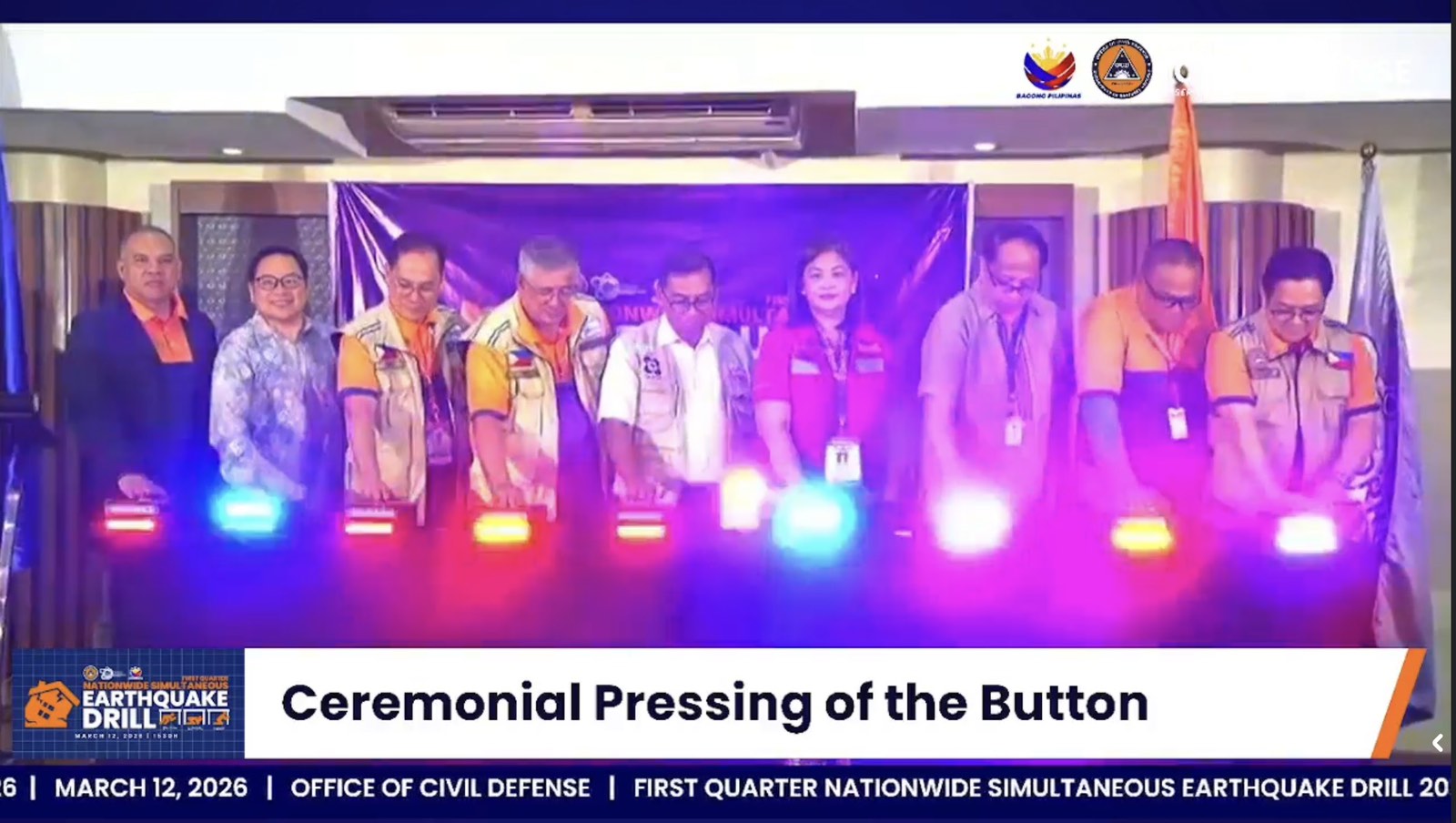
The Nationwide Simultaneous Earthquake Drill (NSED) for the first quarter of 2026 was held on Thursday across the country as part of efforts to strengthen disaster preparedness and response in case of a strong earthquake.
The Office of Civil Defense (OCD), in collaboration with member agencies of the National Disaster Risk Reduction and Management Council (NDRRMC), led a series of activities for the exercise.
The ceremonial pressing of a button in Quezon City formally launched the drill.
After pressing the button, alarms rang and heads of different government agencies performed the “duck, cover, and hold” maneuver.
This was followed by a tabletop exercise simulating a magnitude 7.2 earthquake triggered by a movement along the West Valley Fault.
The OCD said the scenario was designed to test the coordination and response capabilities should a major earthquake affect Metro Manila and nearby regions.
The activity served as a preliminary exercise ahead of the full-scale earthquake drills scheduled in the succeeding quarters of 2026.
Authorities said the drill also aims to strengthen coordination among national and regional response systems and assess operational readiness during a high-magnitude earthquake scenario or “The Big One.”
The OCD also encouraged the public and institutions to participate in earthquake preparedness activities as part of broader efforts to improve disaster resilience. — JMA, GMA Integrated News
Facts Only
The Nationwide Simultaneous Earthquake Drill (NSED) for Q1 2026 was held on Thursday.
The Office of Civil Defense (OCD) and the National Disaster Risk Reduction and Management Council (NDRRMC) led the drill.
A ceremonial button-pressing event in Quezon City marked the official start of the exercise.
Alarms sounded, and government agency heads performed the "duck, cover, and hold" maneuver.
A tabletop exercise simulated a magnitude 7.2 earthquake caused by movement along the West Valley Fault.
The scenario tested coordination and response capabilities for a major earthquake in Metro Manila and nearby regions.
The drill serves as a preliminary exercise before full-scale drills in later quarters of 2026.
Authorities aim to strengthen coordination between national and regional response systems.
The exercise assesses operational readiness for a high-magnitude earthquake scenario.
The OCD encouraged public and institutional participation in earthquake preparedness activities.
The drill is part of broader efforts to improve disaster resilience.
Executive Summary
The Philippines conducted a nationwide earthquake drill on Thursday as part of its first-quarter 2026 disaster preparedness efforts. Led by the Office of Civil Defense (OCD) and the National Disaster Risk Reduction and Management Council (NDRRMC), the exercise included a ceremonial launch in Quezon City, followed by a "duck, cover, and hold" maneuver and a tabletop simulation of a magnitude 7.2 earthquake along the West Valley Fault. The drill aimed to test coordination and response capabilities for a potential major earthquake affecting Metro Manila and surrounding regions, serving as a precursor to larger-scale exercises later in the year. Authorities emphasized the importance of public participation to enhance disaster resilience, though the effectiveness of such drills in real-world scenarios remains an open question.
The exercise highlights ongoing efforts to mitigate risks from "The Big One," a hypothetical high-magnitude earthquake long anticipated by seismologists. While the drill provides a structured opportunity for agencies to assess operational readiness, its impact depends on sustained engagement from both institutions and the public. The scenario-based approach allows officials to identify gaps in communication and resource allocation, though real-world disasters often unfold unpredictably. The initiative reflects a broader regional trend toward proactive disaster management, though challenges in implementation and public compliance persist.
Full Take
The strongest version of this narrative is that the Philippine government is taking proactive steps to prepare for a catastrophic earthquake, demonstrating institutional commitment to disaster risk reduction. The drill’s structured approach—combining ceremonial launch, practical maneuvers, and scenario-based simulations—shows a methodical effort to test and improve response systems. Credit is due for transparency in outlining the exercise’s goals and for encouraging public participation, which is critical in a country highly vulnerable to seismic activity.
However, the narrative leans on the specter of "The Big One," a framing that could inadvertently amplify fear rather than fostering constructive preparedness. While the scenario is scientifically plausible, the repeated invocation of a worst-case earthquake risks normalizing anxiety without proportional emphasis on actionable resilience measures. The focus on institutional coordination, while necessary, may also obscure systemic gaps—such as infrastructure vulnerabilities or inequities in disaster response—that drills alone cannot address.
Root cause: The paradigm here is one of technocratic disaster management, where preparedness is framed as a matter of procedural efficiency and public compliance. This assumes that top-down coordination will suffice, potentially sidelining grassroots resilience and local knowledge. Historically, such approaches have struggled with last-mile implementation, where community engagement and resource disparities determine real-world outcomes.
Implications: For human agency, the drill empowers institutions but may leave individuals feeling dependent on government action rather than self-efficacy. The costs of inadequate preparation would disproportionately fall on marginalized communities, while the benefits of successful drills accrue to systemic stability. Second-order consequences could include complacency if drills are seen as sufficient, or panic if the messaging overemphasizes catastrophe without clear mitigation paths.
Bridge questions: How might this drill’s effectiveness be measured beyond procedural compliance? What role do local communities play in shaping disaster preparedness, and are their voices adequately represented? Would a shift from fear-based messaging to capacity-building change public engagement?
Counterstrike scan: A bad actor seeking to exploit this narrative might amplify fear of "The Big One" to justify expanded emergency powers or divert attention from systemic failures. They could frame drills as proof of government competence while downplaying unresolved vulnerabilities. However, the actual content aligns with standard disaster preparedness communication, focusing on coordination and public participation without overt manipulation. No structural alignment with a hypothetical influence campaign is detected.
Patterns detected: none
Sentinel — Human
The article exhibits strong hallmarks of human-written news reporting, with no significant stylometric or coherence red flags; minor formulaic phrasing is typical of institutional communications.