Latest News
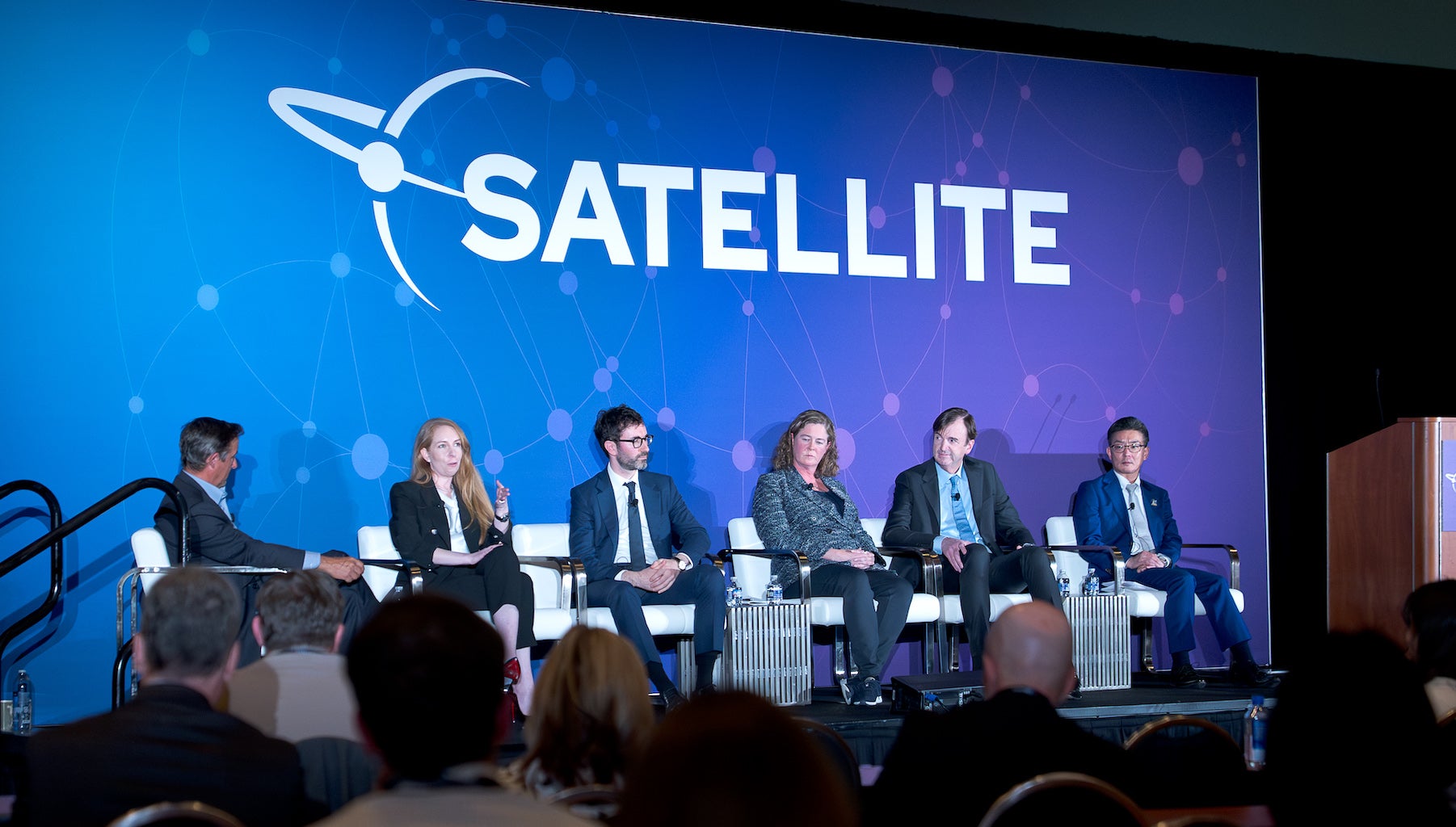
“Really, really busy.” That’s how launch providers described manifests for the next two years during a conversation on heavy-lift launch competition at SATShow on Tuesday.
SpaceX is looking at a “packed” manifest from 2026 through 2028, and a “very busy” 2029, said Stephanie Bednarek, vice president of Commercial Sales at SpaceX. After launching 165 missions in 2025, the company is continuing to execute on Falcon 9 while working toward operational Starship launches.
Arianespace, which marked the first flight of Ariane 64 in February, is looking to double its launch cadence in the coming years, targeting seven to eight launches in 2026 and reaching nine to 10 in 2027. Based on demand, the company is prioritizing flights on the Ariane 64 heavy-lift and fewer on the medium-lift Ariane 62.
Arianespace CEO David Cavaillolès said he believes the current schedule “can cover European institutions” as well as commercial demand. “Of course, depending on how things go … we might consider going up beyond 10 flights per year.”
Blue Origin continues to ramp up capacity and cadence on New Glenn after successfully landing its first reusable first-stage booster in November with NG-2 launching NASA’s ESCAPADE Mars mission.
Laura Maginnis, vice president of New Glenn for Blue Origin described the success as “a gamechanger” for the company. Blue Origin is now refurbishing the booster and preparing to launch NG-3 “in a few weeks,” carrying AST SpaceMobile’s BlueBird Block 2 satellites.
“We’ve got a lot of demand,” said Maginnis. “A lot of customers looking for significant scale, significant volume and mass to orbit and we believe that system is really going to provide for that market.”
Looking ahead, Maginnis anticipates the new super-heavy New Glenn 9×4 will be rolled out “in the coming years,” with four boosters and a larger 8.7-meter fairing to deliver 70 metric tons to Low-Earth Orbit (LEO).
United Launch Alliance (ULA) is primarily focused on “operationalizing” the Vulcan Centaur heavy-lift rocket after experiencing a performance anomaly in February related to a malfunction of one of four solid rocket motors.
According to COO Mark Peller, ULA is “burning off” its Atlas V backlog in the early part of this year and working to transition customers from Atlas to Vulcan.
“Beyond our initial flights, we’ve been putting a tremendous amount of effort into increasing our capacity,” Peller said. ULA has doubled payload processing infrastructure at its Eastern launch site and will bring its West Coast launch site online later this year with modifications to serve Vulcan, Peller said.
Mitsubishi Heavy Industries (MHI) is currently targeting a launch cadence of eight per year on its H3 heavy-lift rocket by the end of 2028. “We’re trying to increase the launch status gradually, year by year,” said Nobuyuki Shiina, deputy general manager of MHI, noting the Japanese government set a goal of 30 domestic launches per year from all providers. “We feel like there’s such a big demand here in Japan, Asia and onward,” said Shiina.
Mitsubishi Heavy Industries’ (MHI) H3 rocket has completed five successful launches and two failures, one of which occurred in December resulting in payload loss. Shiina described the anomaly as “limited” with manageable technical challenges to remedy the issue.
‘A Situation of Scarcity’
Launch providers reported strains from growing commercial demand from multiple megaconstellation deployments, sovereign launch and ambitious civil space programs.
According to Bednarek, the launch vehicle is not the only bottleneck. “A unique situation that we’re looking at right now is that rockets don’t seem to be the limiting factor. It’s more about payload processing space,” she said.
Satellite manufacturers that initially contract for launch are posting delays, requiring flexibility on the part of launch providers, Bedneck continued.
Cavaillolès dismissed the idea that an increasing number of launch providers and vehicles would saturate the market. “It is absolutely a situation of scarcity,” he said. “I think it will be the case for years and year because the satellite projects are more and more ambitious.”
In the near-term, the biggest source of demand is commercial space rather than government, according to Cavaillolès, noting that IRIS², facing delays, would produce more demand in the mid-term. Arianespace is responding to a growing commercial demand with new and bigger boosters on the Ariane 64 that it says provide 10% to 15% more performance.
Maginnis described “a huge amount of commercial demand relative to DoD [Department of Defense] demand.” DoD demand has remained stable, she noted, but plans for Golden Dome could change that in the future.
Even with tight manifests and soaring demand, providers were excited by NASA’s Tuesday announcement that it would build a $20 billion base on the Moon’s surface over the next seven years.
“It is going to require a lot of mass into space, a lot of mass to the surface of the moon,” said Bedneck, citing SpaceX support for the Commercial Lunar Payload Services (CLPS) initiative.
Blue Origin, whose Mark 1 lunar lander undergoing thermal vacuum endurance trials, is encouraged by the lunar plan. “We have significant infrastructure to support what’s being asked of us right now,” said Maginnis.
SpaceX IPO Could Boost Launch Sector
Launch providers are also monitoring reports of a SpaceX IPO, which could debut at over $1.75 trillion. Several leaders agreed the listing could be a catalyst for further investment into the sector.
“Our sector is gaining speed,” said Cavaillolès. “We see more and more of public budget. We see also growing private investment, which is positive.” He added that the SpaceX IPO is likely to motivate European markets to increase investment.
Peller agreed that the IPO would have a positive spillover effect. “I think it benefits all of us, whether or not we’re involved directly in an IPO or not, bringing that additional capital to market,” he said. “One aspect is that capital flows through all of us. It helps strengthen our industrial base, which we all benefit from.”
Stay connected and get ahead with the leading source of industry intel!
Subscribe Now
Facts Only
SpaceX: planning a packed manifest from 2026 through 2028, a busy 2029
Arianespace: targeting seven to eight launches in 2026, reaching nine to 10 in 2027
Blue Origin: ramping up capacity on New Glenn after successful first reusable booster landing
ULA: focusing on operationalizing the Vulcan Centaur heavy-lift rocket
MHI: targeting eight launches per year on its H3 heavy-lift rocket by 2028
Demand sources: commercial space initiatives, megaconstellation deployments, ambitious civil space programs
Executive Summary
Full Take
The launch industry is entering a period of intense competition and growing demand. This situation echoes the pattern of ARC-0043 Motte-and-Bailey, where providers are positioning themselves as competitive leaders while emphasizing the scarcity of their resources to justify higher prices (ARC-0024 Ambiguity). The increasing demand stems from commercial space initiatives, megaconstellation deployments, and ambitious civil space programs.
SpaceX's planned busy manifest reinforces its position as a leader in the industry. Arianespace's aim to double its launch cadence indicates a strategic response to growing demand, potentially driven by the need to maintain market share (ARC-0031 FOMO). Blue Origin's success with reusable boosters positions them well for future growth. ULA's focus on operationalizing the Vulcan Centaur demonstrates a commitment to staying competitive in the heavy-lift rocket market. MHI's target of eight launches per year reflects Japan's ambitions for its domestic launch industry and the growing demand from Asia.
As the industry grows, it is essential to consider the potential implications for human agency and dignity. The increasing reliance on private companies for space travel raises questions about accessibility and affordability for nations and organizations without significant resources. It also highlights the importance of continued investment in public space programs to ensure equitable access to space.
Sentinel — Human
This article appears to be written by a human journalist who interviewed industry leaders. There are signs of natural variation in sentence length, coherent narrative, and unique insights from each source. However, a low synthetic confidence score indicates that the text does not show clear signs of AI-generated content.