Shock Line
Hormuz truce activates southern corridor transit.
What Changed (Last 24 Hours)
US and Iran executed memorandum of understanding ending four-month conflict with 60-day ceasefire framework and Hormuz reopening commitment.
Indian LNG carrier Disha completed first Indian-flagged transit of Hormuz in over three months carrying 62,370 tonnes.
Two Iran-linked tankers Musik and Argo Maris transited Hormuz with active transponders prior to formal signing.
Trump confirmed at G7 no US reparations to Iran and Iranian commitment against nuclear weapons.
Israel publicly rejected deal implications and ruled out withdrawal from seized territories in Lebanon, Syria, and Gaza.
UK Parliament approved constitutional changes imposing prime ministerial term limits and dismantling Orban-era public trusts.
Why This Matters (The System)
The Security-First Energy Regime just pivoted from blockade to managed de-escalation.
Physical chokepoint access partially restored under verified naval corridors while legal sanctions architecture and Israeli security buffers remain intact.
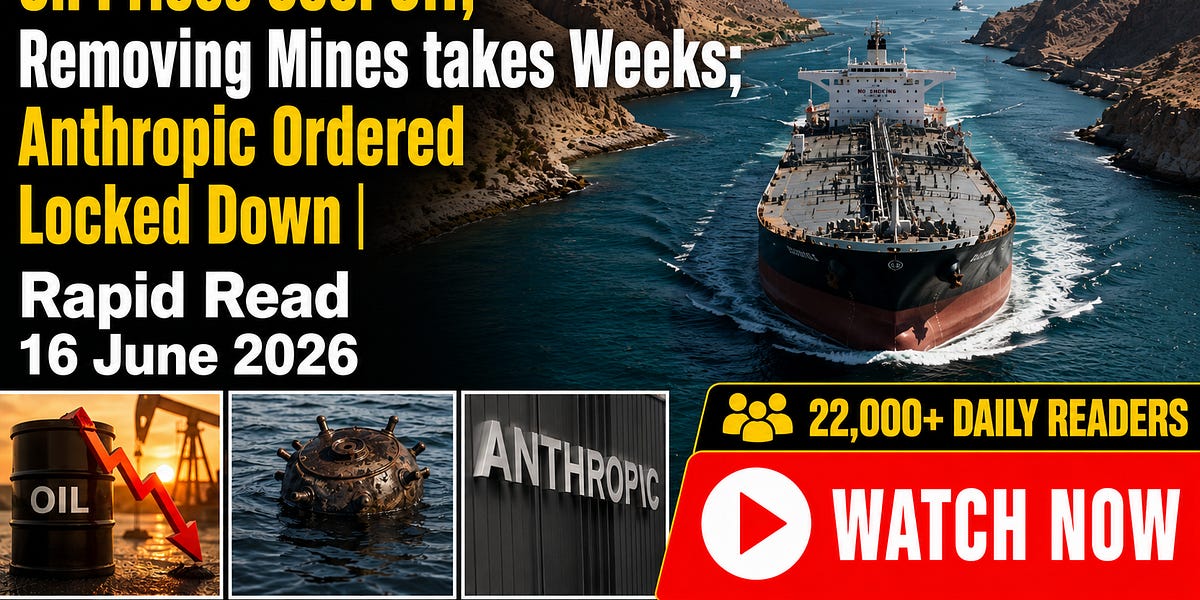
Hard anchor: full mine clearance and safe routing verification requires 40-50 days.
What Breaks Next (Forward Risk)
If southern corridor holds without incident, tanker rates compress as insurance underwriters accept partial flows within days.
If mine clearance lags, Qatar LNG ramp to 50 percent capacity stalls at one-month mark due to port and loading constraints.
Optionality loss for European buyers locked into Russian diesel contracts ahead of full 2027 UK ban.
Israel-Syria friction escalates if Hezbollah containment shifts to Damascus without US enforcement mechanisms.
If Anthropic foreign access curbs persist, US AI model export timelines compress against open Chinese alternatives.
Hungary term limits trigger immediate succession positioning inside EU structures before 2027 rotation.
Signal vs. Noise
Signal:
Executed US-Iran MoU and first post-truce tanker transits
Israeli territorial rejection and Hungary constitutional rollback
Mine clearance timeline reality versus political announcement
Noise:
Oil price cooling and tanker rate wobbles
Speculation on Exxon-Woodside or orbital data centers
The Line to Remember
Truces reopen routes. Verification timelines and residual buffers still govern flows.
Community Notes:
We are very happy to announce that we have a new YouTube page.
PLEASE go to www.YouTube.com/@GeopoliticsUnpluggedRapidRead and SUBSCRIBE.
Why You Should Upgrade to Paid:
Upgrade to Paid for the full Rapid Read 16 June 2026 and gain exclusive access to the deepest layer of analysis that turns raw headlines into actionable foresight on the fragile Hormuz truce, lingering minefield realities, Israeli buffers, and second order market ripples. Free readers get the surface scan, but paid subscribers unlock the verified risk matrix, contrarian scenarios, and forward indicators that separate informed positioning from reactive noise in this pivotal energy transition.
With an upgrade you…
Dive into granular breakdowns of mine clearance timelines, Qatar LNG ramp schedules, and tanker operator caution signals that will dictate the pace of supply normalization.
Access proprietary geopolitical risk scoring with quantified drivers for Hormuz reopening, Israeli rejection risks, and AI export curbs that free summaries skip entirely.
Receive our synthesized energy markets intelligence linking WTI cooling, shipping rate wobbles, and crack spread shifts to specific trading cues and hedging implications.
Explore the full Our Take synthesis and contrarian view on deal fragility plus the complete Geopolitical Risk Scoreboard, all absent from the free edition.
This edition summarizes 39 news stories and 19 Substack articles. Upgrade now to stay ahead instead of catching up after the next volatility spike.
Facts Only
* The US and Iran executed a memorandum of understanding ending a four-month conflict with a six-day ceasefire framework.
* Commitments were made regarding the reopening of the Hormuz chokepoint.
* An Indian LNG carrier completed the first Indian-flagged transit of Hormuz carrying 62,370 tonnes in over three months.
* Two Iran-linked tankers, Musik and Argo Maris, transited Hormuz with active transponders prior to the formal signing.
* The US confirmed no reparations to Iran and noted Iranian commitment against nuclear weapons at a G7 meeting.
* Israel publicly rejected deal implications and ruled out withdrawal from seized territories in Lebanon, Syria, and Gaza.
* UK Parliament approved constitutional changes imposing prime ministerial term limits and dismantling Orban-era public trusts.
Executive Summary
Full Take
Sentinel — Likely Synthetic
The text exhibits high structural coherence, precise use of predictive timelines, and a perfectly optimized marketing conclusion, strongly indicating synthetic origin.