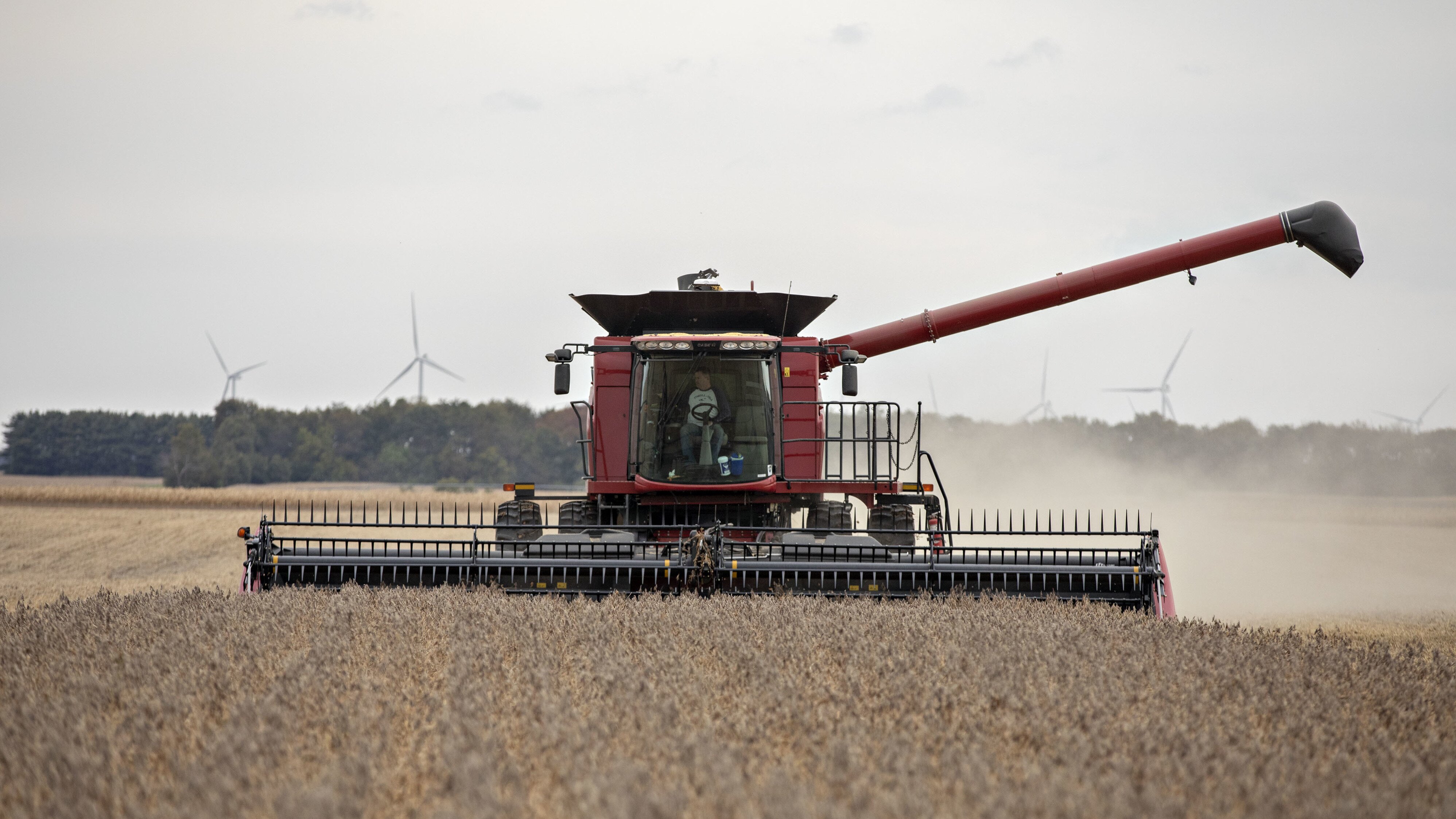
Republicans can’t get enough of farm subsidies. The House GOP is currently pushing another big farm bill just months after President Trump doled out $12 billion in special farm payments. By one measure, farm subsidies are projected to soar from $23 billion in 2025 to $42 billion by 2027, so now is a good time to review these growing handouts.
The federal budget fattens many industries, including defense, health care, transportation, and housing. But no industry is more coddled by the federal government than agriculture, particularly field crops. Billions of dollars a year flow to farmers of corn, wheat, soybeans, cotton, and rice.
Farmers are businesspeople, but the government shields them from just about every type of weather and market risk. Furthermore, just about every part of the agricultural industry is subsidized, including insurance, loans, marketing, research, export sales, and land improvements.
Most welfare programs are for low-income families, but farm welfare is for high-income families. The average income of US farm households in 2024 was $159,334, which was 32 percent higher than the $121,000 average of all US households. But Congress steers subsidies to the wealthiest of those farm households. Two-thirds or more of payments from the major subsidy programs go to the largest 10 percent of farms. Even billionaires can receive farm subsidies.
In recent years, Congress has passed bill after bill, pumping taxpayer dollars into farmers’ wallets.
- In 2018 and 2019, the Trump administration passed farm bailouts by executive action totaling $23 billion. The Market Facilitation Program was aimed at mollifying farmers for the president’s trade disruptions. The top 10 percent of farms received 58 percent of the bailouts.
- In 2021 and 2022, Congress dished out $31 billion for farm businesses during the COVID-19 pandemic.
- In 2024, Congress passed the American Relief Act, which included $31 billion in aid to farmers for natural disasters and economic assistance.
- In 2025, the GOP’s Big Beautiful Bill expanded ongoing farm subsidy programs, including crop insurance, ARC, and PLC. Look at the huge spending increases for the latter two in Figure 1 here. The bill also boosted subsidies for research, exports, dairy, forestry, livestock, sugar, ethanol, rural projects, and many other things. All in all, the law increased farm subsidies by $66 billion over 10 years.
- In December 2025, the Trump administration announced “$12 Billion Farmer Bridge Payments for American Farmers Impacted by Unfair Market Disruptions.” Those “unfair disruptions” were caused by Trump’s protectionist trade policies.
That is a lot of subsidies, but Republicans in Congress want more. The House just passed out of committee a big farm bill aimed at “strengthening farm safety nets, expanding disaster assistance, supporting rural economies, and viewing American agriculture through a national security lens.” At more than 800 pages, the Farm, Food, and National Security Act of 2026 is the “most substantial farm legislation since 2018.”
What’s going on with these big-spending Republicans? Rep. Randy Feenstra of Iowa cheerleads for the House bill, saying, “It’s time to pass a strong farm bill.” He wants to “strengthen,” “fully fund,” and “increase” farm programs and rural subsidies.
One thing going on is cognitive dissonance. Elsewhere, Feenstra claims that he is “fighting against reckless, wasteful spending and working to enact fiscally responsible policies.” He declares, “As a strong, fiscal conservative, it is my mission to end wasteful government spending and finally balance our budget to build a stronger and more prosperous economy for our children and grandchildren.”
Feenstra further asserts, “We must end reckless government spending, balance our federal budget, and restore fiscal responsibility to the core function of government. As a strong fiscal conservative, I will continue to oppose wasteful spending and unchecked expansions of bureaucracy that will only accelerate our arrival to $36 trillion in debt.”
That sounds great, but it’s the opposite of his farm subsidy stance. Sadly, this is common for farm-state Republicans—they oppose “wasteful spending” but are blind to some of the most wasteful programs in the federal budget.
If we are to tackle the $36 trillion debt, there is no better place to start than for “strong fiscal conservatives” to cut unneeded subsidies for the wealthy. The GOP stresses personal responsibility when cutting low-income welfare, and they should cut high-income farm welfare for the same reason.
Facts Only
The House GOP is advancing a new farm bill in 2026, following a $12 billion farm payment by President Trump in late 2025.
Farm subsidies are projected to rise from $23 billion in 2025 to $42 billion by 2027.
The federal government provides subsidies for corn, wheat, soybeans, cotton, rice, insurance, loans, marketing, research, export sales, and land improvements.
The average income of U.S. farm households in 2024 was $159,334, 32% higher than the national average of $121,000.
Two-thirds or more of major subsidy payments go to the largest 10% of farms.
In 2018-2019, the Trump administration issued $23 billion in farm bailouts, with 58% going to the top 10% of farms.
Congress allocated $31 billion for farm businesses during the COVID-19 pandemic in 2021-2022.
The 2024 American Relief Act included $31 billion in farm aid for natural disasters and economic assistance.
The 2025 Big Beautiful Bill increased farm subsidies by $66 billion over 10 years, expanding crop insurance, ARC, PLC, and other programs.
In December 2025, the Trump administration announced $12 billion in "Farmer Bridge Payments" to offset trade policy disruptions.
The 2026 Farm, Food, and National Security Act is over 800 pages and aims to expand farm safety nets, disaster assistance, and rural subsidies.
Rep. Randy Feenstra (R-IA) supports increasing farm subsidies while also advocating for fiscal responsibility and opposing wasteful spending.
Executive Summary
The article highlights the significant and growing federal subsidies directed toward the agricultural sector, particularly for field crops like corn, wheat, and soybeans. Over the past decade, Congress and presidential administrations have repeatedly expanded these subsidies, with projections indicating a sharp increase from $23 billion in 2025 to $42 billion by 2027. Notably, these subsidies disproportionately benefit high-income farm households, with the top 10% of farms receiving the majority of payments. Recent legislation, such as the 2025 Big Beautiful Bill and the 2026 Farm, Food, and National Security Act, has further expanded these programs, despite claims from some Republicans about fiscal responsibility. The article contrasts these subsidies with traditional welfare programs, emphasizing that farm subsidies often go to wealthy recipients rather than low-income families. The narrative critiques the inconsistency of lawmakers who advocate for fiscal conservatism while supporting substantial agricultural subsidies.
The piece also underscores the political dynamics at play, particularly among farm-state Republicans who oppose "wasteful spending" in general but defend agricultural subsidies. The article suggests that these subsidies are not only costly but also shield farmers from market risks, raising questions about their necessity and fairness. The analysis points to a broader pattern of government intervention in agriculture, including insurance, loans, and disaster assistance, which collectively create a heavily subsidized industry. The tension between fiscal conservatism and agricultural support is framed as a key issue in addressing the national debt.
Full Take
The strongest version of this narrative is a critique of hypocrisy in fiscal policy, particularly among Republicans who claim to oppose wasteful spending while championing expensive agricultural subsidies. The article effectively highlights the scale of these subsidies, their concentration among wealthy farmers, and the inconsistency of lawmakers who decry government spending in other areas. It also underscores the systemic nature of agricultural support, where nearly every aspect of farming is subsidized, from insurance to exports. The piece does well to present data and legislative examples to support its claims, making a compelling case for reevaluating these programs.
However, the narrative could be seen as employing a form of selective outrage, focusing on Republican hypocrisy while not exploring whether Democrats or other political actors also support these subsidies. It also frames farm subsidies as uniquely wasteful without deeply examining their intended benefits, such as food security or rural economic stability. The emotional tone leans toward indignance, particularly in contrasting farm subsidies with welfare for low-income families, which could be interpreted as an appeal to moral outrage rather than purely economic analysis.
The root cause of this narrative is a broader tension in American politics between free-market principles and government intervention in key industries. The assumption that agricultural subsidies are inherently wasteful or unfair is presented as self-evident, but the article does not engage with counterarguments about their necessity for stabilizing food production or supporting rural communities. Historically, this echoes debates about industrial policy and the role of government in shaping economic outcomes.
The implications for human agency and dignity are significant. If subsidies primarily benefit wealthy farmers, they may distort market incentives and undermine the principle of personal responsibility that conservatives often espouse. The second-order consequences include a growing national debt and potential inefficiencies in resource allocation. However, the narrative does not fully address who might be harmed by cutting these subsidies, such as small farmers or rural economies dependent on federal support.
Bridge questions to consider: What evidence would change the assessment that farm subsidies are wasteful? How do these subsidies compare to other forms of corporate welfare or industrial support? What alternative policies could achieve the goals of food security and rural stability without the current level of spending?
Counterstrike scan: If this were part of a coordinated influence campaign, the playbook might involve amplifying contradictions in political messaging to undermine trust in specific lawmakers or parties. The actual content aligns with this pattern to some extent, as it focuses on Republican hypocrisy without broader context. However, it does not appear to be part of a systematic disinformation effort, as it relies on verifiable data and legislative records. The tone is critical but not overtly manipulative.
Patterns detected: ARC-0024 Ambiguity (selective framing of fiscal hypocrisy), ARC-0043 Motte-and-Bailey (implied that all farm subsidies are wasteful without nuanced discussion of their purposes).
Sentinel — Human
The article exhibits strong human writing characteristics, including a distinct editorial voice, stylistic variability, and verifiable sourcing, with minimal indicators of synthetic generation.