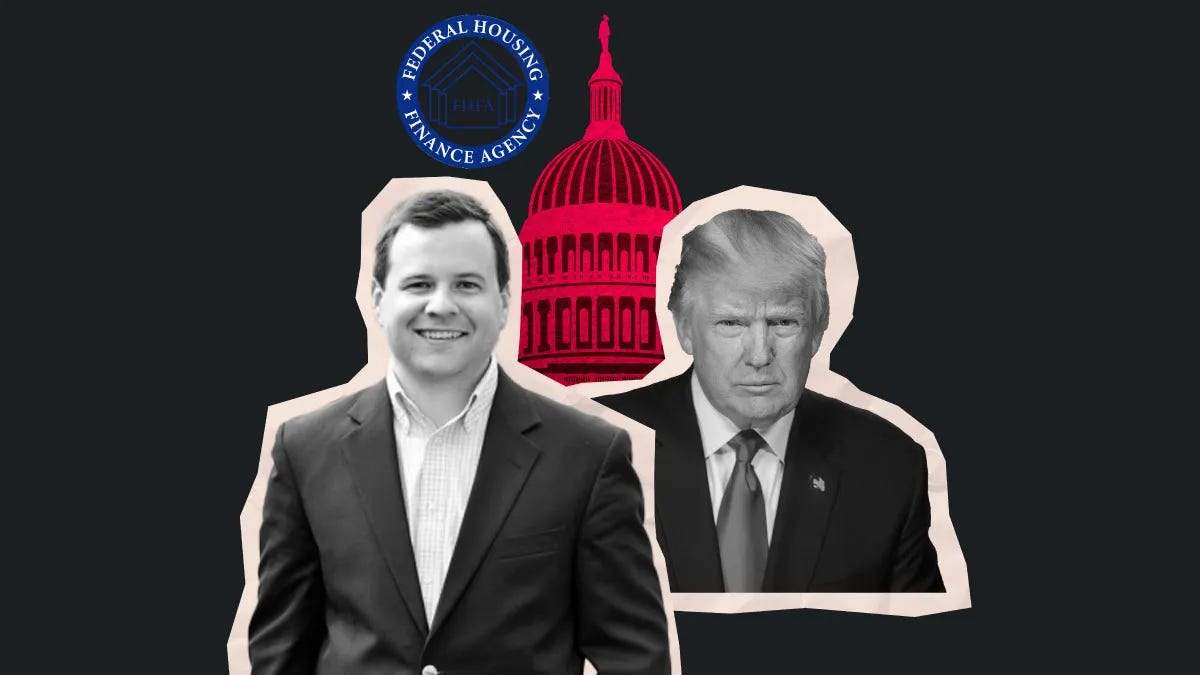
Trump scuttles Clayton pick & surveillance law in effort to pressure Congress to enact voting hurdles
Take a seat, Jay Clayton, your flight is delayed. Mr. Pulte, we’re ready for you to board.
And so it went at Zero-Dark-30 Wednesday when President Trump announced—on Truth Social, where else?—that he was pulling the nomination of Clayton to be the next director of National Intelligence.
Clayton, a SEC commissioner in the first Trump administration who is currently the top Justice Department prosecutor for the Southern District of New York, was arguably not legally qualified for the job, since by law it requires “extensive national security experience.” But Republicans audibly sighed with relief that his Clayton pick put a wooden stake in Trump’s rash pick of Bill Pulte, whose only “qualification” for the job is a demonstrated passion for using his position as director of the Federal Housing Finance Agency to investigate the mortgages of Trump’s “enemies,” to be the acting DNI.
But at 3:54 am Eastern, that turned out to be premature. Clayton was off the table—and perhaps soon out of a job, since Trump had already announced his successor to replace him in the SDNY.
Also scuttled, an extension of Section 702 of the Foreign Intelligence Security Act, the controversial program, popular with defense hawks, that allows the government to vacuum up the private communications of Americans in contact with suspect foreigners—without a warrant.
For the time being, at least, Bill Pulte will soon be presiding over the budgets and operations of the entire, 18-member U.S. intelligence community, whose agencies run everything from code-breaking to spy satellites to recruiting spies to stopping them.
When Trump picked him, he encouraged Pulte to make cuts. “I’d like to see it smaller,” he said, adding with a tinge of retribution, “I think there are a lot of people in there that shouldn’t be there.” He also wouldn’t be disappointed if Pulte looked for evidence of “rigged elections,” as Tulsi Gabbard had.
In Service to His Majesty
All this, Trump said, was in service of his SAVE America Act, which erects more barriers to voting, his principal obsession. Section 702, he suggested, could be tucked into that—a nonstarter as far as legislators were concerned.
Bipartisan apoplexy reigned on Capitol Hill. Asked why Trump was blowing up an already fraught effort to get somebody—anybody—to run U.S. intelligence in a time of war, rising terrorist threats, and escalating espionage from Russia, China and Israel, not to mention a fast-approaching need to police whatever nuclear “deal” is reached with Iran, Senate Majority Leader John Thune (R-SD) said, “good question.” Sen. Tom Cotton (R-Arkansas), chairman of the Intelligence Committee, called the decision “regrettable” (polite for “it sucks”) and indicated he wasn’t giving up on Clayton. Sen. Mark Warner of Virginia, his Democratic counterpart on the committee, blasted Trump for what he called “an extraordinary display of dysfunction.”
“Over the past two weeks, President Trump has careened from one personnel decision and political demand to the next – first installing Bill Pulte, then nominating Jay Clayton, then demanding unrelated legislation be attached to FISA reauthorization, and now threatening to derail both the confirmation process and a bipartisan reauthorization effort,” Warner said in a statement. “At every turn, the president has injected more uncertainty into a process that should be focused on one thing: keeping the American people safe.”
Predictably, though, at least one prominent MAGA fanatic loved the chaos the president had created.
“President Trump just pulled the pin on a hand grenade named Bill Pulte,” Steve Bannon told Axios’s Mike Allen, “and rolled it into the Tent called the Deep State.”
He’s scheduled to take office on Thursday.
This reminds me of a grade school game called "musical chairs." Who will be standing when the music stops?
Yikes. More Yikes is this article on surveillance tools from Italy where they are illegal.
https://alisav.substack.com/p/surveillance-in-america-is-about?r=f0qfn&utm_campaign=post-expanded-share&utm_medium=web
Facts Only
Executive Summary
Full Take
Sentinel — Human
The text exhibits the distinctive voice, cadence, and contextual linkage typical of human political commentary, rather than generic synthetic generation.