- Date:
- March 28, 2026
- Source:
- University of Kansas
- Summary:
- For decades, astronomers have been puzzled by strange “zebra stripe” patterns in radio waves from the Crab Pulsar — bright bands separated by complete darkness. Now, new research suggests the answer lies in a cosmic tug-of-war between gravity and plasma. The pulsar’s plasma spreads light apart, while gravity bends it back together, creating interference patterns that form the striking stripes.
- Share:
For more than 20 years, astronomers have been puzzled by a striking pattern of bright, evenly spaced stripes in the radio waves coming from the Crab Pulsar, the dense remnant of a supernova recorded by Chinese and Japanese astronomers in 1054.
In 2024, a theoretical astrophysicist at the University of Kansas proposed a solution that explained much of this unusual "zebra" pattern. Now, with a refined analysis, he has identified gravity's lensing effect as the final missing ingredient needed to fully explain the phenomenon.
"Gravity changes the shape of spacetime," said Mikhail Medvedev, KU professor of physics & astronomy, who will present his findings at the American Physical Society's 2026 Global Physics Summit taking place March 15-20 at the Colorado Convention Center in Denver.
An associated paper, accepted by the peer-reviewed Journal of Plasma Physics, currently is available on the pre-print site arXiv.
"Light doesn't travel in a straight line in a gravitational field because space itself is curved," he said. "What would be straight in flat spacetime becomes curved in the presence of strong gravity. In that sense, gravity acts as a lens in curved spacetime."
Gravity and Plasma Create a Unique Cosmic Tug-of-War
While gravitational lensing is well known in studies of black holes, Medvedev says this is the first observed case where both gravity and plasma work together to shape a signal detected from space.
"In black hole images, gravity alone shapes the structure," he said. "In the Crab Pulsar, both gravity and plasma act together. This represents the first real-world application of this combined effect."
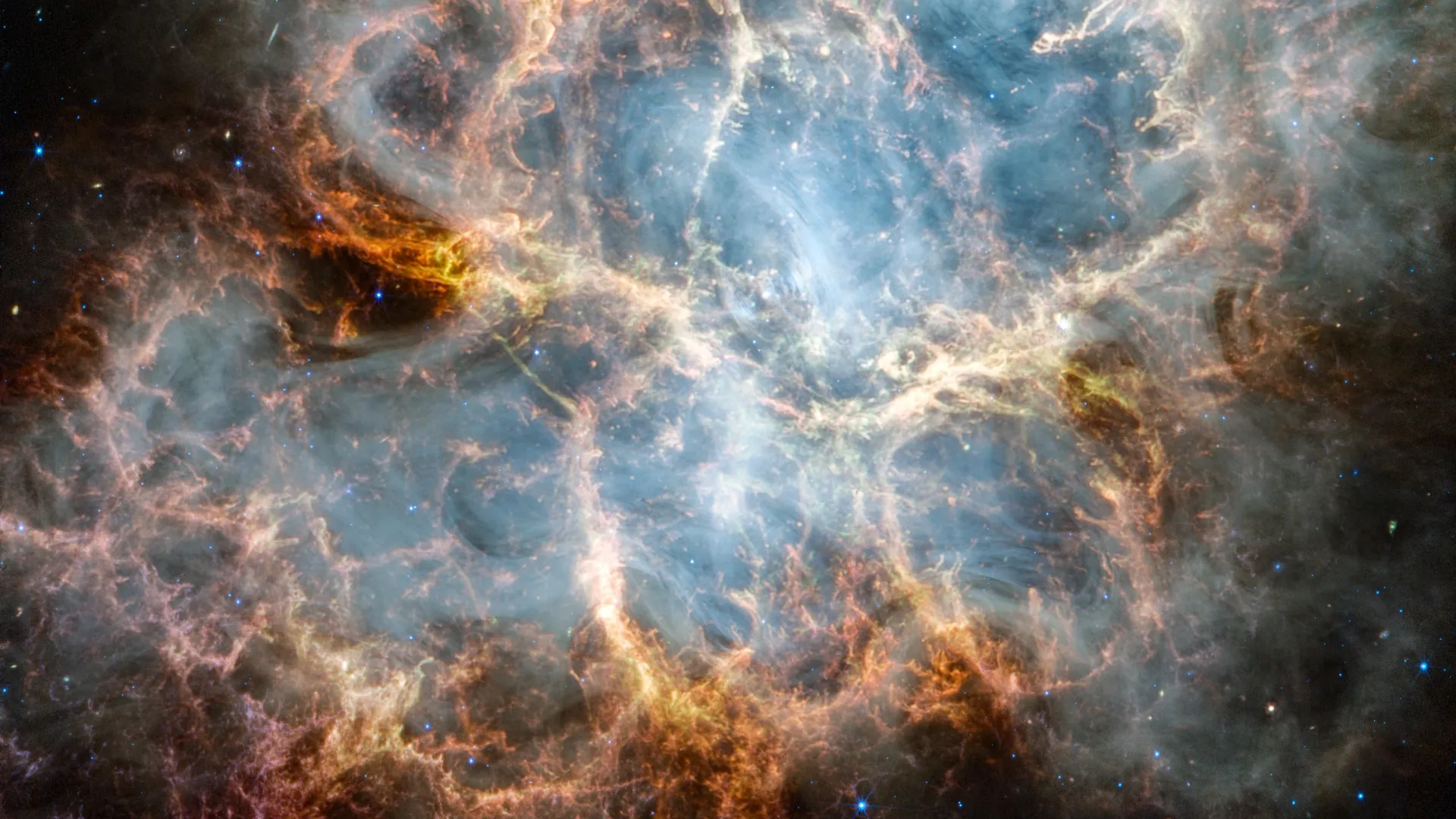
The Crab Pulsar sits at the center of the Crab Nebula in the Perseus Arm of the Milky Way, about 6,500 light-years from Earth. Its relatively close distance and clear visibility make it a key object for studying neutron stars, supernova remnants, and nebulae.
A Strange Signal Unlike Any Other Pulsar
Medvedev describes the pulsar's signal as highly unusual. Instead of a continuous spectrum like sunlight, which spreads smoothly across all colors, the Crab Pulsar produces distinct, separated bands.
"There's a remarkable pattern in Pulsar's spectrum," Medvedev said. "Unlike ordinary broad spectra -- such as sunlight, which contains a continuous range of colors -- the Crab's high-frequency inter-pulse shows discrete spectral bands. If it were a rainbow, it's as if only specific 'colors' appear, with nothing in between."
Most pulsars emit radio waves that are noisy and spread out across frequencies. The Crab Pulsar stands apart with sharply defined stripes separated by complete darkness.
"The stripes are absolutely distinct with complete darkness between them," Medvedev said. "There's a bright band, then nothing, bright band, nothing. No other pulsar shows this kind of striation. That uniqueness made the Crab Pulsar especially interesting -- and challenging -- to understand."
Gravity Provides the Missing Piece
Earlier versions of Medvedev's model could reproduce the striped pattern, but they failed to match the strong contrast seen in real observations. His research showed that plasma around the pulsar bends and spreads electromagnetic waves through diffraction, helping form the pattern.
Now, by adding Einstein's theory of gravity into the model, he has accounted for the missing contrast.
"The previous theoretical model could reproduce stripes, but not with the observed contrast. The inclusion of gravity provides the missing piece," Medvedev said. "The plasma in the pulsar's magnetosphere can be thought of as a lens -- but a defocusing lens. Gravity, by contrast, acts as a focusing lens. Plasma tends to spread light rays apart; gravity pulls them inward. When these two effects are superimposed, there are specific paths where they compensate each other."
Interference Patterns Produce the Zebra Stripes
The interaction between plasma and gravity creates multiple paths for the pulsar's radio waves. When these paths align, the waves can either reinforce or cancel each other, forming a pattern of bright and dark bands.
The KU researcher said the combination of a defocusing magnetospheric plasma and a focusing gravity create in-phase and out-of-phase interference bands of radio-wave intensity that appear as the Crab Pulsar's zebra stripes.
"By symmetry, there are at least two such paths for the light," he said. "When two nearly identical paths bring light to the observer, they form an interferometer. The signals combine. At some frequencies, they reinforce each other (in phase), producing bright bands. At others, they cancel (out of phase), producing darkness. That is the essence of the interference pattern."
A New Tool for Studying Neutron Stars
Medvedev believes the core mechanism behind the zebra stripes is now largely understood, though further refinements may improve precision.
"There appears to be little additional physics required to explain the stripes qualitatively," Medvedev said. "Quantitatively, there may be refinements. For example, the current treatment includes gravity in a static, lowest-order approximation. The pulsar is rotating, and including rotational effects could introduce quantitative changes, though not qualitative ones."
This new model could give scientists a powerful way to study rotating gravitational systems and better understand pulsars, which are typically difficult to visualize directly. It may also help map how matter is distributed around neutron stars and even offer clues about their internal structure through their gravitational effects.
Story Source:
Materials provided by University of Kansas. Note: Content may be edited for style and length.
Journal Reference:
- Mikhail V. Medvedev. Theory of striped dynamic spectra of the Crab pulsar high-frequency interpulse. arXiv, 18 Feb 2026 DOI: 10.48550/arXiv.2602.16955
Cite This Page:
Facts Only
The Crab Pulsar exhibits "zebra stripe" patterns in its radio waves, characterized by bright, evenly spaced bands separated by darkness.
These patterns have puzzled astronomers for over 20 years.
The Crab Pulsar is the remnant of a supernova recorded by Chinese and Japanese astronomers in 1054.
Mikhail Medvedev, a theoretical astrophysicist at the University of Kansas, proposed a solution in 2024 and refined it by 2026.
Medvedev's model attributes the stripes to a combination of plasma effects and gravitational lensing.
Plasma in the pulsar's magnetosphere spreads light apart, while gravity bends it back together, creating interference patterns.
The Crab Pulsar is located in the Crab Nebula, approximately 6,500 light-years from Earth.
Medvedev presented his findings at the American Physical Society's 2026 Global Physics Summit in Denver.
His research is published in the *Journal of Plasma Physics* and available on arXiv.
The model suggests that gravity and plasma work together to shape the pulsar's radio signal, a phenomenon not previously observed in other astronomical objects.
The Crab Pulsar's signal is unique among pulsars, with sharply defined stripes and complete darkness between bands.
Medvedev's model could help study the internal structure of neutron stars and map matter distribution around them.
Executive Summary
Full Take
The strongest version of this narrative is that Medvedev's research provides a compelling explanation for a long-standing astronomical mystery, combining gravitational lensing and plasma physics to account for the Crab Pulsar's unique "zebra stripes." The model is supported by peer-reviewed research and presented at a major scientific conference, lending it credibility. However, the narrative also highlights the complexity of the phenomenon, acknowledging that further refinements may be needed to fully quantify the effects of the pulsar's rotation and other factors.
Patterns detected: none
The paradigm driving this narrative is the pursuit of scientific understanding through the integration of theoretical physics and observational astronomy. The unstated assumption is that the Crab Pulsar's behavior can be fully explained by known physical laws, without invoking exotic or unknown phenomena. This echoes historical patterns in astrophysics, where seemingly anomalous observations are eventually explained by refining existing theories rather than overturning them.
The implications of this research extend beyond the Crab Pulsar itself. If the model is correct, it could provide a new tool for studying neutron stars and their environments, offering insights into their internal structure and the distribution of matter around them. This could have second-order consequences for our understanding of stellar evolution, supernovae, and the behavior of matter under extreme conditions.
Bridge questions: What other pulsars or astronomical objects might exhibit similar interference patterns? How might this model be tested or refined through future observations? What limitations does the current model have, and how might they be addressed?
Counterstrike scan: If this narrative were part of a coordinated influence campaign, the playbook might involve exaggerating the significance of the findings to secure funding or attention for the researcher or institution. However, the content does not match this pattern, as it presents the findings in a measured and scientific manner, acknowledging uncertainties and the need for further research.
Sentinel — Human
This text exhibits low signs of being synthetic, likely written by a human journalist.