Truthout is a vital news source and a living history of political struggle. If you think our work is valuable, support us with a donation of any size.
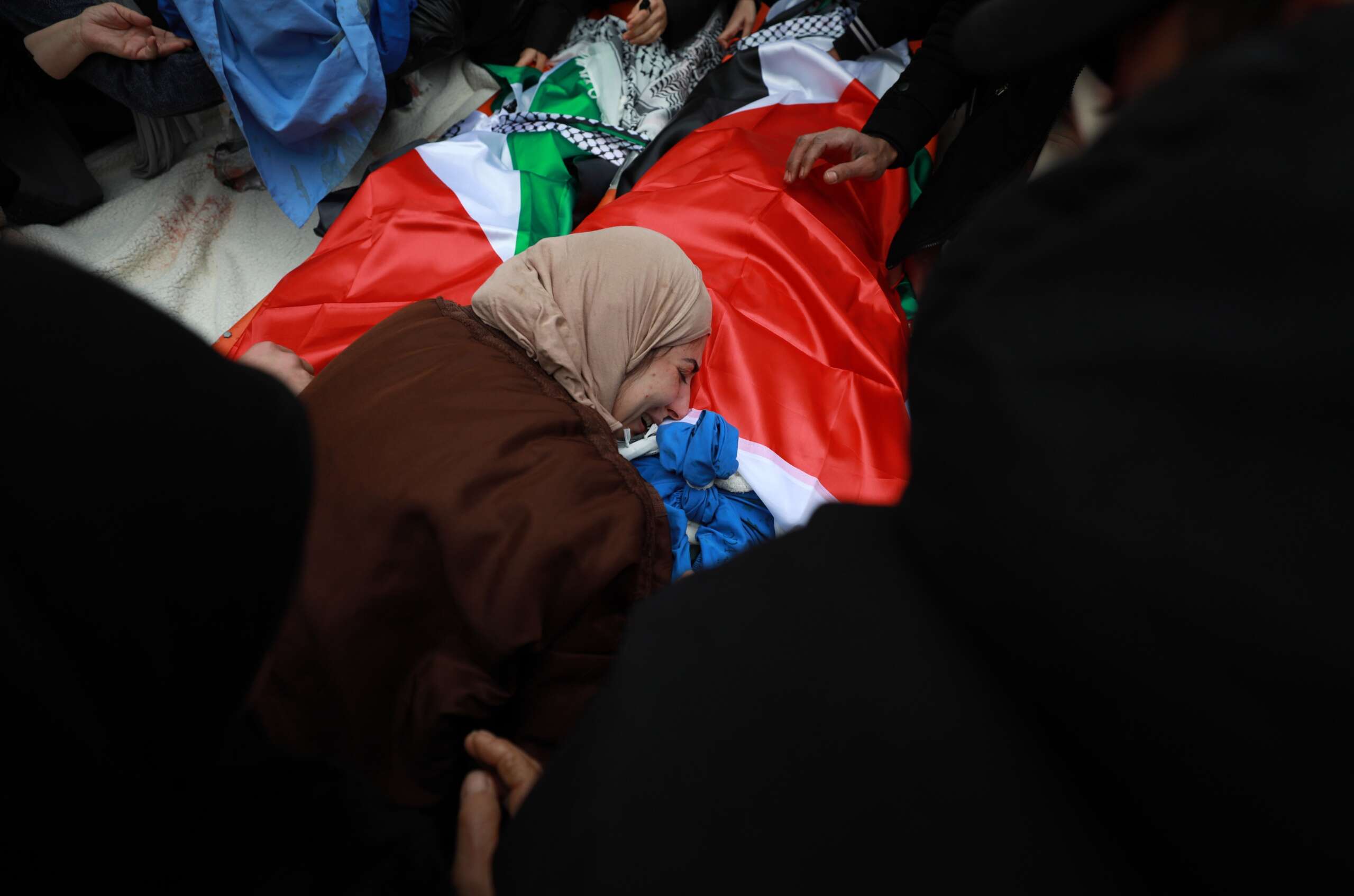
The Israeli Defense Forces killed a Palestinian couple and two of their children in the West Bank on Sunday, on one of the deadliest days for Palestinians in Gaza and the West Bank in weeks.
The soldiers opened fire on a car in the village of Tammun in which 37-year-old Ali Khaled Bani Odeh, his 35-year-old wife Waad, and their four sons Mohammad, Othman, Mustafa, and Khaled were traveling. Odeh, Waad, 5-year-old Mohammad, and 7-year-old Othman were shot in the head and died, leaving behind two injured children.
“We came under direct fire, we didn’t know the source. Everyone in the car was martyred, except my brother Mustafa and me,” one of the surviving children, 12-year-old Khaled, told Reuters from the hospital.
He said that after the shooting was over, the Israeli soldiers pulled him out of the car and began to beat him, telling him, “We killed dogs.”
The soldiers also beat his other surviving brother, according to Al Jazeera.
Breaking: Testimony of a surviving child after Israeli forces opened fire on a Palestinian vehicle in the town of Tammun, leaving most of the Bani Odeh family dead.
— Ramy Abdu| رامي عبده (@RamAbdu) March 15, 2026
Killed were the father Ali Khaled Sayel Bani Odeh, the mother Waad Othman Aql Bani Odeh, and their sons Mohammad… pic.twitter.com/YfirO9MXIz
The Israeli military said that it had been operating in Tammun to make arrests on “terrorist” charges and that soldiers had fired on a vehicle when it accelerated toward them, according to Reuters. It said it was reviewing the incident.
Al Jazeera journalist Nida Ibrahim said that the family had been totally shocked by the shooting.
“The extended family says the father and the mother did not know that Israeli forces were there as they were in a Palestinian car,” she said.
The Palestinian Ministry of Foreign Affairs condemned the killing on social media as a “terrifying arbitrary execution crime that targeted an entire Palestinian family inside their vehicle.”
The Israeli soldiers also prevented Red Crescent workers from reaching the family, the ministry said, leading to the families’ “deliberate and cold-blooded execution.”
The ministry continued: “The Ministry affirms that targeting an entire family in this savage manner reveals the true nature of the Israeli occupation and its policies based on killing and extermination, destruction and displacement, amid a systematic impunity, and it further affirms that these crimes, concurrent with the escalation of settler crimes and their organized terrorism in the occupied West Bank, are not isolated incidents, but part of a comprehensive and systematic aggression aimed at exterminating the Palestinian people and displacing them, in clear exploitation of the escalation occurring in the region.”
In a statement issued on social media, the Palestinian Centre for Human Rights (PCHR) also blamed the deaths on the Israeli occupation of the West Bank, which has been deemed illegal by the International Court of Justice.
“This escalation in these crimes comes as a direct result of the expansion of shooting instructions in the Israeli army, the rising violence of settlers amid the prevalence of an impunity policy, and the entrenchment of ethnic cleansing amid unprecedented international silence,” PCHR said.
It continued: “While the Palestinian Centre for Human Rights condemns the unjustified murder crimes committed by occupation forces and settlers, it affirms that these crimes occur within a systematic policy pursued by the occupation authorities using lethal force against Palestinian civilians, in flagrant violation of the principles of necessity and distinction that form fundamental pillars of international humanitarian law and international human rights law. Moreover, they come as part of a pattern aimed at terrorizing citizens, intimidating them, and entrenching ethnic cleansing policies, and replicating acts of genocide, albeit in a less overt manner.”
Also on Sunday, Israeli settlers killed a Palestinian man in Nablus Governorate, making him the sixth man killed by settlers since the US and Israel launched their war on Iran. Movement restrictions imposed due the war have emboldened setters to attack, knowing that ambulances will be delayed in reaching their victims, human rights advocates and healthcare workers told Reuters.
In total, Israeli settlers and soldiers have killed 25 Palestinians in the West Bank since the beginning of the year, PCHR said.
In Gaza, where Israeli strikes at first declined following the beginning of the Iran war, the death toll is rising again. On Sunday, Israeli strikes killed nine police officers in Zawayda and a pregnant woman, her husband, and son in Nuseirat.
An urgent appeal for your support: 10 Days to raise $50,000
Truthout relies on individual donations to publish independent journalism, free from political and corporate influence. In fact, we’re almost entirely funded by readers like you.
Unfortunately, donations are down. At a moment when independent journalism is urgently needed, we are struggling to meet our operational costs due to increasing political censorship.
Truthout may end this month in the red without additional help, so we’ve launched a fundraiser. We have 10 days to hit our $50,000 goal. Please make a tax-deductible one-time or monthly donation if you can.
Facts Only
Israeli Defense Forces (IDF) killed four members of a Palestinian family in Tammun, West Bank, on Sunday.
The victims were Ali Khaled Bani Odeh (37), his wife Waad (35), and their sons Mohammad (5) and Othman (7).
Two surviving children, Khaled (12) and Mustafa, reported being beaten by IDF soldiers after the shooting.
The family was traveling in a car when soldiers opened fire.
The IDF stated they were conducting arrests for "terrorist" charges and fired after the vehicle accelerated toward them.
The Palestinian Ministry of Foreign Affairs condemned the killings as a deliberate execution.
The Palestinian Centre for Human Rights (PCHR) attributed the deaths to Israeli occupation policies.
Israeli settlers killed a Palestinian man in Nablus Governorate the same day.
In Gaza, Israeli strikes killed nine police officers in Zawayda and a pregnant woman with her family in Nuseirat.
PCHR reports 25 Palestinians killed by Israeli settlers and soldiers in the West Bank since January.
The IDF is reviewing the incident.
Red Crescent workers were allegedly prevented from reaching the family.
Executive Summary
On Sunday, Israeli Defense Forces (IDF) killed a Palestinian family in the West Bank village of Tammun, including a couple and two of their four children. The family was traveling in a car when soldiers opened fire, killing 37-year-old Ali Khaled Bani Odeh, his 35-year-old wife Waad, and their sons Mohammad (5) and Othman (7). Two other children, Khaled (12) and Mustafa, survived but were beaten by soldiers after the shooting. The IDF claimed the vehicle accelerated toward them during an arrest operation, while the family stated they were unaware of the soldiers' presence. The Palestinian Ministry of Foreign Affairs condemned the incident as a deliberate execution, and the Palestinian Centre for Human Rights (PCHR) linked it to broader Israeli policies of ethnic cleansing. Additionally, Israeli settlers killed a Palestinian man in Nablus, part of a pattern of increased settler violence since the US-Israel war on Iran began. In Gaza, Israeli strikes killed nine police officers and a pregnant woman with her family. The PCHR reports 25 Palestinians killed by settlers and soldiers in the West Bank this year.
The incident reflects escalating tensions, with Palestinian authorities framing the killings as part of systematic oppression, while the IDF maintains the shooting was a response to perceived threat. Human rights groups highlight the broader context of impunity for settler violence and expanded military rules of engagement. The international silence on these events is noted as enabling further violence.
Full Take
The strongest version of this narrative centers on the systemic nature of Israeli military and settler violence against Palestinians, framed as part of a broader policy of ethnic cleansing. The testimony of the surviving children, the condemnation by Palestinian authorities, and the statistical context provided by human rights groups lend weight to the argument that these killings are not isolated but part of a pattern. The IDF’s claim of self-defense is presented alongside counterclaims of arbitrary execution, creating a tension that invites scrutiny of military rules of engagement and accountability mechanisms.
Patterns detected: ARC-0024 Ambiguity (competing narratives without resolution), ARC-0043 Motte-and-Bailey (IDF’s narrow self-defense claim vs. broader accusations of systemic violence).
The root cause paradigm here is the occupation itself—its legal status, the impunity it affords to settlers and soldiers, and the international silence that enables escalation. The narrative echoes historical patterns of colonial violence, where state and non-state actors collaborate in displacement and repression. The implications for human dignity are severe: families are destroyed, children traumatized, and communities live under constant threat. The beneficiaries of this paradigm are those who seek to entrench Israeli control over the West Bank, while the costs are borne by Palestinian civilians.
Bridge questions: How would the IDF’s rules of engagement need to change to prevent such incidents? What role does international media play in either amplifying or obscuring these patterns? What evidence would shift your view on whether this was an isolated tragedy or part of a systemic policy?
Counterstrike scan: A coordinated influence campaign would amplify emotional testimonies while omitting IDF perspectives, frame the incident as genocidal, and use it to delegitimize Israel entirely. This article includes IDF statements and human rights context, avoiding outright propaganda. However, the lack of independent verification of key claims (e.g., soldiers beating children) leaves room for manipulation. The content does not fully match a hypothetical attack playbook, as it presents multiple perspectives.
Sentinel — Human
The article shows strong human markers: emotional survivor testimony, advocacy framing, and specific attributions. Minimal stylometric or coordination red flags suggest human authorship.