Tenzin Nyidon
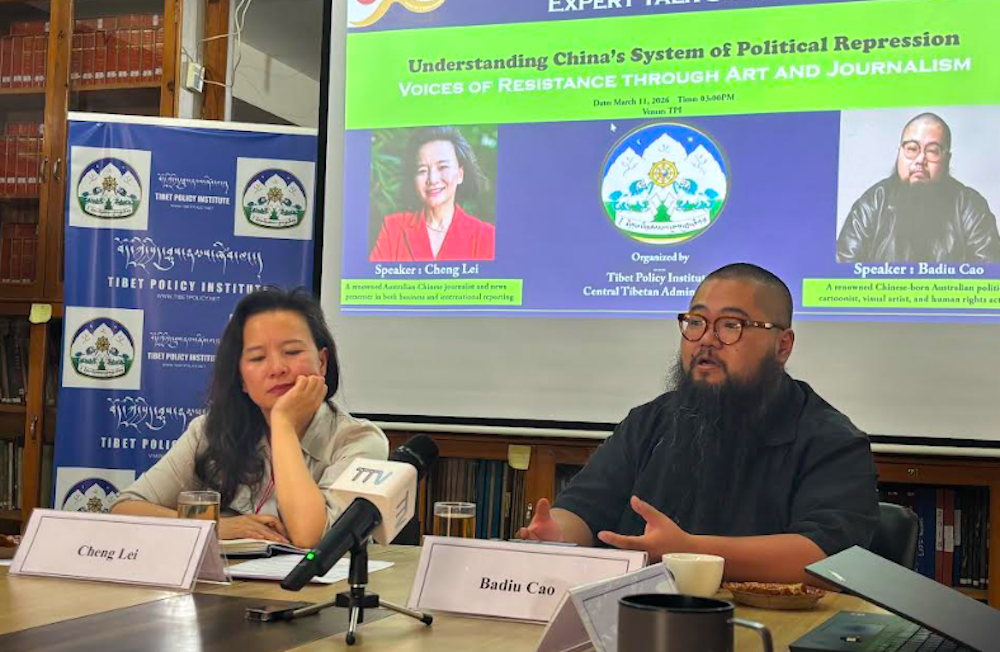
DHARAMSHALA, March 11: The Tibet Policy Institute (TPI), the think tank under the exile Tibetan government known officially as the Central Tibetan Administration, on Wednesday hosted an expert talk titled “Understanding China’s System of Political Repression: Voices of Resistance through Art and Journalism” at Gankyi compound in Dharamshala.
The program featured Australian-Chinese journalist Cheng Lei and Chinese-Australian political cartoonist and activist Badiucao, who shared insights into censorship, surveillance, and political control under the Chinese government, highlighting how independent reporting and creative expression continue to challenge authoritarian narratives and expose repression, amplifying silenced voices.
Artist and activist Badiucao, known internationally for his political cartoons that criticise authoritarianism, spoke about the personal and professional risks associated with producing dissident art. As a Han Chinese artist, he said he felt a responsibility to address injustices committed against Tibetans and other marginalized communities.
“For me, being a dissident is not intentional—it is a by-product of being a truthful artist,” he said, explaining that his work reflects both his family history and his commitment to universal human rights.
Badiucao described how Chinese authorities discovered his identity in 2018 after years of anonymity and subsequently pressured his relatives in China to force the cancellation of one of his exhibitions in Hong Kong. He said such tactics are part of broader “transnational repression,” in which authorities target families and associates to silence critics abroad.
He further detailed the Chinese government’s online harassment campaigns against dissidents, including the creation of fake websites, bot networks, and disinformation designed to discredit activists and distort search results. In recent years, he warned, artificial intelligence has made censorship and propaganda campaigns more efficient and harder to counter.
Beyond digital attacks, Badiucao said Chinese officials have repeatedly attempted to sabotage his exhibitions overseas through diplomatic pressure on museums and galleries. Despite these challenges, he continues to use social media, public art, and street installations to directly reach his audiences.
While acknowledging the increasing sophistication of censorship systems, the artist emphasized that visual satire and political art still hold the power to challenge authoritarian narratives. “When people start asking questions, you have already broken the cage of information,” he said.
Speaking about her two decades of experience in China’s media landscape, Australian-Chinese journalist Cheng Lei said censorship operated within both state-owned and foreign media outlets. Having begun her career in 2002 at China’s state broadcaster, she said many journalists at the time were optimistic that China’s media environment would gradually liberalize amid rapid economic growth and increasing global engagement.
However, she noted that strict red lines remained, particularly around sensitive subjects such as Tibet, Taiwan, and the 1989 Tiananmen protests. “The top propaganda chiefs decide what the masses must know, what they must not know, and how they should interpret it,” she said, describing daily propaganda directives circulated among media organizations outlining topics to promote, avoid, or frame in specific ways.
Lei also recounted how even foreign media organizations operating in China faced pressure due to business interests and concerns over staff safety. She described instances of harassment while reporting and the confiscation of equipment during interviews, illustrating the limits placed on journalists.
According to Lei, the space for independent reporting has narrowed significantly under the leadership of Chinese President Xi Jinping. “There used to be a saying that if you were silent, you were safe, but now if you don’t cheer loudly enough, you get into trouble,” she said, pointing to the growing politicization of media and the decline of investigative journalism in China.
She also observed that Chinese public perceptions of Tibet are heavily shaped by state propaganda, noting that many Chinese citizens remain poorly informed about the region despite being skeptical about other international issues.
Facts Only
The Tibet Policy Institute (TPI), under the Central Tibetan Administration, hosted an expert talk on March 11 in Dharamshala.
The event was titled “Understanding China’s System of Political Repression: Voices of Resistance through Art and Journalism.”
Speakers included Australian-Chinese journalist Cheng Lei and Chinese-Australian political cartoonist Badiucao.
Badiucao is known for political cartoons criticizing authoritarianism.
Chinese authorities identified Badiucao in 2018 after years of anonymity and pressured his relatives to cancel an exhibition in Hong Kong.
Badiucao described tactics of transnational repression, including online harassment, fake websites, and disinformation campaigns.
He noted that Chinese officials have used diplomatic pressure to sabotage his overseas exhibitions.
Cheng Lei has two decades of experience in China’s media, including work at China’s state broadcaster.
Lei stated that censorship operates in both state-owned and foreign media outlets in China.
She described daily propaganda directives that outline topics to promote, avoid, or frame in specific ways.
Lei observed that independent reporting space has narrowed under Xi Jinping’s leadership.
She noted that Chinese public perceptions of Tibet are heavily influenced by state propaganda.
Executive Summary
The Tibet Policy Institute hosted an expert talk in Dharamshala featuring Australian-Chinese journalist Cheng Lei and Chinese-Australian political cartoonist Badiucao, who discussed China’s political repression and the role of art and journalism in resistance. Badiucao, known for his dissident art, highlighted the risks of challenging authoritarianism, including transnational repression, online harassment, and diplomatic pressure to censor his work. He emphasized that visual satire remains a powerful tool to disrupt state narratives. Cheng Lei, drawing on her experience in Chinese media, described the tightening of censorship under Xi Jinping, where even foreign outlets face pressure and propaganda directives dictate coverage. Both speakers underscored the shrinking space for independent reporting and creative expression in China, while also noting the resilience of those who continue to expose repression.
The event underscored the broader context of China’s control over information, where state propaganda shapes public perception, particularly on sensitive issues like Tibet. While Badiucao and Lei acknowledged the increasing sophistication of censorship, they also demonstrated how art and journalism can still challenge authoritarianism by amplifying silenced voices. Their accounts reveal a system where dissent is met with both digital and physical repression, yet resistance persists through creative and investigative means.
Full Take
The strongest version of this narrative highlights the resilience of dissident voices in the face of China’s sophisticated repression machinery. Badiucao and Cheng Lei provide firsthand accounts of how censorship, surveillance, and transnational repression function, while also demonstrating that art and journalism remain potent tools for challenging authoritarian control. Their testimonies align with broader patterns of state-led information control, where propaganda directives and digital harassment are used to silence criticism. The narrative gains credibility from the speakers’ direct experiences—Badiucao’s anonymity being breached, Lei’s observations of media constraints—and their continued efforts to expose repression despite personal risks.
Patterns detected: ARC-0043 Motte-and-Bailey (state narratives shifting between rigid control and selective openness), ARC-0024 Ambiguity (propaganda directives framing what the public "must" and "must not" know).
The root cause of this narrative is the tension between authoritarian control and the human drive for truth-telling. The Chinese state’s paradigm assumes that information must be tightly managed to maintain stability, while dissidents operate from the assumption that transparency and free expression are inherent rights. Historically, this echoes Cold War-era information wars, where states sought to control narratives while dissidents used art and journalism as subversive tools.
The implications for human agency are profound. While the Chinese government benefits from maintaining information dominance, the costs are borne by those silenced—Tibetans, Uyghurs, and other marginalized groups—and by Chinese citizens deprived of unbiased information. The second-order consequence is a global erosion of trust in media, as state-backed disinformation campaigns blur the line between fact and fiction.
Bridge questions: How might the rise of AI further complicate the battle between censorship and dissent? What role do international platforms play in either amplifying or suppressing dissident voices? Would the narrative change if more Chinese citizens had access to uncensored information about Tibet?
Counterstrike scan: If this were part of a coordinated influence campaign, the playbook would involve amplifying dissident voices to undermine China’s legitimacy while framing the West as a beacon of free expression. However, the content here aligns with documented cases of repression and does not exhibit the hallmarks of a manufactured narrative. The speakers’ credibility and the specificity of their accounts suggest genuine resistance rather than a strategic attack.
Sentinel — Human
The article exhibits strong human authorship signals, including natural stylistic variation, personal voice in quotes, and detailed, context-specific reporting. No significant indicators of synthetic generation were detected.