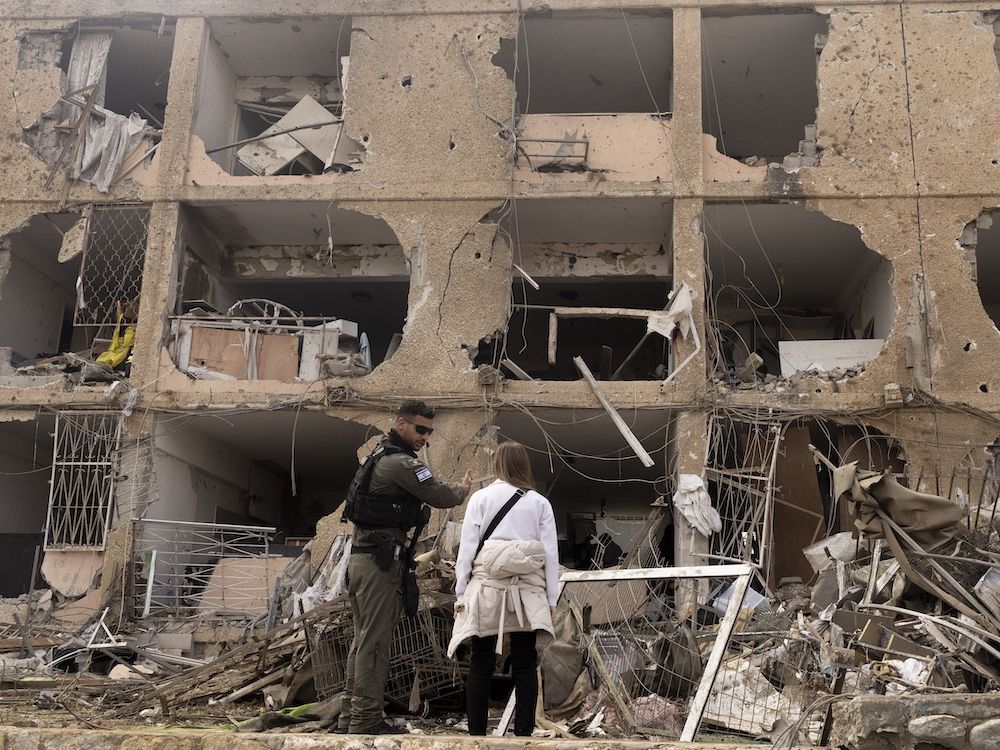
Iran’s most recent retaliatory barrage involved hundreds of ballistic missiles and drones launched across Kuwait and neighbouring Gulf states
KUWAIT CITY — Weeks into the U.S. and Israeli war with Iran, alarm is mounting after a series of strikes targeting sensitive nuclear facilities, including reported damage last week metres from the reactor of Iran’s Bushehr Nuclear Power Plant — located just across the Gulf from Kuwait.
The developments come as hundreds of Canadian troops remain stationed at Camp Canada located within as U.S. operated air base which was struck earlier this month and targeted on Sunday by four drones that were intercepted underscoring the heightened risks facing personnel deployed in the region amid rapidly escalating tensions.
Recommended Videos
The Bushehr Nuclear Power Plant lies just 276 kilometres across the Gulf from Kuwait, placing the country within immediate reach in the event of a radioactive release. Prevailing northwesterly winds could rapidly carry contamination toward Kuwait, further heightening the risk.
Experts have warned that a severe incident at Bushehr could have consequences comparable to Chernobyl, underscoring the gravity of the regional threat.
Rafael Grossi, director of the International Atomic Energy Agency, has called for maximum restraint, warning that continued strikes risk triggering a nuclear accident as fighting between the United States, Israel and Iran enters its fourth week.
“An accident at an operating nuclear power plant would be something very, very serious,” Grossi cautioned in a statement Wednesday. “This is the reddest line of all in nuclear safety.”
Saturday night, I sat in the passenger seat of a car, gazing out at the sweeping desert landscape, dotted with distant flickering lights from a sea of oil refineries on the horizon, as my driver carried me across the border from Saudi Arabia into Kuwait City. The journey by road was out of necessity —t he airport had been closed after being struck multiple times by Iranian drones.
In the span of just four hours — cut off from the world during a flight from Egypt to Saudi Arabia — the breaking news that trickled through the radio upon landing left me stunned.
- Adam Zivo: Liberal sanctimony won't reopen Strait of Hormuz
- Vivian Bercovici: Regime change in Iran is no longer a fantasy
- Advertisement 1Story continues below
The U.S. and Israeli war with Iran has taken a dangerous and deeply consequential turn, inching ever closer to the unthinkable: direct strikes in the vicinity of nuclear facilities. Within hours after the Natanz enrichment complex — a nuclear site — in Iran was reportedly struck on Saturday Iran launched retaliatory ballistic missile attacks on the southern Israeli towns of Dimona and Arad leaving about 180 people injured. The strike was just 13 kilometres from the Negev Nuclear Research Center, the country’s most secretive and strategically sensitive facility.
Whether by design or proximity, the message was unmistakable: no target is beyond reach.
As a radio presenter announced the news, I could not help but reflect on the alarming speed of this escalation transforming what might once have been covert confrontation into overt and immediate reprisal.
“Where is all this going?” the driver asked, voicing concern that U.S. President Donald Trump’s warning to “obliterate” Iran’s power plants if it fails to fully reopen the Strait of Hormuz within 48 hours would only lead to further carnage. Trump said Monday those strikes would be postponed five days, after talks between Washington and Tehran.
Iran immediately responded warning that retaliatory strikes on the region’s infrastructure would follow if the U.S. president proceeds with his ultimatum.
Last week, Canada joined a 22-nation coalition — including the UK, France, Germany, Japan, and Gulf allies like the UAE and Bahrain — in a U.S.-led effort to reopen the Strait of Hormuz. The mission is urgent: to secure shipping, clear mines, and protect one of the world’s most critical energy arteries, through which nearly 20 per cent of global oil flows. Iran’s reported mining of the strait has turned this vital waterway into a dangerous flashpoint with global consequences.
Iran’s most recent retaliatory barrage involved hundreds of ballistic missiles and drones launched across Kuwait and neighbouring Gulf states, including the UAE, Bahrain, Saudi Arabia, and Oman, targeting oil refineries, gas installations, and major ports.
While Kuwaiti air defence forces have intercepted and destroyed dozens of missiles and drones, a few have slipped through, and falling debris from the interceptions has caused material damage and casualties in the city, including an 11-year-old girl who was struck while sleeping in her bed. Her televised funeral, attended by hundreds of mourners in Kuwait, has left a deep psychological mark on a population already enduring the war.
Thousands of Canadians have chosen to leave the Middle East since the outbreak of the war on Feb. 28, including dozens from Kuwait.
“The schools are closed, and air sirens are ringing multiple times a day, and distant booms keeps more people at home farther from public places. But my company is booming — cashing in on the crisis — as more and more people opt to leave, with land routes now the only way out,” the Egyptian driver added as he sped through the quiet streets of Kuwait.
As of March 2026, several major international and national organizations are actively preparing for the possibility of a nuclear incident, driven by escalating tensions in the Middle East and the ongoing conflict involving the United States, Israel, and Iran.
Days ago, the World Health Organization (WHO) acknowledged that it is preparing for a “worst-case scenario” involving nuclear risks. The agency is refreshing staff training on emergency response protocols and reinforcing guidance on radiation-related health risks. At the same time, regional teams are updating contingency plans across 13 countries to prepare for potential strikes on nuclear facilities or the use of nuclear weapons.
Kuwait has strengthened its emergency preparedness by establishing 196 public shelters — primarily in schools and universities — to protect civilians from potential chemical, radiological, or nuclear threats. These facilities are equipped with specialized ventilation systems, food supplies, bunk beds, prayer areas, medical clinics, and decontamination and clothing disposal units.
The war has left the world on the brink of a potential global economic depression should the conflict fail to de-escalate, with more Gulf nations being drawn into a conflict they had long sought to avoid.
The escalation to direct strikes on nuclear sites could trigger a humanitarian crisis spanning multiple countries — a fear now increasingly felt across the streets of the Middle East.
National post
Postmedia is committed to maintaining a lively but civil forum for discussion. Please keep comments relevant and respectful. Comments may take up to an hour to appear on the site. You will receive an email if there is a reply to your comment, an update to a thread you follow or if a user you follow comments. Visit our Community Guidelines for more information.
Facts Only
The U.S., Israel, and Iran are engaged in a conflict that has entered its fourth week.
Iran’s Bushehr Nuclear Power Plant, located 276 kilometers from Kuwait, was reportedly damaged near its reactor.
The International Atomic Energy Agency (IAEA) has warned of the risks of a nuclear accident due to continued strikes.
The U.S. and Israeli war with Iran has led to direct strikes near nuclear facilities, including the Negev Nuclear Research Center in Israel.
Iran launched retaliatory ballistic missile attacks on southern Israeli towns, injuring about 180 people.
Canada is part of a 22-nation coalition led by the U.S. to reopen the Strait of Hormuz, which has been mined by Iran.
Iran’s retaliatory strikes have targeted Gulf states, including Kuwait, the UAE, Bahrain, Saudi Arabia, and Oman.
Kuwait has established 196 public shelters to protect civilians from potential chemical, radiological, or nuclear threats.
The World Health Organization (WHO) is preparing for a "worst-case scenario" involving nuclear risks.
Thousands of Canadians have left the Middle East since the outbreak of the war on February 28, 2026.
Kuwaiti air defense forces have intercepted dozens of missiles and drones, but some have caused casualties and material damage.
U.S. President Donald Trump has warned to "obliterate" Iran’s power plants if it fails to reopen the Strait of Hormuz within 48 hours.
Executive Summary
Full Take
The narrative presented here is a stark portrayal of escalating tensions in the Middle East, with the specter of nuclear catastrophe looming large. The strongest version of this narrative is its emphasis on the immediate and tangible risks posed by the conflict, particularly the potential for a nuclear accident at Iran’s Bushehr plant. The article effectively highlights the regional and global stakes, from the disruption of critical oil routes to the humanitarian crisis unfolding in Gulf states. However, the narrative also leans heavily on fear appeals, painting a scenario of imminent disaster that could be seen as emotional exploitation (ARC-0043). The repeated references to the potential for a Chernobyl-like event and the psychological toll on civilians serve to amplify the sense of urgency and danger.
The root cause of this narrative appears to be a paradigm of escalating conflict, where each side’s actions are framed as both defensive and provocative. The unstated assumption is that the conflict is spiraling out of control, with no clear off-ramp. This echoes historical patterns of proxy wars and brinkmanship, where the risk of miscalculation leads to unintended consequences. The implications for human agency and dignity are profound, as civilians bear the brunt of the conflict, with thousands displaced and communities living under the constant threat of attack.
What perspectives are missing from this narrative? How might the conflict be de-escalated, and what role could diplomatic efforts play? What would it take to shift the focus from military confrontation to dialogue and negotiation?
If this narrative were part of a coordinated influence campaign, the playbook might involve amplifying fear and uncertainty to justify military intervention or to rally support for a particular side. However, the content does not appear to match this pattern, as it presents a balanced account of the risks and consequences without overtly pushing a specific agenda.
Sentinel — Human
The article exhibits strong human signals, including personal narrative, stylistic idiosyncrasies, and emotional depth, with no significant indicators of synthetic generation.