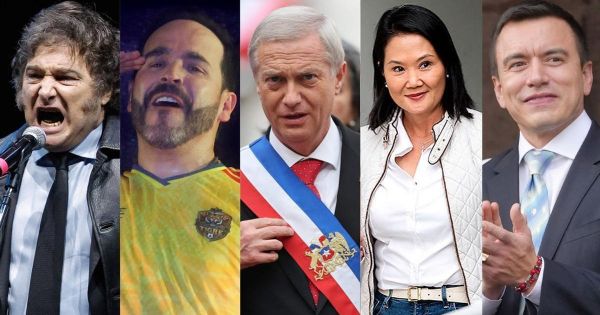
The confirmation of right-wing Keiko Fujimori's victory in Peru's presidential runoff drew a wave of congratulations from leaders across the region, who framed the result within the shift to the right underway in several Latin American countries. With Fujimori's arrival in power, the right will add a new government, alongside those of Argentina, Ecuador, Chile, Paraguay and El Salvador, and the recent victory of Abelardo de la Espriella in Colombia.
Argentine President Javier Milei was among the most emphatic. “I congratulate Keiko Fujimori on her historic victory in Peru. The Peruvian people join Colombia and have sent a clear message: the region wants to return to the path of freedom and security,” he wrote on the social network X, where he held that Peruvians “rejected the communist debacle” of her rival, left-wing Roberto Sánchez, and said that “freedom is advancing across Latin America.” Along similar lines, Colombia's president-elect, De la Espriella, said both countries would be “guided by governments that share the defense of democracy, freedom and the rule of law.”
Other messages took a more institutional tone. Bolivia's President Rodrigo Paz expressed his “respect for the democratic will of the Peruvian people” and his commitment to strengthening bilateral ties, while Costa Rica's President Laura Fernández wished Fujimori a term “marked by prosperity and progress for all Peruvians.” The secretary general of the Organization of American States (OAS), Albert Ramdin, also congratulated her and said he had been invited to the inauguration, scheduled for July 28.
The enthusiasm of like-minded leaders contrasts, however, with the narrowness of the result and the division the election left behind. Fujimori won by just 49,641 votes —50.14% against Sánchez's 49.87%— and did not win within Peruvian territory, where her rival prevailed; the margin tilted in her favor thanks to the vote of Peruvians abroad. The Fuerza Popular candidate won in nine of the country's 25 regions and will have to govern a divided Peru, which has had eight presidents in a decade.
Added to this is that Sánchez has not conceded. The Juntos por el Perú candidate alleges, without presenting evidence, an alleged fraud linked to the overseas vote, an objection that electoral authorities have rejected and that the National Jury of Elections dismissed when it declared all his appeals unfounded. Fujimori's official proclamation as president-elect is scheduled for Friday, July 3, ahead of her inauguration on July 28, for the 2026-2031 term.
Top Comments
Disclaimer & comment rulesNo comments for this story
Please log in or register (it’s free!) to comment. Login with Facebook
Sentinel — Human
This text functions as standard analytical news reporting, successfully synthesizing electoral data with regional political rhetoric, displaying characteristics typical of human journalistic writing.