PARIS — The war in Ukraine is driving a shift toward fast-changing, mass warfare that Western militaries are unprepared for, while Russia is adapting rapidly, according to Adm. Pierre Vandier, NATO’s Supreme Allied Commander Transformation.
The gap between what Europe should be doing for defense and its actual capabilities undermines deterrence, risking Russian aggression if Moscow concludes Europe or NATO are too weak to resist attack, Vandier said at the Paris Defense & Strategy Forum on March 25.
Ensuring Europe’s safety in the next decade requires “a dramatic increase of credibility of our deterrence,” he said.
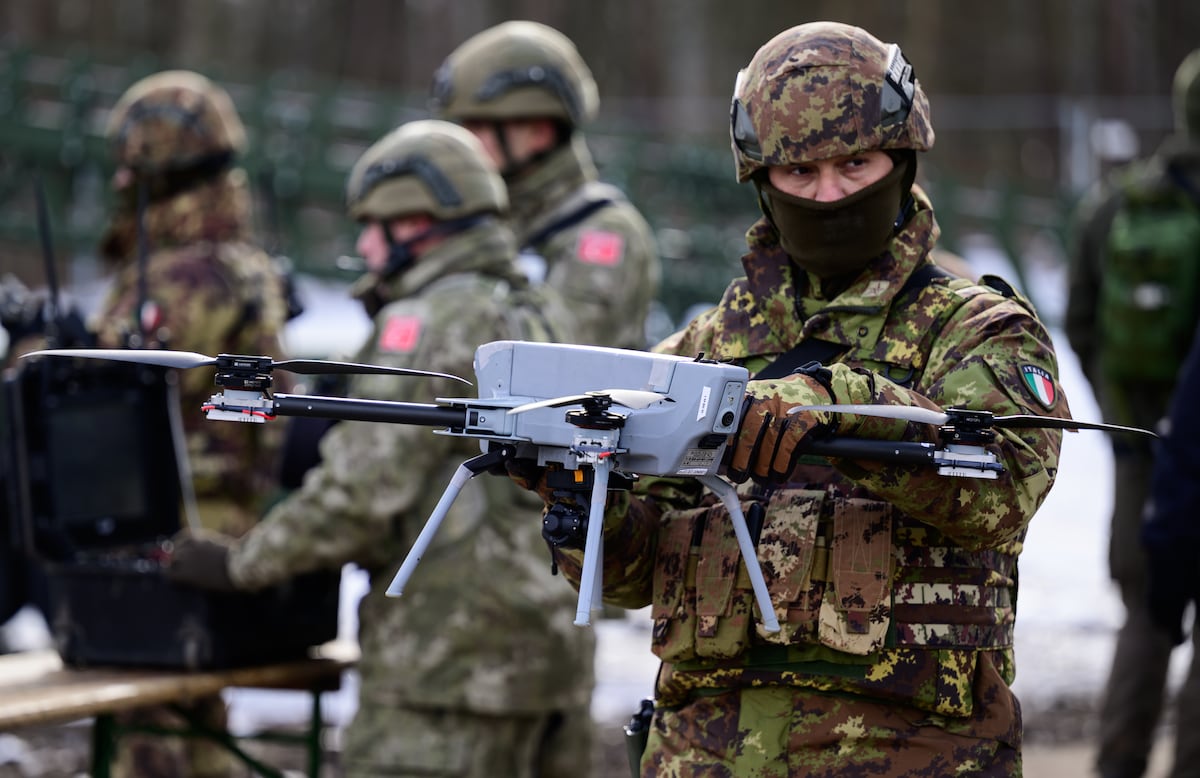
Russia’s invasion of Ukraine sparked a technology race, with Ukraine innovating to make up for its smaller force and Russia adapting in response. The result is a war unlike any NATO has faced, with thousands of drones used each day on a battlefield saturated by electronic warfare, where constant surveillance makes movement deadly and unmanned systems destroy tanks and warships.
“A shock is a period where you need to invent a new world, a new way of doing things,” Vandier said. “It’s what you see in Ukraine. Short of everything but the enemy, they have to invent a new war. And this is coming. And our enemies are doing the same, they are inventing the next war.”
While the evolution of warfare in Ukraine and now the Middle East signals an “era of shocks,” Europe remains in crisis-management mode, according to Vandier. He said countries need to start delivering, because “we are weak, the stockpile is not very big, the enemy knows that.”
The challenge is not to simply continue along the same lines, but to evaluate what is needed to maintain security in a “totally different world,” Vandier said. The return of mass is one of the key challenges for allies not organized for that kind of warfare, with many Western systems that can’t be mass produced.
“How do we deal with mass?” Vandier asked. “And as far as I can see, it’s the same problem on the other side of the Atlantic. If we do more of the same, we will not answer the question.”
Vandier said Russia and Iran produce hundreds of Shahed drones for every single AIM-120 or AIM-9 interceptor, and doubling or tripling output won’t close that gap. Protecting Europe with Patriot air-defense batteries would require ten times as many, but with a seven-year lead time, “you will not be protected by Patriots in the next five years.”
“You have far more targets than weapons to kill it,” Vandier said. “You need to invent something different. It’s what is going on in Ukraine.”
Vandier warned that simply spending more won’t be enough, noting how Gulf states have struggled to defend critical infrastructure against waves of relatively cheap Iranian drones and missiles despite vast resources. Western failure to prepare risks similar vulnerabilities, he said.
“It’s not a question of money, it’s a question of speed, it’s a question of making the right choices,” Vandier said. “More of the same will not save us.”
Speed of adaptation remains a core issue, with common-funded NATO projects taking years just to define requirements as countries seek to include their specifications, Vandier said. Meanwhile, Shahed drones have received five updates since a drone incursion in Poland in September, according to the NATO commander.
The Western defense industry needs “newcomers that will do the things at the speed of relevance,” Vandier said, even as NATO still relies on traditional manufacturers of major platforms such as fighter jets, aircraft carriers, submarines and battle tanks. But those systems must adapt quickly to new threats.
“Today, if you do not adapt your jammers, your tank will be destroyed in 10 minutes,” Vandier said. “If you don’t protect your frigate against drones, it will be sunk in 10 minutes.”
Vandier cited countries saying they’ll buy frigates first and address drones in 10 years, warning they may lose their frigates on the first night of a war. He said Russia has learned the lesson from Ukraine and knows the cost of not being protected against unmanned surface vehicles, and is reverse engineering Ukraine’s sea-going drones.
“I’m not saying you get rid of frigates, because to go in the middle of the Atlantic, to chase a Yasen-class submarine, we’ll not do that with drones today,” Vandier said. “But in the Baltic, your harbor may be overwhelmed by drones, as Ukraine did with the Russians.”
NATO needs to invent the next war rather than prepare for the last one, “because the last one, the Russians think they can win,” Vandier said. “But the next one, they don’t know.”
Vandier dismissed ideas that Ukraine is fighting a specific war because the country lacks modern air power, and that NATO would fight differently. “The enemy has changed,” he said. “Russia is no longer what it looked like four years ago. So we need to be prepared for a new enemy.”
Europe needs to deliver on deterrence to force the enemy to recalculate, and given sanctions on Russia and Europe’s pool of hundreds of thousands of engineers, “we need to demonstrate we can win it,” Vandier said.
The NATO commander said he’s confident Europe can deliver, but “there is an urgency. We need to do it now, tomorrow, and not in 10 years.”
NATO will organize a large-scale counter-drone exercise in Romania in April, and while all countries are invited, for now only 20 of the 32 member states are signed up, with 24 companies participating, according to Vandier.
The admiral says he’s bought €10 million ($11.5 million) worth of targets, and for more than a week, “six hours a day, we shoot and shoot and shoot. We’ll see who are the liars, who are the champions amongst the twenty.”
The exercise will give decision makers insight into who is delivering results rather than glossy presentations, Vandier said.
The defense industry also needs different key performance indicators, or KPIs, that reflect the new way of war, such as price per shot, scalability, interoperability and adaptability. He said vendor-lock-in systems where “you pay a million euros for a new line of code, this is finished. That will never work again.”
Vandier described visiting a concealed drone factory in a Kyiv neighborhood, where 1,000 workers led by a 30-year-old former childcare worker produce 3,000 drones a day while operating off-grid to evade detection.
“We need to avoid that,” Vandier said. “We need to be smarter. We need to invent the war that Russia will lose.”
“We need to make Russia wake up each morning, thinking to themselves: ‘Not today.’”
Rudy Ruitenberg is a Europe correspondent for Defense News. He started his career at Bloomberg News and has experience reporting on technology, commodity markets and politics.
Facts Only
Admiral Pierre Vandier, NATO’s Supreme Allied Commander Transformation, spoke at the Paris Defense & Strategy Forum on March 25.
Vandier stated that the war in Ukraine is driving a shift toward mass warfare that Western militaries are unprepared for.
He warned that Europe’s defense capabilities are insufficient to deter Russian aggression.
The war in Ukraine involves thousands of drones daily, electronic warfare saturation, and unmanned systems targeting tanks and warships.
Russia and Iran produce hundreds of Shahed drones for every Western interceptor like the AIM-120 or AIM-9.
Protecting Europe with Patriot air-defense batteries would require ten times the current number, with a seven-year lead time.
NATO’s procurement processes are slow, with common-funded projects taking years to define requirements.
Vandier cited a concealed drone factory in Kyiv producing 3,000 drones daily.
NATO will organize a large-scale counter-drone exercise in Romania in April, with 20 of 32 member states participating.
Vandier emphasized the need for speed, scalability, and adaptability in defense systems.
He dismissed the idea that Ukraine’s war is unique due to its lack of modern air power, stating Russia has evolved as an enemy.
Vandier called for Europe to demonstrate it can win against Russia to force a recalculation of aggression.
Executive Summary
Admiral Pierre Vandier, NATO’s Supreme Allied Commander Transformation, warned at the Paris Defense & Strategy Forum on March 25 that the war in Ukraine is reshaping modern warfare in ways Western militaries are unprepared for. He emphasized that Russia is rapidly adapting to new battlefield realities, including drone saturation, electronic warfare, and unmanned systems, while Europe remains in crisis-management mode. Vandier highlighted a critical gap between Europe’s defense capabilities and the deterrence needed to prevent Russian aggression, stressing that incremental improvements won’t suffice. He pointed to the asymmetry in drone production, with Russia and Iran outpacing Western interceptor output, and criticized slow NATO procurement processes. The admiral called for faster adaptation, new defense industry approaches, and a shift from traditional platforms to scalable, cost-effective solutions. He also announced a NATO counter-drone exercise in Romania to test real-world capabilities, underscoring the urgency of innovation to counter evolving threats.
The conflict in Ukraine has exposed vulnerabilities in Western defense strategies, particularly in mass production, electronic warfare, and drone defense. Vandier’s remarks reflect broader concerns about NATO’s readiness for high-intensity, technology-driven warfare, where speed and adaptability are paramount. While he expressed confidence in Europe’s potential, he stressed the need for immediate action to avoid falling behind adversaries who are already redefining combat tactics.
Full Take
**Steelman:** Admiral Vandier’s warnings carry significant weight as a high-ranking NATO official with direct insight into military preparedness. His assessment of the Ukraine war as a catalyst for rapid technological and doctrinal change is well-supported by observable trends—drones, electronic warfare, and mass production are indeed reshaping combat. The call for urgency is justified by the asymmetry in production capacity (e.g., Shahed drones vs. Western interceptors) and the slow pace of NATO procurement. His emphasis on adaptability over traditional platforms reflects a realistic appraisal of modern threats.
**Pattern Scan:** The narrative leans heavily on urgency and existential risk, which could border on fear appeals (ARC-0012). However, Vandier’s arguments are grounded in verifiable military trends rather than emotional manipulation. The critique of NATO’s bureaucracy and defense industry inertia is valid, though the framing of "we are weak" risks oversimplifying complex systemic challenges. No overt distortion or bad faith is detected, but the emphasis on speed could be exploited to justify rushed, unaccountable spending.
**Root Cause:** The paradigm here is the clash between industrial-age military structures and information-age warfare. The unstated assumption is that Western superiority in traditional platforms (e.g., frigates, fighter jets) is no longer sufficient. This echoes historical shifts like the transition from trench warfare to blitzkrieg, where doctrinal rigidity proved fatal. The deeper pattern is the democratization of military technology—cheap drones and AI-enabled systems eroding the West’s technological edge.
**Implications:** Human agency is at stake in two ways: first, the need for rapid innovation to preserve deterrence; second, the risk of overcorrecting into a perpetual arms race that drains resources. The beneficiaries of this narrative are defense industries and NATO’s transformation agenda, while the costs fall on taxpayers and smaller nations struggling to keep pace. Second-order consequences include potential mission creep in NATO’s role and the normalization of perpetual "crisis mode" governance.
**Bridge Questions:**
1. How can NATO balance the need for speed with accountability in procurement, given the risks of corruption or wasted spending?
2. What role should civilian oversight play in shaping military adaptation, especially as warfare becomes more automated?
3. If Russia is adapting so rapidly, what prevents Western militaries from learning from Ukraine’s innovations at scale?
**Counterstrike Scan:** A coordinated influence campaign would amplify the urgency to justify expanded defense budgets, sidestep accountability, and frame dissent as naivety. The actual content aligns with this pattern in tone but not in substance—Vandier’s arguments are evidence-based, not manipulative. The risk lies in how his warnings could be weaponized by others, not in the warnings themselves.
Patterns detected: ARC-0012 Fear Appeals (mild)
Sentinel — Human
The article exhibits strong human authorship signals, including natural stylistic variation, direct attribution, and idiosyncratic emphasis, with no detectable synthetic patterns.