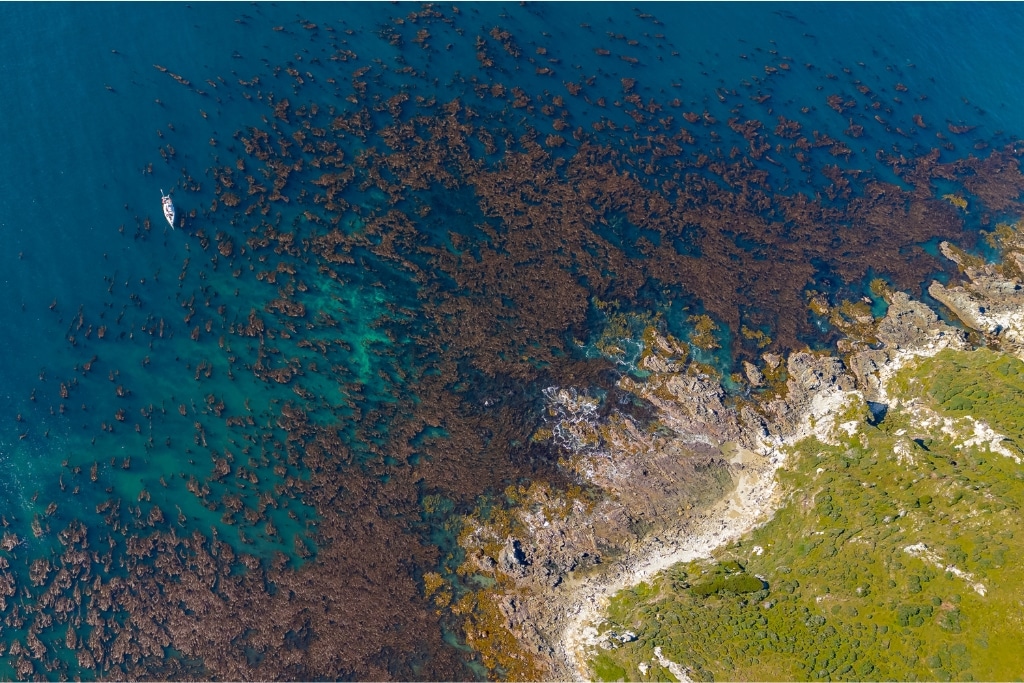
At the frozen tip of South America, where the mountains of Tierra del Fuego meet the jagged currents of the Beagle Channel, a dedicated team of scientists and explorers is diving into one of the planet’s last truly intact marine refuges. While the rest of the world’s underwater forests vanish at an alarming rate, these resilient subantarctic kelp systems offer a rare blueprint for how we might still protect the life-sustaining pulse of our oceans.
—
By Andi Cross
It was five in the morning, and the team was meeting for the first time on the dock in Ushuaia, Argentina. We barely knew each other, but months of planning had led us to this point. Everyone had taken a different path to arrive, but we shared a common goal: to explore one of the most intact and overlooked ecosystems left on the planet. This far south – what some call the “end of the world” – cold-water kelp forests are still surging with life.
For those who know where Ushuaia is, it is usually considered a gateway to Antarctica. On one side, jagged mountains, glaciers, and dense forest. On the other, the Beagle Channel. The setting alone makes it feel like the edge of something – especially outside the summer tourism window, when the area quiets down and winter creeps in with its annual ferocity.
Tierra del Fuego, or “Land of Fire”, straddles Chile and Argentina and is home to the resort town of Ushuaia. The further east you go, the wilderness becomes more pure, untouched in ways most places no longer are. While many adventurers head to the peaks, we were headed below the surface to a world even fewer have charted, but one filled with life you can spot even from ashore. Endangered sei whales pass through the channel. Magellanic penguins skim the coastline. Kelp geese feed off thick patches of seaweed right at the town’s edge. Witnessing this on dry land made us realize that what we were about to witness out to sea would be of another world – something that would intensify as we escaped the confines of civilization.
Our team was scrappy, loading our gear onto the sturdy sailboat that would be home for the next eight days. The mission was to explore these remote kelp forests in partnership with Por El Mar, an Argentine non-profit working to protect 90% of the country’s kelp forests – most of which can be found in Patagonian regions. The non-profit’s conservation team has derived that 10% can be found in Chubut, 30% in Santa Cruz, and 60% in Tierra del Fuego. For the last three years, the team has been doing whatever it takes to keep these forests from being exploited, fighting for the kind of protections that are becoming rare globally.
While most vessels around us were headed toward Antarctica, we were eastbound toward Peninsula Mitre, the tip of the Tierra del Fuego archipelago. After two years of traveling the world in search of intact kelp systems, we kept arriving at the same recommendation. From our advisors at the US Marine Conservation Institute to kelp researchers across the Pacific Northwest and even as far as Tasmania, all signs pointed here. If we wanted to see giant kelp (Macrocystis pyrifera) forests that were still thriving, this was the place.
Carolina Pantano, Science & Conservation Manager at Por El Mar, explained that giant kelp forests cover 28% of the world’s marine coastlines, but they are declining faster than tropical rainforests and coral reefs. Rising ocean temperatures are one of the main reasons. But Patagonia’s subantarctic waters are different. Here, temperatures have remained relatively stable, creating one of the last remaining global refuges for these underwater forests. As we prepared to set sail, Carolina told us that what we would see in these waters would be unlike anything we had seen before. We came to learn very quickly that she was right.
Life on the sailboat was focused and repetitive in the best possible way. We lived alongside a team of scientists, conservationists, policymakers, content creators, and writers, with all onboard sharing a love of diving. The routine was simple: sleep, eat, dive, talk about kelp, repeat. As we made our way through the Beagle Channel, hugging the Chilean and Argentine border, the world as we knew it fell behind us. Civilization faded from our line of sight, and hours passed without a single boat in our near vicinity. No lights, no noise – just sea, sky and dense, remote land. The sun stretched long into the evenings, giving us time to take this wild corner of Patagonia all in. This untouched and undisturbed wonderland.
Cristian Lagger, Por El Mar’s Science & Conservation Director and a National Geographic Explorer, led our dive operations alongside Carolina. As the team suited up, layer by layer into drysuits and cold-water scuba gear, sea lions popped up at the surface, eyeing us newcomers. Peale’s dolphins tracked the boat, leaping in and out of the wake with effortless motion. We were all bracing for the shock of 8C water, which we knew would be sharp, biting, and immediate. But it was the pull of the strong ocean surge that proved to be much more daunting.
Even from the deck, it was obvious we had found what we came for. Giant kelp stretched in every direction, with southern bull kelp (Durvillaea antarctica) hugging the coastlines, proving to be exceptionally thick and towering. In some places, the visibility was so clear you could see all the way to the seafloor, 30 meters down. At times, diving almost seemed unnecessary. The scale and health of the forest was visible from the surface. Nonetheless, we dropped in, ready to be fully immersed. This was one of the last intact underwater forests on Earth, giving us a chance to witness what a healthy kelp ecosystem is supposed to look like. A rarity in today’s modern world.
Edges of the world like these deliver their fair share of “unforgettables”, as we like to call them. The constant clicks and clacks of tiny marine life going about their work. Octopi flashing from orange to yellow as they vanished into the kelp. Bright sea sponges standing out ostentatiously on every dive. And the curious and unbothered sea lions circling us while our hands froze to our cameras, too mesmerized to pull away.
But the most unforgettable thing while down at depth was the kelp itself. Twice a day, we dropped into these forests and let our bodies move with theirs. Massive strands surged with the tide, pulling and releasing in a rhythm we wouldn’t dare fight. Often we’d lock eyes with our dive buddies, clearly all thinking the same thing: we were inside something ancient, something essential.
Kelp forests sustain life on a global scale. They draw down carbon more efficiently than most land-based plants, buffer coastlines from storm surge and erosion, regulate oxygen levels, and provide essential habitat for thousands of marine species – from fish nurseries to feeding grounds for top predators. This makes them one of the planet’s most powerful natural climate tools.
Unlike high-tech solutions still in development, kelp is already doing its share. But as we dropped into these dense, vibrant forests, the signs of risk were impossible to ignore.
Patagonia, on both the Chilean and Argentine sides, has long been a place of extraction. Its vast resources have drawn industries ranging from agriculture to fisheries to oil and gas. Now, as those sectors shift, wild algae harvesting is emerging as the next frontier. With no regulation at the provincial or national level, kelp forests are left exposed. Layer in coastal pollution and mismanagement, as well as a warming world, and the pressure on these ecosystems is only growing.
That’s why Por El Mar has made kelp its focus. Their work – exploration, protection, and if needed, rewilding – is all aimed at creating a science-based marine protected corridor along the coasts of Tierra del Fuego and its provincial neighbor, Santa Cruz. It is an ambitious effort, but one that is already showing results.
In just three years, this small but determined team of 36 has made major strides. They have been leading scientific expeditions along Patagonia’s southern coastline, working with partners like Más Kelp and Kelpwatch to produce the first comprehensive maps of Argentina’s kelp ecosystems and the species they support. Carolina and Cristian were at the core of that effort, helping confirm what we were told before our first dive: these forests are still holding the line despite rising pressures from development, invasive species like Undaria pinnatifida, and a rapidly warming planet.
To confront these threats head-on, Por El Mar is developing science-based management plans and expanding conservation strategies, always in close collaboration with local communities. In December 2022, years of advocacy, research, and grassroots organizing culminated in a major milestone: the creation of Península Mitre Provincial Park, now the largest provincial park in Argentina.
This remote region, originally home to the nomadic Haush people, holds one of the planet’s last great peatland reserves. Often overlooked, these wetlands are now recognized as Argentina’s most important carbon sink. Península Mitre alone stores approximately 84% of the country’s peatlands, sequestering an estimated 315 million metric tons of carbon, according to the UN Environment Programme. This landmark move by the Tierra del Fuego government now protects over one million hectares of land and sea, including the province’s most pristine and dense kelp forests. Those very forests we were diving through during our eight-day expedition.
And the momentum has not slowed. In December 2024, the Tierra del Fuego legislature unanimously passed a law protecting all kelp forests in the province – whether inside marine protected areas or not. The law backs science-based management, promotes regenerative ocean farming as a sustainable alternative, and explicitly bans destructive practices like wild kelp extraction and underwater deforestation.
This is a local solution with global relevance – a practical model for how other regions might safeguard their own marine ecosystems. And this is proof that community-led action, grounded in science, can shift the future of a threatened ecosystem. They show what happens when people take ownership of the resources that sustain them, and make the choice to protect them in return.
Places like Península Mitre, and teams like Por El Mar, push back against the narrative of despair often portrayed when it comes to climate change. They offer something rare: a working blueprint. Certifiable proof that protecting what is still intact is not only possible, but already happening.
Ángeles De La Peña, a Tierra del Fuego local and one of the legal and strategic forces behind Por El Mar, knows what it takes. She played a key role in the creation of the park, and was also behind the successful push to ban open net salmon farming in the region in 2021, a full year before the park was established. Ángeles understands that building legal momentum in a place that still feels, to many, like the end of the world, is not something that happens overnight by any means. Before we set sail back to Ushuaia, she said something that stayed with us, and should stick with anyone working to protect what’s left: “You don’t need to look far to find what’s worth protecting. You just need to recognize the value of what’s already in front of you and then not back down when it comes to preserving it.”
This far off corner of the globe had more encounters and eye-openers than we could’ve hoped for. Those sea lions, sei whales, dolphins, penguins and of course, the ancient kelp forest itself, in all its wild splendor. But what left its indelible mark more so was the fighting spirit. A spirit present in every person we met along the coast – from divers and scientists to legal advocates and local organizers.
It takes a particular kind of grit to live in a place this wild; to endure the harshness and isolation of this land and its surrounding waters and; to push for a better future where it’s needed most. But that unwavering strength comes from a deep understanding of just how special and critical this place truly is. As we stood shivering on deck, dive after dive, aboard that humble boat we were starting to relish calling home, we knew that the fight we witnessed here was one thing, above all else: unforgettable.
Featured image: Adam Moore.
—
This story is part of an editorial collaboration between Earth.Org and Edges of Earth Expedition, a team dedicated to uncovering powerful stories from the frontlines of the climate crisis. Leading the charge is Andi Cross, an expeditionist, impact strategist, writer, and SSI divemaster who has spent over two years traveling the world, immersing herself in the realities of environmental change.
One-time
Show your support.
A one-time donation is a powerful way to show your appreciation for our work and commitment to protecting the planet. Every contribution helps us continue raising awareness and inspiring change.
Monthly
Make a lasting impact.
Monthly donations sustain and expand our efforts. By becoming a recurring supporter, you help us grow our website, reach more people, and amplify our mission for a better planet.
Earth.Org
Free, non-profit and independent environmental journalism.
Facts Only
A team of scientists, conservationists, and explorers conducted an eight-day expedition in Tierra del Fuego, Argentina, to study kelp forests in the Beagle Channel and Peninsula Mitre.
The expedition was organized in partnership with Por El Mar, an Argentine non-profit focused on protecting 90% of Argentina’s kelp forests, with 60% located in Tierra del Fuego.
Giant kelp (Macrocystis pyrifera) forests cover 28% of the world’s marine coastlines but are declining faster than tropical rainforests and coral reefs due to rising ocean temperatures.
Patagonia’s subantarctic waters have remained relatively stable in temperature, making them one of the last global refuges for thriving kelp forests.
The team observed dense kelp forests, southern bull kelp (Durvillaea antarctica), and high biodiversity, including sei whales, Magellanic penguins, sea lions, and Peale’s dolphins.
Por El Mar has mapped Argentina’s kelp ecosystems and supported the creation of Península Mitre Provincial Park, the largest provincial park in Argentina, protecting over one million hectares of land and sea.
In December 2024, Tierra del Fuego passed a law banning wild kelp extraction and underwater deforestation, promoting science-based management and regenerative ocean farming.
The region’s peatlands, including those in Península Mitre, store approximately 84% of Argentina’s peatland carbon, sequestering an estimated 315 million metric tons of carbon.
Threats to the kelp forests include industrial extraction, coastal pollution, invasive species like Undaria pinnatifida, and climate change.
The expedition team included divers, scientists, policymakers, and content creators, with a routine of diving, data collection, and discussion.
Ángeles De La Peña, a local legal strategist, played a key role in banning open-net salmon farming in 2021 and establishing the provincial park.
The expedition was part of a collaboration between Earth.Org and Edges of Earth Expedition, led by Andi Cross, to document climate change impacts.
Executive Summary
A team of scientists and conservationists embarked on an eight-day expedition to explore the kelp forests of Tierra del Fuego, Argentina, one of the last intact marine ecosystems on the planet. Led by Por El Mar, an Argentine non-profit, the mission aimed to document and protect these resilient subantarctic kelp systems, which are declining globally due to rising ocean temperatures. The expedition focused on Peninsula Mitre, where giant kelp forests thrive in stable, cold waters, providing critical habitat for marine species and acting as a natural climate solution by sequestering carbon. The team observed thriving biodiversity, including endangered sei whales, Magellanic penguins, and sea lions, while also noting threats from industrial extraction, pollution, and climate change. Por El Mar’s advocacy has already secured significant protections, including the creation of Península Mitre Provincial Park and a provincial law banning destructive kelp harvesting. The effort highlights a community-led model for marine conservation with global relevance, demonstrating that local action grounded in science can safeguard threatened ecosystems.
The expedition underscored the urgency of protecting these forests, which face growing pressures from algae harvesting, invasive species, and warming temperatures. Despite these challenges, the team’s work—combining exploration, policy advocacy, and collaboration with local communities—offers a blueprint for preserving marine biodiversity. The success in Tierra del Fuego serves as a rare example of proactive conservation in an era of environmental decline, proving that intact ecosystems can still be defended when stakeholders unite around science and shared values.
Full Take
**STEELMAN:** The narrative presents a compelling case for the urgency and feasibility of marine conservation, grounded in firsthand exploration and policy success. The expedition to Tierra del Fuego’s kelp forests is framed as both a scientific endeavor and a proof-of-concept for community-led environmental protection. The strongest version of this story highlights the resilience of these ecosystems, the tangible achievements of Por El Mar (e.g., legal protections, park creation), and the broader implications for global conservation strategies. It avoids doom-and-gloom framing by emphasizing actionable solutions and local agency, which is a refreshing counterpoint to typical climate despair narratives.
**PATTERN SCAN:** The article employs emotional resonance—vivid descriptions of wildlife, the "end of the world" setting, and the team’s awe—to anchor its argument in experiential credibility. While this is not inherently manipulative, it risks veering into *ARC-0012 Emotional Appeal* if the reader’s focus shifts from the data to the spectacle. The framing of Tierra del Fuego as a "last refuge" could also flirt with *ARC-0024 Ambiguity* if the global decline of kelp forests is oversimplified (e.g., are all regions equally threatened?). However, the piece mitigates this by citing specific threats (extraction, warming) and policy responses. The emphasis on Por El Mar’s grassroots success avoids *ARC-0030 Authority Games* by grounding claims in verifiable achievements (e.g., the 2024 law) rather than vague appeals to expertise.
**ROOT CAUSE:** The narrative assumes that local, science-driven advocacy can outpace industrial and climatic threats—a paradigm rooted in the "think globally, act locally" ethos. This reflects a broader shift in conservation toward decentralized, community-led models, but it also presupposes that political will and scientific consensus are sufficient to overcome economic pressures (e.g., algae harvesting). Historically, such efforts succeed when aligned with broader systemic changes (e.g., carbon markets, international treaties), which the article only implicitly acknowledges.
**IMPLICATIONS:** The story’s optimism is double-edged. On one hand, it empowers readers by showcasing a replicable model; on the other, it risks understating the scalability challenges. The second-order consequences of Patagonia’s protections—such as displaced extraction pressures elsewhere—are unexamined. The focus on kelp’s carbon sequestration also raises questions about commodifying nature: could this lead to "carbon colonialism," where Global North entities fund conservation in the Global South for offset credits?
**BRIDGE QUESTIONS:**
How might the success in Tierra del Fuego translate to regions with weaker governance or competing industrial interests?
What trade-offs exist between strict protection (e.g., banning all extraction) and sustainable use models (e.g., regenerative farming)?
If kelp forests are a "natural climate solution," who controls the narrative around their value—scientists, policymakers, or corporations?
**COUNTERSTRIKE SCAN:** A bad actor pushing this narrative might exaggerate the uniqueness of Tierra del Fuego’s success to discredit broader climate action ("See, local efforts work—no need for systemic change!") or use the emotional imagery to greenwash extractive industries ("We’re protecting kelp *while* harvesting responsibly!"). However, the article’s focus on policy specifics, threats, and Por El Mar’s transparency (e.g., naming invasive species, industrial pressures) aligns poorly with such manipulation. The content is structurally aligned with genuine advocacy, not influence operations.
**Patterns detected: ARC-0012 Emotional Appeal (mild), ARC-0024 Ambiguity (potential, mitigated)**
Sentinel — Human
The article exhibits strong human authorship signals, including a distinct personal voice, emotional engagement, and detailed sensory descriptions. No significant indicators of synthetic generation were detected.