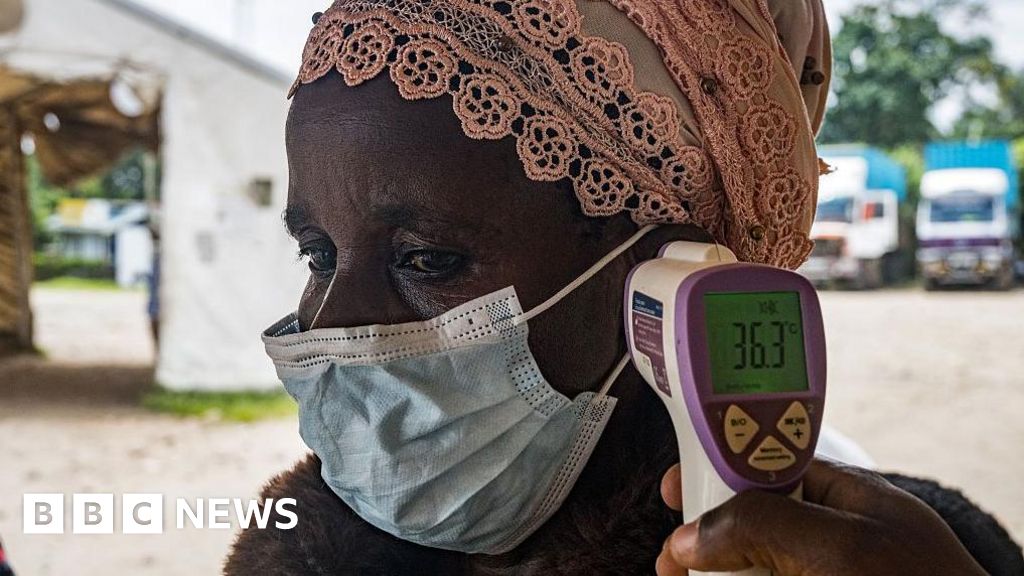
Fear has gripped Ebola-hit areas in eastern Democratic Republic of Congo as the suspected number of deaths continues to rise, as officials say they are struggling to catch up to an outbreak that may have previously been spreading undetected.
"Ebola has tortured us," says a taxi rider in his late twenties in the gold-mining town of Rwampara.
"I am scared because people are dying very fast... We are really afraid."
Following a visit to Ituri province, the epicentre of the outbreak, over the weekend, Congolese Health Minister Dr Samuel Roger Kamba acknowledged health teams are playing catch-up with the virus, which may have been circulating earlier than first detected on 24 April.
The presumed patient zero is a nurse who died in the provincial capital Bunia, but was buried in Mongwalu, also a gold-mining town. Most of the suspected cases and deaths have been reported there and in neighbouring Rwampara.
Rwampara resident Fred Kiza told the BBC that "there is fear", which he calls "normal when there's a disease like this."
"It would be good if they gave us masks to protect ourselves."
As of Tuesday, there were 514 suspected cases, with 136 people believed to have died from the virus, officials said. One person has also died in neighbouring Uganda.
Cases have also been identified in Butembo city and rebel-controlled Goma in North Kivu province, as well as in South Kivu province.
Health officials say that several deaths occurred in the community without being reported to the authorities, meaning they could not be investigated at the time.
According to the health ministry, formal community alerts were only registered from 8 May.
"At community level, this hasn't been effective," Dr Kamba explained. "It means someone may have died before him [the presumed index case], or someone else may have been sick before him, but no one reported it."
He added: "We really need to look within the community to understand what happened - how people became ill and sometimes even died without any report being filed."
A virus hiding in plain sight
The outbreak has been caused by the Bundibugyo strain of Ebola. DR Congo - which is currently facing its 17th outbreak of Ebola - is more familiar with the Zaïre species.
Bundibugyo has caused only two outbreaks before - in 2007 and 2012 - where it killed around 30% of people infected.
Dr Kamba explained the symptoms: "There is heavy bleeding everywhere, very high fever. But Bundibugyo can show fewer obvious signs, which delays diagnosis because people think, 'No, this is just malaria.'"
That delay, officials say, may have allowed the virus to spread silently.
In Mongwalu, some deaths were attributed not to illness, but to witchcraft. The belief became known locally as the "coffin phenomenon" - the idea that anyone who touched the coffin of a deceased person would also die.
International charity Save the Children said the Bundibugyo strain has not been seen in Ituri before. The limited testing that was available in the province was testing for the Zaïre strain and not coming up positive.
"By the time the Bundibugyo strain was detected, it had already spread quite far. We are in a game of catch-up," its DR Congo representative Greg Ramm said in a statement.
Authorities warn that the spread of the virus into large urban centres presents serious challenges.
Despite Dr Kamba's visit to Bunia over the weekend, residents feel that progress to curb the spread of the virus has been slow.
"If there's no treatment centre here in the capital," one resident asked, "then what about other areas?"
Bunia in Ituri, and Butembo and Goma in North Kivu, are home to hundreds of thousands of people, yet none has a fully operational Ebola treatment centre five days into the declaration of the outbreak.
Residents in Goma - eastern DR Congo's biggest city - tell the BBC that basic public health measures, such as avoiding handshakes, limiting gatherings and regular handwashing, are widely ignored.
"I'm heading to the border to report on people stranded there," said José Mutanava, a local journalist. "I'm wearing a face mask, but not many people are."
Another resident, who asked not to be named, said: "Nobody can follow the barrier measures - maybe only when we see more deaths. Today in the city centre I saw only four people wearing masks."
Others say daily survival takes priority.
"It's too much to ask people struggling to eat to follow these rules," one resident said.
Eastern DR Congo is badly hit by conflict, bringing additional difficulties in dealing with the virus.
Save the Children said the Ebola outbreak is a "new massive crisis on top of an already difficult situation".
"It is in an area of conflict, an area of humanitarian crisis, with hundreds of thousands of people displaced, and healthcare systems are already severely compromised," it added.
Currently, four of the affected areas are in Ituri province: Mongwalu, the epicentre of the outbreak, as well as Bunia, Rwampara and Nyakunde.
In North Kivu, Goma is controlled by the M23 rebel group, while the province's second largest city, Butembo, is also affected by militia activity.
The US has announced $13m (£9.7m) in emergency assistance for DR Congo and Uganda and says it is considering further funding through the UN's pooled humanitarian fund, alongside travel restrictions linked to the outbreak.
An American national, Dr Peter Stafford, is among the infected after he tested positive while working at Nyakunde Hospital in Ituri.
The doctor, his wife and another colleague had been treating patients when the outbreak started, Serge, the Christian missionary group they were working for, has said.
According to the US Centers for Disease Control and Prevention (CDC), a US national was evacuated to Germany for treatment, adding that it is working to evacuate at least six other Americans who were exposed.
On Sunday, the World Health Organization (WHO) declared the outbreak a public health emergency of international concern, after confirmed cases were reported on 15 May.
For now, Congolese authorities say they are relying on hard‑learned experience, and public‑health measures, to confront what is now the country's 17th Ebola outbreak.
Go to BBCAfrica.com for more news from the African continent.
Follow us on Twitter @BBCAfrica, on Facebook at BBC Africa or on Instagram at bbcafrica
Facts Only
The Ebola outbreak in eastern DR Congo is caused by the Bundibugyo strain, with 514 suspected cases and 136 deaths reported as of the latest update.
The outbreak was first detected on April 24, but officials suspect it may have been spreading earlier.
The presumed index case is a nurse who died in Bunia and was buried in Mongwalu.
Cases have been reported in Ituri, North Kivu, and South Kivu provinces, including in the cities of Goma and Butembo.
One death has been confirmed in neighboring Uganda.
The Bundibugyo strain has caused only two previous outbreaks, in 2007 and 2012, with a lower fatality rate than the Zaïre strain.
Symptoms of Bundibugyo Ebola include heavy bleeding and high fever, but initial signs can be milder, leading to delays in diagnosis.
Community underreporting and misattribution of deaths to witchcraft have hindered early detection.
No fully operational Ebola treatment centers exist in major urban areas like Bunia, Goma, or Butembo.
The U.S. has pledged $13 million in emergency aid and is considering further funding.
An American doctor working in Nyakunde Hospital has tested positive for Ebola and is being evacuated for treatment.
The WHO declared the outbreak a public health emergency of international concern on May 15.
Eastern DR Congo is already facing conflict and humanitarian crises, complicating the Ebola response.
Executive Summary
Fear is spreading in eastern Democratic Republic of Congo as an Ebola outbreak, caused by the Bundibugyo strain, continues to claim lives. The outbreak, first detected on April 24, may have been circulating undetected earlier, with the presumed index case being a nurse who died in Bunia but was buried in Mongwalu. As of the latest reports, there are 514 suspected cases and 136 deaths, with cases also confirmed in Uganda. The virus has spread to multiple provinces, including Ituri, North Kivu, and South Kivu, with urban centers like Goma and Butembo at high risk due to their large populations and limited healthcare infrastructure. Health officials acknowledge delays in detection and response, partly due to the Bundibugyo strain's milder initial symptoms, which were mistaken for malaria. Community mistrust, conflict, and displacement further complicate containment efforts. International aid, including $13 million from the U.S., is being mobilized, but challenges remain as treatment centers are still not fully operational in key areas.
The situation is exacerbated by local beliefs, such as the "coffin phenomenon," where deaths are attributed to witchcraft rather than illness, leading to underreporting. The WHO has declared the outbreak a public health emergency of international concern, highlighting the urgency of the response. Despite past experience with Ebola, Congo's healthcare system is strained by ongoing conflict and humanitarian crises, making this outbreak particularly difficult to control.
Full Take
The strongest version of this narrative highlights the severe challenges posed by the Ebola outbreak in eastern DR Congo, where a combination of healthcare system weaknesses, conflict, and community mistrust has allowed the virus to spread undetected. The reporting effectively underscores the urgency of the situation, the delays in response, and the international community's efforts to intervene. However, the narrative also reveals deeper patterns of systemic vulnerability—how recurring outbreaks, underfunded healthcare, and societal instability create a perfect storm for disease spread.
One notable pattern is the **ARC-0024 Ambiguity** in the initial detection of the outbreak, where the Bundibugyo strain's milder symptoms led to misdiagnosis as malaria, delaying critical response time. Additionally, the **ARC-0043 Motte-and-Bailey** tactic appears in how local beliefs (e.g., the "coffin phenomenon") are framed as mere superstition, while the broader systemic failures—such as the lack of testing for the Bundibugyo strain—are downplayed. The narrative also risks **ARC-0012 Emotional Exploitation** by emphasizing fear and desperation, which, while real, could overshadow structural solutions.
The root cause of this crisis is not just the virus itself but the chronic underinvestment in Congo's healthcare infrastructure, exacerbated by decades of conflict and displacement. The assumption that international aid alone can resolve the outbreak ignores the need for long-term systemic resilience. The implications are stark: without addressing these underlying issues, future outbreaks will continue to exploit the same vulnerabilities.
Bridge questions to consider:
How might local community engagement strategies be improved to bridge the gap between traditional beliefs and public health measures?
What would it take for Congo's healthcare system to become self-sufficient in detecting and responding to outbreaks without relying solely on external aid?
If this outbreak had been detected earlier, how differently might the response have unfolded?
Counterstrike scan: If this narrative were part of a coordinated influence campaign, the playbook would likely emphasize fear and urgency to justify rapid international intervention, potentially sidelining local agency. However, the actual content aligns more with legitimate public health reporting than manipulation, as it acknowledges systemic failures and does not overly sensationalize the crisis.
Sentinel — Human
The text reads like a human-sourced news report, effectively blending official health data with local cultural context and personal testimony, demonstrating strong journalistic grounding.