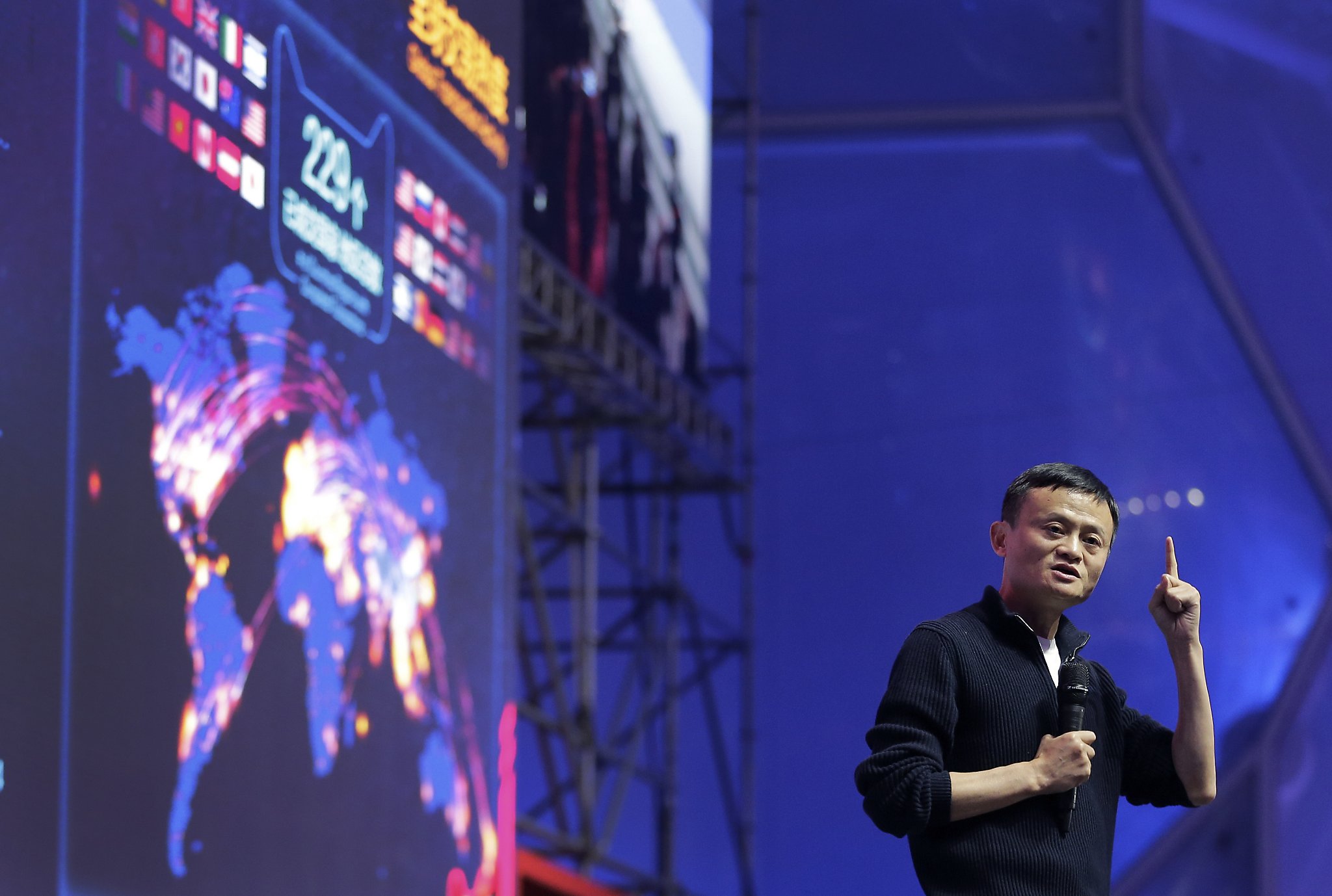
Do you find this unnerving? Slightly terrifying? No big deal? A shuddering and surreal sign that all is not well in the world? Perhaps you should.
I’m talking about Singles Day, of course, AKA "the world's biggest shopping day," as run by that same world's biggest, most powerful e-commerce site: China’s Alibaba.
Think of Singles Day as Black Friday colliding with Cyber Monday in an orgasmic nightmare cataclysm of apoplectic consumerist hysteria, times four. Indeed, Alibaba moved an Earth-shaking $25.3 billion worth of product — up from $16 billion last year — all in one day. (By comparison, Amazon moved just $1 billion in stuff during its last Prime Day, AKA “our biggest day ever.” This year, Alibaba cleared $1 billion in the first two minutes.) That $25 billion, like it matters, is higher than the GDP of Iceland.
Advertisement
Article continues below this ad
At one point, the site was processing 325,000 orders per second. The televised gala celebrating the epic weirdness was directed by the guy who produced the Oscars. Nicole Kidman was there, on stage with Alibaba Group chairman Jack Ma, because of course she was. Pharrell Williams sang a song, most likely “Happy.” The world is very weird.
Everything is staggering, and nothing matters. It is barely possible to imagine the titanic scale of human labor, ingenuity and genius-level technological advancement required to make something like Singles Day happen. What sort of massive logistical miracle is required to shove hundreds of millions of products to tens of millions of people in a 24-hour window? Is this really where we, as the most supremely advanced species on Earth, are directing our most ingenious talents, our most valuable creative resources? So it would appear.
See more S.F. Chronicle on Google
One thing we know: The astonishing audacity of hyper-consumerism has frayed the nerves and shattered the bones of the 21st century. Our staggering addiction to glorious human consumption slams up against everything we appear, as a species, to be doing wrong in the world: massive resource abuse, blinding pollution, unstoppable climate change, massive wealth inequality, shameless Wall Street corruption, furious gun violence, palpable spiritual disconnection, the death of fundamental kindness and, of course, the invention of the vulgar hate-beast known as Trump.
Do we care? We do not care. Or rather, we care a lot, but we do not know what the hell to do about it, and millions feel entirely powerless to stop it, as we merely await what feels like an inevitable and terrible collapse. Meanwhile, shopping!
Advertisement
Article continues below this ad
While Alibaba’s sales on Singles Day were much larger than Amazon’s biggest haul to date, Amazon's chief is still richer. Jeff Bezos boasts a net worth of $94.8 billion, topping Jack Ma's $40 billion. This is not because Bezos (or Jack Ma, for that matter) provide a service that abets and improves the tender and needful soul of the human animal. I mean, obviously.
It is because Bezos brilliantly engorged our sense of pampered entitlement. He commodified laziness. Perhaps more than any single American in modern history, Bezos made it seem totally natural and obvious that you damn well right deserve to get whatever you want, anytime you want, without ever leaving your couch, and never you mind the countless millions of man-hours, massive carbon footprints, cheap factory labor, ridiculous over-packaging and insane technologies required to keep you from ever interacting with anyone other than the stressed-out UPS driver.
In other words, Bezos is a brilliant capitalist, but as well all know, the rich almost never gain their massive wealth through striving to improve humankind. Be not naive. They make it by exploiting it.
His post-Microsoft philanthropy aside, Bill Gates made his fortune swiping an idea from Apple and then forcing hundreds of millions of people to suffer the indignity of Windows, for years and decades. Mark Zuckerberg made his money by preying upon our innate vanity, loneliness, and need for validation. Jack Ma, who has said he's far too busy to spend any of his estimated $43 billion, enjoys deep ties to China's Communist Party, which help him block rival businesses and gain access to China's exploding wealth. Warren Buffet made his billions manipulating the wealth of other people. And of course Trump made his by combining a toxic business reputation with a revolting, grope-happy reality-TV persona.
To some degree and if you’re at all sentient to the true pulse of the world, you already sense the truth: The center cannot hold. There would seem to be no imaginable way Alibaba could haul, say, $40 billion in one day next year, without the world shuddering and angels weeping blood. The karmic stress load feels far too high.
Advertisement
Article continues below this ad
Or does it? It wasn't long ago that all experts agreed that, say, five billion humans was far too many for the Earth to possibly sustain. And here we are, fast rushing to 10 billion (by 2050), with inadequate water and an overheating planet and no way to feed or house most of them.
Guest opinions in Open Forum and Insight are produced by writers with expertise, personal experience or original insights on a subject of interest to our readers. Their views do not necessarily reflect the opinion of The Chronicle editorial board, which is committed to providing a diversity of ideas to our readership.
Of course, if the poor and developing worlds would just learn to order some organic sandwiches from a fleet of Amazon/Whole Foods/Alibaba drones using their iPhone Xs, all would be fine.
Facts Only
Singles Day is an annual shopping event hosted by Alibaba, the world's largest e-commerce platform.
In 2017, Alibaba generated $25.3 billion in sales during Singles Day, up from $16 billion in 2016.
At peak, the site processed 325,000 orders per second.
The event includes a televised gala, with past participants including Nicole Kidman and Pharrell Williams.
Alibaba's Singles Day sales dwarf Amazon's Prime Day, which generated $1 billion in sales.
Jeff Bezos' net worth is $94.8 billion, compared to Jack Ma's $40 billion.
Bezos' wealth is attributed to Amazon's business model, which prioritizes convenience and rapid delivery.
The article mentions Bill Gates, Mark Zuckerberg, Warren Buffett, and Donald Trump as examples of wealthy individuals whose fortunes are tied to controversial business practices.
Global population is projected to reach 10 billion by 2050, raising concerns about resource sustainability.
The event is framed as a symbol of hyper-consumerism, with critiques of its environmental and social impacts.
Executive Summary
Singles Day, orchestrated by Alibaba, has become the world's largest shopping event, surpassing Amazon's Prime Day in scale. In 2017, Alibaba processed $25.3 billion in sales in a single day, up from $16 billion the previous year, with peak order rates reaching 325,000 per second. The event features a televised gala with high-profile celebrities like Nicole Kidman and Pharrell Williams, underscoring its cultural and commercial significance. The article contrasts this hyper-consumerism with broader societal issues, such as climate change, wealth inequality, and ethical concerns about labor and resource exploitation. It also critiques the wealth accumulation of tech billionaires like Jeff Bezos and Jack Ma, suggesting their success stems from exploiting consumer behavior rather than improving humanity. The narrative questions whether such unsustainable consumption can continue without severe consequences, framing it as a symptom of deeper systemic problems.
The piece blends factual reporting with sharp commentary, highlighting the tension between technological progress and its ethical implications. While it acknowledges the logistical marvel of Singles Day, it also critiques the prioritization of consumerism over pressing global challenges. The tone is provocative, urging readers to reflect on the long-term viability of such trends.
Full Take
The strongest version of this narrative is its critique of unchecked consumerism and the ethical implications of tech-driven capitalism. It effectively highlights the staggering scale of Singles Day, using it as a lens to examine broader issues like wealth inequality, environmental degradation, and the exploitation of labor. The piece deserves credit for weaving together data, cultural commentary, and moral questioning to provoke reflection on the priorities of modern society.
However, the analysis leans heavily on emotional exploitation (ARC-0012) and exaggeration to absurdity (ARC-0021). Phrases like "orgasmic nightmare cataclysm of apoplectic consumerist hysteria" and "angels weeping blood" are designed to provoke visceral reactions rather than reasoned debate. The narrative also employs a false binary (ARC-0043) by framing consumerism as inherently destructive without acknowledging its role in economic growth or individual agency. The critique of billionaires like Bezos and Ma, while valid, risks oversimplifying complex systems into a morality tale of exploitation.
Rooted in this narrative is a paradigm of techno-pessimism, where progress is viewed as inherently extractive and unsustainable. The unstated assumption is that consumerism is the primary driver of global crises, rather than one symptom among many. This echoes historical critiques of industrialization and capitalism, where technological advancement is seen as morally corrupting.
The implications for human agency are mixed. On one hand, the piece empowers readers to question the status quo; on the other, it risks fostering fatalism by portraying systemic collapse as inevitable. The costs are borne by workers, the environment, and future generations, while the benefits accrue to a small elite. Second-order consequences include the normalization of extreme consumption as a cultural value and the erosion of trust in institutions that enable it.
Bridge questions: How might consumerism be reformed to align with sustainability without stifling innovation? What alternative models of economic success could challenge the dominance of hyper-consumerism? Would the absence of events like Singles Day address the root causes of inequality and environmental harm, or merely shift the problem elsewhere?
Counterstrike scan: A coordinated influence campaign would amplify the narrative's emotional triggers (e.g., fear of collapse, moral outrage) while suppressing nuanced discussion of solutions. The actual content aligns partially with this pattern but stops short of outright manipulation, as it still invites critical thought. The exaggerated language could be a red flag, but the inclusion of factual data and multiple perspectives mitigates this concern.
Patterns detected: ARC-0012 Emotional Exploitation, ARC-0021 Exaggeration to Absurdity, ARC-0043 False Binary
Sentinel — Human
The provided text shows signs of being written by a human. It demonstrates irregular sentence length variance, a personal voice, and does not show evidence of coordinated synthetic production or talking points appearing verbatim across sources.