Advertisement
1 month, 2 straits, more strikes: how long will the US-Israeli war on Iran last?
With Houthi rebels entering the fray, the next maritime choke point at risk could be the Bab el-Mandeb
4-MIN READ4-MIN
1
Listen
As the US-Israeli war on Iran enters its second month, another major shipping lane is at risk of closure but the chances of a prolonged conflict remain slim, according to Chinese analysts.
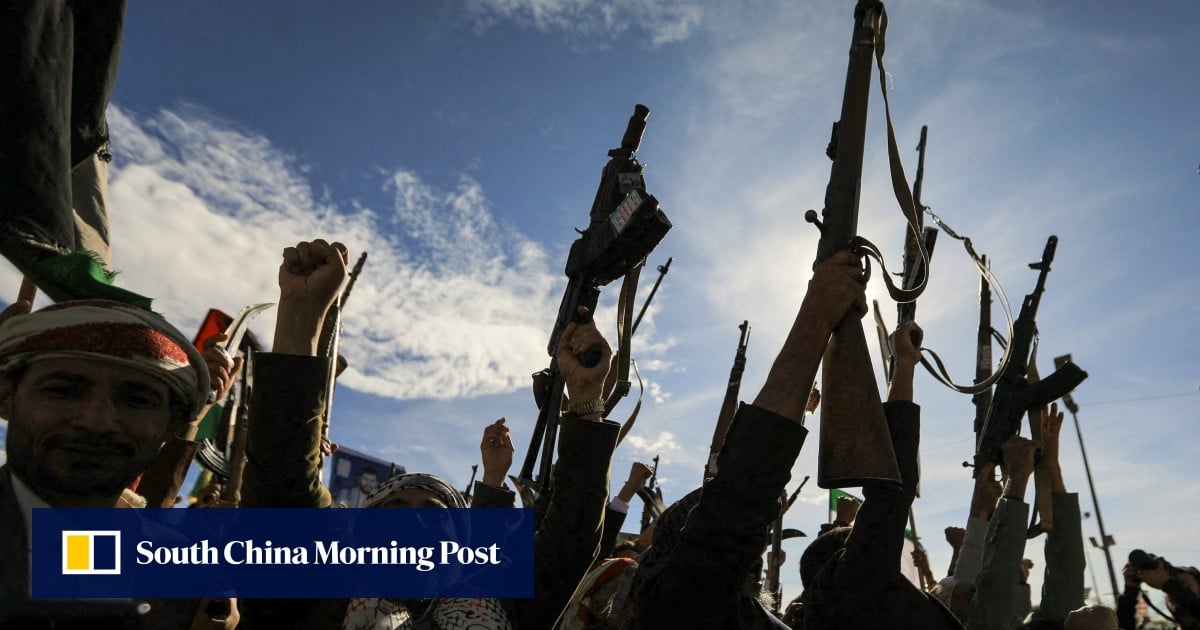
The assessment came on Saturday as Iran-backed Houthi rebels joined the fray by firing missiles at Israel from Yemen. The Israeli military said it intercepted one of the projectiles.
Chinese state news agency Xinhua quoted a Houthi source as saying the missile attack was meant “as a warning”.
Advertisement
The Houthis operate in the northern part of the Bab el-Mandeb Strait, a key part of the shortest sea route for Eurasian commodity and energy trade.
The rebels have previously attacked merchant ships in the Red Sea and analysts said that obstruction of this route could lead to another rise in oil prices, which have already soared above US$100 a barrel.
Advertisement
Jodie Wen, a scholar from the Centre for International Security and Strategy (CISS) at Tsinghua University, said that blocking the strait would have dire consequences for the world economy.
Advertisement
Select Voice
Select Speed
1.00x
Facts Only
The US-Israeli conflict with Iran has lasted over one month.
Houthi rebels, backed by Iran, fired missiles at Israel from Yemen.
Israel intercepted one of the missiles launched by the Houthis.
A Houthi source described the missile attack as "a warning."
The Houthis operate in the northern part of the Bab el-Mandeb Strait.
The Bab el-Mandeb Strait is a key route for Eurasian commodity and energy trade.
The Houthis have previously attacked merchant ships in the Red Sea.
Oil prices have surpassed US$100 per barrel.
Jodie Wen, a scholar from Tsinghua University’s Centre for International Security and Strategy, stated that blocking the strait would severely impact the global economy.
Chinese analysts assess that a prolonged conflict is unlikely.
Executive Summary
Full Take
The narrative presents a clear escalation in the US-Israeli conflict with Iran, now drawing in the Houthis as a proxy force. The strongest version of this story highlights legitimate concerns about maritime security and economic stability, given the strategic importance of the Bab el-Mandeb Strait. The inclusion of Chinese analysts provides a counterbalance to Western-centric perspectives, emphasizing the global stakes of the conflict.
However, the framing leans toward a "domino effect" pattern, where regional tensions are portrayed as inevitably spiraling into broader economic disruption. This could amplify fear appeals (ARC-0012) by focusing on worst-case scenarios—oil price spikes, strait closures—without proportional emphasis on de-escalation mechanisms or diplomatic efforts. The article also subtly reinforces a binary framing (ARC-0024) by presenting the conflict as a US-Israeli vs. Iran axis, with the Houthis as mere extensions of Iranian influence, potentially oversimplifying local Yemeni dynamics.
Root cause assumptions include the idea that proxy conflicts are primarily driven by great-power competition, with little agency attributed to non-state actors like the Houthis. This echoes Cold War-era proxy wars, where local grievances were often subsumed under superpower rivalries. The implications for human agency are significant: civilians in Yemen and the broader region bear the brunt of economic disruptions, while global markets react to perceived instability. The beneficiaries of this narrative may include actors seeking to justify military buildups or energy market speculation.
Bridge questions: How might local Yemeni interests diverge from Iran’s strategic goals? What diplomatic channels exist to prevent strait closures, and why aren’t they more visible in this coverage? Would evidence of successful de-escalation change the assessment of prolonged conflict being "unlikely"?
Counterstrike scan: A coordinated influence campaign would likely exaggerate the risk of strait closures to stoke market panic or justify military interventions. While the article acknowledges uncertainty, it doesn’t actively counterbalance the escalatory framing with alternative scenarios. The content doesn’t fully match a hypothetical attack playbook, but the emphasis on economic doom could be exploited by bad actors seeking to manipulate energy markets or public opinion.
Patterns detected: ARC-0012 Fear Appeals, ARC-0024 False Binary