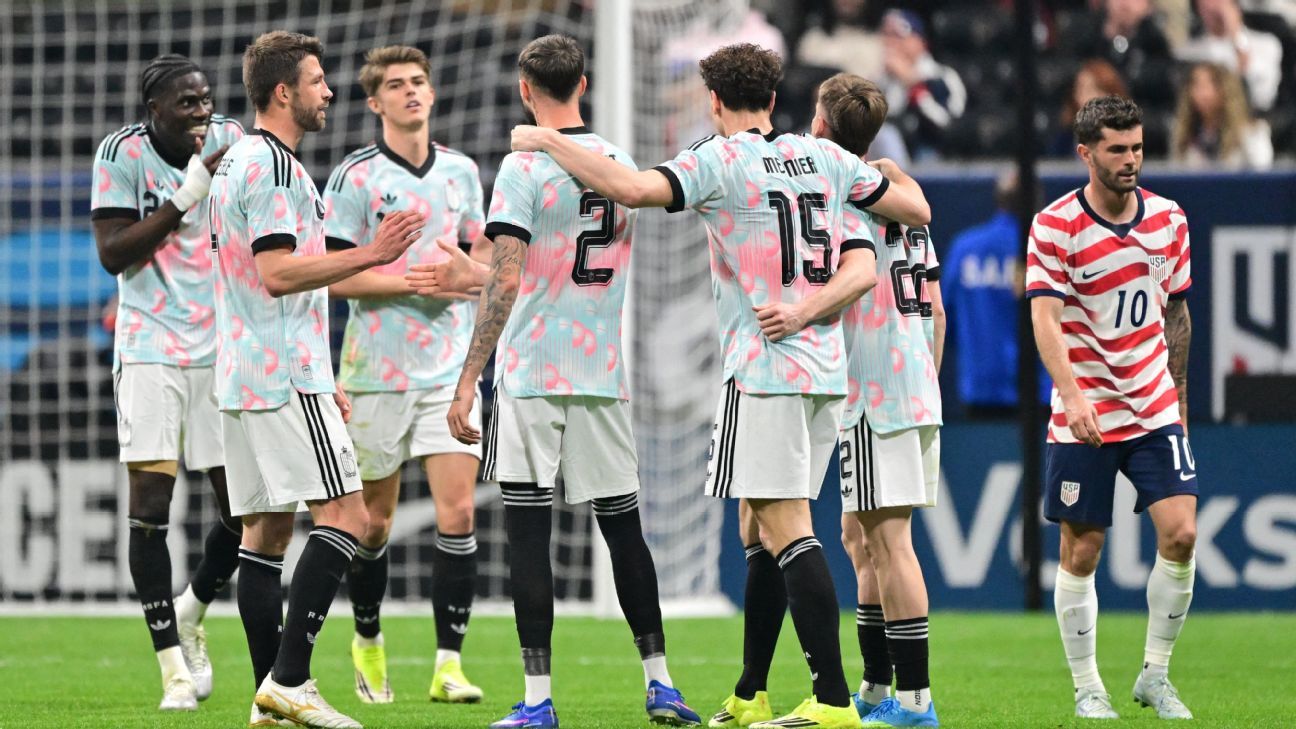
The United States men's national team suffered what coach Mauricio Pochettino described as a "reality check" in its preparations for the World Cup as Belgium ran rampant in the second half to emerge emphatic 5-2 winners at Atlanta's Mercedes-Benz Stadium on Saturday.
Weston McKennie rewarded the U.S. for an impressive start with the opening goal in the 39th minute as he turned in an Antonee Robinson corner at the back post for his 12th international goal and first in three years.
- Pulisic, U.S. 'shocked' by Belgium jersey clash
- USMNT handed reality check by Doku, Belgium ahead of World Cup
- Player ratings: Weah poor as USMNT suffer heavy Belgium defeat
But Zeno Debast scored a long-range equalizer for Belgium on the stroke of halftime and the No. 9-ranked visitors scored three more times in a 15-minute spell in the second half to expose some defensive vulnerabilities for Mauricio Pochettino's side.
Amadou Onana's strike was added to by a penalty from Charles De Ketelaere, after a handball by U.S. captain Tim Ream, before Dodi Lukebakio scored the pick of the goals, with a curling effort into the top corner of Matt Turner's net.
Lukebakio added his second and Belgium's fifth in the 82nd minute to prompt early exits from some among the largely pro-American crowd of 66,867 before substitute Patrick Agyemang scored a late consolation for the U.S.
The result snapped a five-game unbeaten streak for the U.S., which was tied for the best run of Pochettino's tenure.
While acknowledging it was a chastening result for his side, Pochettino insisted that there was no need to panic just over two months before the World Cup begins.
"I think it's the last thing to be concerned about the World Cup," he said at a news conference. "It's more about analyzing the game.
"I think that of course 5-2 is always difficult to accept. It's painful, but at the same time I think we need to take so many positive things. The first half was really good. I think we really play better than Belgium.
"I think we create chances to finish the 45 minutes in a positive way, but we concede in the last action of the first half and then there was an impact. And it's true that after the second half, it really was difficult for us."
Belgium extended its unbeaten streak to 10 games and has won six straight against the U.S. since losing to the Americans at the initial World Cup in 1930.
The USMNT will now look to regain some momentum against another leading European opponent when facing off with Portugal back in Atlanta on Tuesday. That will be the final game for Pochettino to assess his players before naming his roster for the World Cup at the end of May.
The U.S., which is co-hosting the tournament alongside Canada and Mexico, opens its World Cup campaign against Paraguay on June 12 in Inglewood, California.
"It's a good reality check for us," Pochettino said of Saturday's result ahead of more meaningful challenges to come.
And he insisted he had no regrets about scheduling tuneups against two leading international sides.
"I think we need competitive games to arrive to the World Cup in our best," he said. "I think we can arrive with the wrong idea that we are so good, we are so handsome, we are so well-dressed and we are Americans.
"And it's good to feel that, but if we want to win the World Cup, if we want to go next to the next station in the group and we want to beat Paraguay, do you think that they are not going to fight?"
Injuries to Sergiño Dest, Chris Richards and Miles Robinson left the 15th-ranked U.S. short-handed in defense, while midfielder Tyler Adams was also unavailable. As a result, Tim Weah started at right back and was handed a tough afternoon by Belgium's Manchester City winger Jérémy Doku.
It was also a frustrating afternoon for Turner, the former No. 1 American goalkeeper who made his first appearance since last June. Left back Antonee Robinson was making his first appearance since Nov. 18, 2024, because of injury.
Belgium was missing striker Romelu Lukaku, midfielders Leandro Trossard and Hans Vanaken and goalkeeper Thibaut Courtois because of injuries and fitness issues. The Red Devils play Mexico in Chicago on Tuesday.
ESPN's Jeff Carlisle and The Associated Press contributed to this report.
Facts Only
The United States men's national team lost 5-2 to Belgium in a World Cup preparation match on Saturday at Mercedes-Benz Stadium in Atlanta.
Weston McKennie scored the opening goal for the U.S. in the 39th minute, his 12th international goal.
Zeno Debast equalized for Belgium in the 45th minute with a long-range shot.
Belgium scored four more goals in the second half: Amadou Onana (52nd minute), Charles De Ketelaere (penalty, 58th minute), Dodi Lukebakio (62nd and 82nd minutes).
Patrick Agyemang scored a late consolation goal for the U.S. in the 89th minute.
The match drew a crowd of 66,867, largely supportive of the U.S.
The loss ended the U.S.'s five-game unbeaten streak under coach Mauricio Pochettino.
Belgium extended its unbeaten streak to 10 games and has won six consecutive matches against the U.S. since 1930.
The U.S. played without injured defenders Sergiño Dest, Chris Richards, and Miles Robinson, as well as midfielder Tyler Adams.
Tim Weah started at right back, and Matt Turner made his first appearance since June 2023.
Belgium was missing Romelu Lukaku, Leandro Trossard, Hans Vanaken, and Thibaut Courtois due to injuries or fitness issues.
The U.S. will face Portugal in another preparation match on Tuesday in Atlanta before finalizing its World Cup roster.
The U.S. opens its World Cup campaign against Paraguay on June 12 in Inglewood, California.
Executive Summary
The United States men's national soccer team suffered a 5-2 defeat to Belgium in a World Cup preparation match at Atlanta's Mercedes-Benz Stadium. Weston McKennie opened the scoring for the U.S. in the 39th minute, but Belgium equalized just before halftime through Zeno Debast and dominated the second half with four more goals, including two from Dodi Lukebakio. The loss ended the U.S.'s five-game unbeaten streak under coach Mauricio Pochettino, who described the result as a "reality check" but emphasized the need to analyze the game rather than panic ahead of the World Cup. Belgium, ranked 9th in the world, extended its unbeaten run to 10 games and has won six straight against the U.S. since 1930. The U.S. will face Portugal in another tune-up match before finalizing its World Cup roster. Injuries to key defenders and midfielders left the U.S. shorthanded, while Belgium also played without several starters due to injuries and fitness issues.
Pochettino defended the decision to schedule high-level opponents, arguing that competitive matches are necessary to prepare for the World Cup. He acknowledged defensive vulnerabilities exposed by Belgium but highlighted positive aspects of the first half. The U.S. co-hosts the World Cup with Canada and Mexico and opens its campaign against Paraguay on June 12. The match drew a largely pro-American crowd of 66,867, though some fans left early as Belgium extended its lead. The result underscores the challenges the U.S. faces as it prepares for the tournament, with Pochettino stressing the importance of learning from the defeat rather than overreacting.
Full Take
This match serves as a microcosm of the broader challenges facing the U.S. men's national team as it prepares for a World Cup on home soil. The strongest version of this narrative is that the U.S. was outclassed by a superior Belgian side in the second half, exposing defensive frailties that must be addressed before the tournament. Pochettino’s framing of the result as a "reality check" is credible—high-level opposition reveals gaps that weaker opponents might not. The U.S. showed promise in the first half, but the collapse after halftime suggests mental fragility under pressure, a pattern that could be exploited by elite teams in the World Cup.
However, the narrative also carries subtle manipulation risks. The emphasis on the U.S. being "shocked" by Belgium’s intensity (as hinted in the subheadings) could be interpreted as emotional exploitation, framing the loss as a moral failing rather than a tactical one. The repeated mention of injuries and missing players for both teams might serve as a preemptive excuse, softening the blow of the defeat. The focus on the pro-American crowd leaving early could also be a form of emotional framing, amplifying the sense of disappointment.
The root cause here is the tension between preparation and expectation. The U.S. is co-hosting the World Cup, raising hopes, but the team’s recent performances suggest it is still a tier below Europe’s elite. The assumption that home-field advantage will compensate for technical deficiencies is untested. Historically, host nations often struggle when their squads lack depth, and the U.S. is no exception.
The implications for human agency are significant. For players, this defeat could either galvanize improvement or erode confidence. For fans, it’s a reminder that progress in soccer is nonlinear. The second-order consequences include potential roster changes, tactical adjustments, and heightened scrutiny on Pochettino’s leadership. Who benefits? Belgium gains confidence; the U.S. gains clarity on its weaknesses. Who bears the cost? The players’ morale and the fans’ optimism.
Bridge questions: How much should injuries excuse poor defensive organization? Would a different opponent have produced a different psychological response? What would it take for the U.S. to close the gap with teams like Belgium in the next four years?
Counterstrike scan: If this were part of a coordinated influence campaign, the playbook would involve amplifying the U.S.’s vulnerabilities to undermine confidence ahead of the World Cup, while simultaneously downplaying Belgium’s missing stars to make the loss seem more damning. However, the actual content does not match this pattern. The reporting is straightforward, acknowledging both the U.S.’s struggles and Belgium’s quality without overt distortion.
Patterns detected: none
Sentinel — Human
While the article shows slight signs of human authorship, it is likely to be human-written. The presence of personal voice and idiosyncratic emphasis, along with inconsistent sentence length variance, indicate a human journalist's work.