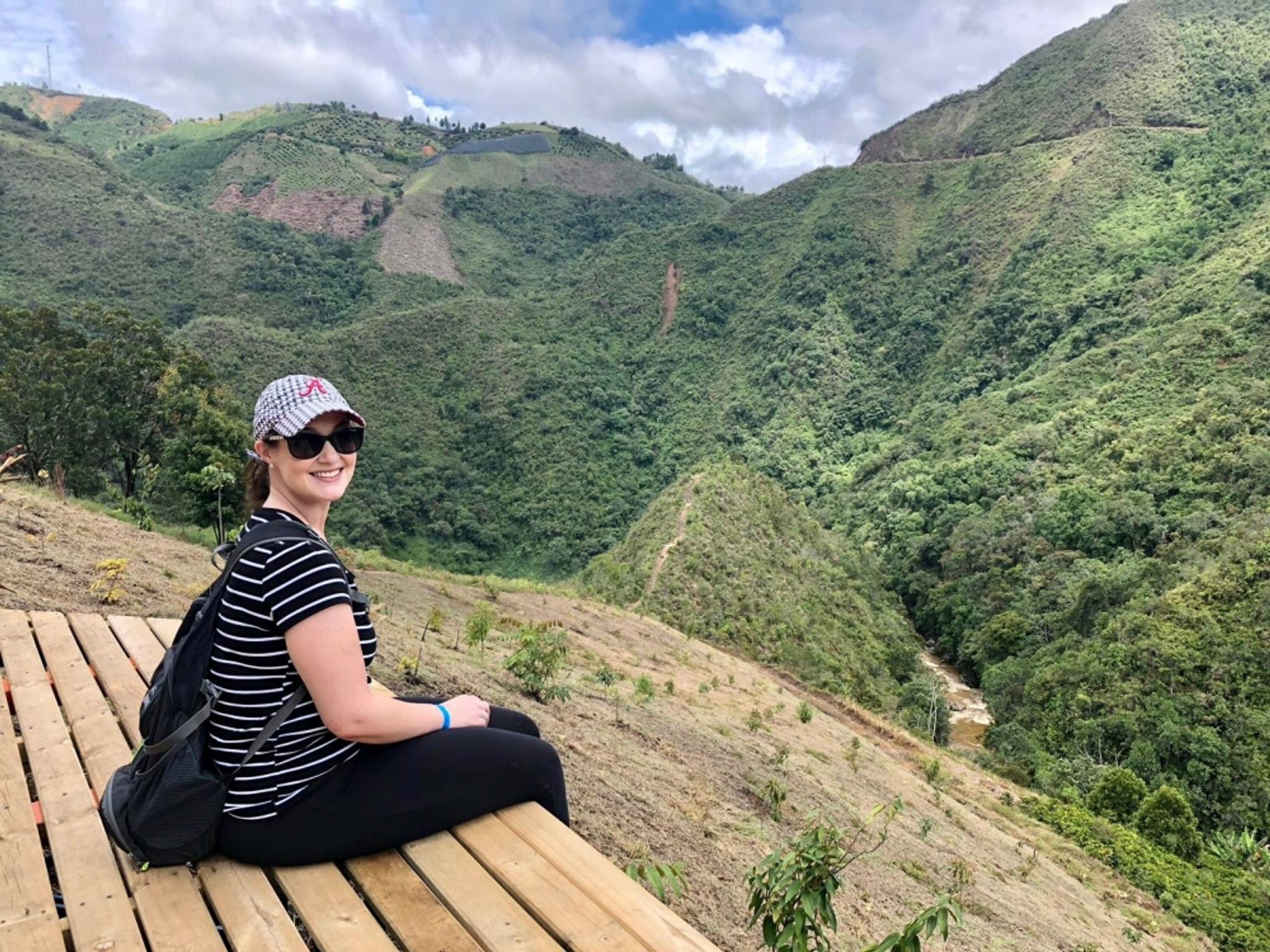
Medellín, Colombia – Following their complaint filed earlier this month before the Inter-American Commission on Human Rights (IACHR), the family of Kelly Knight, a U.S. citizen who was found dead in Medellín in 2019, spoke to Latin America Reports about what the complaint describes as “impunity in the alleged femicide” of their daughter by the “Colombian State.”
On July 19, 2019, 34-year-old Knight was found dead in her apartment in Medellín. According to the complaint, since her marriage to an unnamed man in 2018, Knight was the alleged victim of a pattern of sustained spousal abuse, including an episode on the night before her death.
Lawyers representing the family say that on July 18, while staying with her husband at a hotel in the town of Doradal a few hours outside of Medellín, hotel staff “alerted police after they reported hearing screams.” The complaint said police were “unresponsive” and Knight was later “dragged across the asphalt by her husband, according to documented conversations between the victim and her friend.”
Upon authorities finding her deceased in her Medellín apartment the next day – “under circumstances that to this day remain unclear” – the complaint alleges that a preliminary investigation was opened in 2019 on suspicion of femicide but the case has since gone “stagnant” with no formal charges or arrests made.
Warning signs that went unaddressed
The family’s complaint accuses Colombia of failing to “prevent, investigate, and determine responsibility for the alleged femicide.” The family considers Knight’s husband a principal suspect as well.
“She was close to leaving at the time she was killed, very close. We found a letter in her apartment, in the trash can, telling [her husband] exactly that. And I don’t know if he had wadded it up and thrown it away; I’m not completely sure. We just found it in the trash can, and we turned it in to the investigators,” Ray Knight, her father, told Latin America Reports.
“She told us every time something happened,” he added. “She wanted to come home multiple times.”
Lawyers for Knight’s family say that despite the severity of reported incidents of abuse, Colombian authorities failed to provide “protective measures, psychosocial support, adequate threat assessment against her, or timely investigations into these events until after she died.”
“There were various signs that made the authorities aware of what was going on,” Ignacio Javier Álvarez Martínez, Executive Director of IHR LEGAL, a law firm representing the family, told Latin America Reports. “They could have done something about it, and they didn’t.”
A bungled crime scene
By the time authorities began investigating Knight’s death, key elements of the crime scene had already been compromised, the family’s attorneys said.
“Kelly’s body was moved. No video of the crime scene was taken,” Mariana Hernandez, another lawyer for the family, told Latin America Reports.
“The bedding was destroyed, and her clothes were given back to the main person of interest [the husband],” she added.
Her family also described what they saw as a chaotic and unprofessional crime scene inside the apartment.
“They failed to cordon off the area. It was full of people while authorities were inside,” her mother, Lee Knight, told Latin America Reports.
Some of the most critical forensic evidence was also compromised, they said.
“They mishandled important blood samples,” said Álvarez, noting that the limited amount collected was used in ways that prevented further testing abroad.
“[Her husband] told us he threw the bedding away,” said Knight’s father. “He said it was dirty.”
The family also told Latin America Reports that a representative from the legal team attempting to retrieve Knight’s belongings after the murder was violently confronted by Knight’s husband. No charges were filed in that alleged incident, they said.
Attorneys for the family argue that the alleged failures at the crime scene weakened the investigation and may have permanently undermined any ability to determine what happened to Knight.
Latin America Reports contacted the Prosecutor’s Office and Medellín Mayor’s Office for comment on the case but have not received a response at time of publication.
IHR Legal, the law firm representing the family, said that Colombia has yet to issue an official response to the compliant because the IACHR has not yet officially present the State with the complaint – a process that can take several months.
Knight’s parents also lamented being shut out from information surrounding the investigation into their daughter’s death.
“We had no direct communication with the prosecutor or the medical examiner,” her father said. “We were not consulted on anything.”
Knight’s mother said authorities told them that they couldn’t share findings in the case.
“They said they couldn’t report anything to us,” she said. “We were the parents—we just wanted to know what happened to our daughter.”
Femicides in Colombia
Kelly Knight’s case is not an isolated incident. In recent months, multiple cases of gender-based killings across Colombia have drawn attention to persistent gaps in prevention and accountability, with advocates warning that impunity remains a defining feature in many investigations.
In just the first three months of 2025, over 5,300 women were reported to be victims of intrafamiliar violence, and over 3,800 women were reported victims of sexual violence, most of which were children or teenagers.
A 2024 study by Colombia’s National Institute of Legal Medicine and Forensic Sciences, found that sexism and violence against women are spurred by an enduring patriarchal society in Colombia, where women are positioned as the “self-sacrificing mother” or “submissive wife”, while men are positioned with dominance and strength.
Moreover, the study also demonstrated that the hypersexualization of women, the glorification of “strong” and “dominant” men, and the narrative of traditional gender roles reinforce the patterns that are replicated in society.
In the case of Kelly Knight, the lawyers argue that her husband’s testimony was prioritized over the victim’s family’s.
“His narrative is repeated multiple times in the case file,” said Hernández.
According to the attorneys, the husband’s version of events included claims that Knight struggled with substance abuse and instability, assertions she says were not supported by evidence.
“He said she was ‘crazy’ or a ‘drug addict,’ and there is no evidence of that,” Hernández added.
Despite this, the lawyer argues, authorities relied heavily on his account in building the case since he was the principal witness, yet disregarded the female’s family side of the story.
“They based their investigation on what he told them,” she said. “There is a lack of gender perspective in both the police and the prosecutor’s office.”
What comes next for the Knight family?
After six years, the Knight family, unsatisfied with how the investigation is proceeding in Colombia, filed a formal complaint with the IACHR on March 2, 2026.
Under international law, victims are typically required to exhaust domestic legal remedies before seeking redress from international judicial bodies. But exceptions apply when investigations are subject to prolonged delays or fail to produce meaningful progress.
“After a reasonable period without meaningful progress, you don’t have to wait,” Álvarez, the attorney, said.
The Commission must now determine whether to admit the case and formally notify the Colombian state, which then has an opportunity to respond.
“Part of filing the case is to push the state to do something about it,” Álvarez said, adding that the proceedings could compel local authorities to move the investigation forward.
Beyond the individual case, he said, the implications could be broader. “This case could be paradigmatic for Colombia and the region.”
For Knight’s parents, however, the objective remains unchanged.
“We will try every available avenue to find out what happened,” her father said. “We will get to the bottom of this if we can.”
Featured image: Kelly Knight.
Image credit: Online obituary for Kelly Knight
Facts Only
Who: Kelly Knight (victim), unnamed husband (suspect), Medellín authorities, IHR LEGAL (law firm representing the family)
What: Alleged femicide, sustained spousal abuse, compromised crime scene investigation, impunity in investigations
When: July 18 and 19, 2019; March 2, 2026 (filing of formal complaint with the IACHR)
Where: Medellín, Doradal (Colombia)
Executive Summary
Full Take
The case of Kelly Knight highlights the persistent issue of gender-based violence and impunity in Colombia. The family's allegations point to potential failures by Colombian authorities to investigate reports of abuse, provide protective measures, and ensure an unbiased investigation into the victim's death. The compromised crime scene suggests possible structural issues within the investigative process. The prioritization of the husband's testimony over the victim's family's account raises questions about gender bias in Colombian law enforcement.
Patterns detected: ARC-0024 Ambiguity (the article provides multiple perspectives without clearly stating the author's position), ARC-0043 Motte-and-Bailey (the family's allegations of gender bias are presented as facts, while authorities are given the opportunity to respond).
The case serves as a catalyst for discussion on the need for improved investigative processes in gender-based violence cases, the role of gender bias within law enforcement, and the effectiveness of international bodies such as the IACHR in addressing such issues.
Bridge questions: What measures can be taken to prevent impunity in gender-based violence cases? How can gender bias within law enforcement be addressed and reduced? What role should international bodies play in enforcing accountability for such crimes?
Sentinel — Human
The article appears to be written by a human journalist. The text exhibits signs of human-like sentence length variance, contains idiosyncratic emphasis and personal voice, and provides detailed descriptions of the family's experiences and emotions.