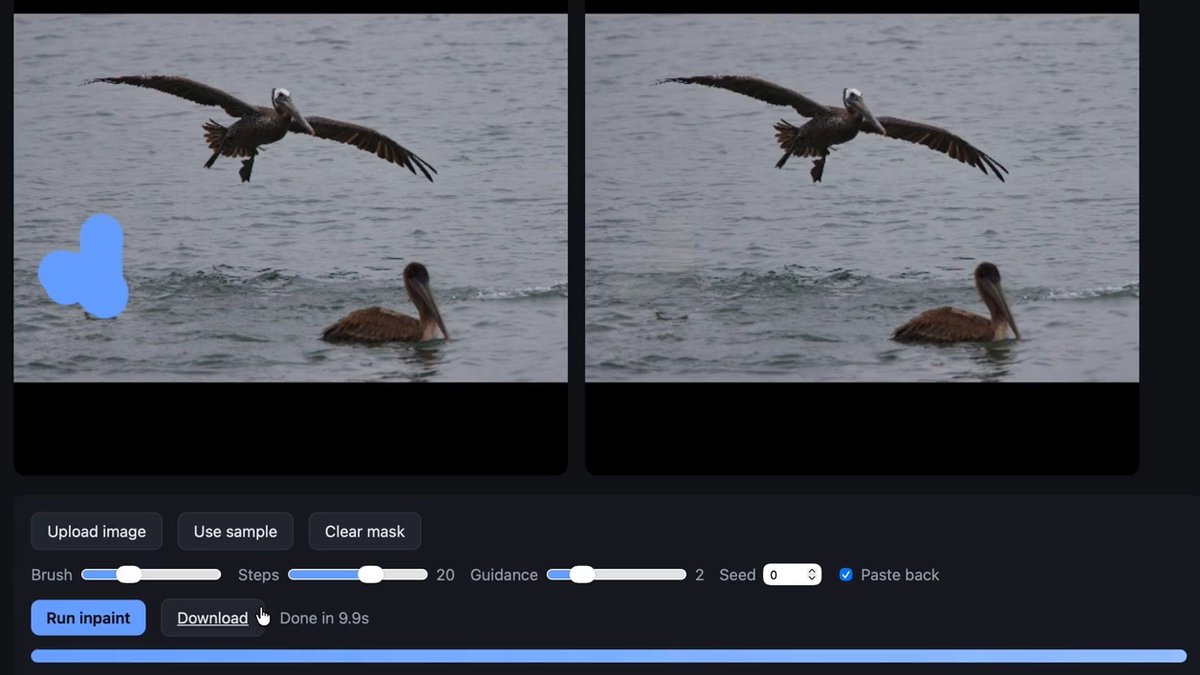
[Simon Willison] ported the Moebuis 0.2B image inpainting model to run locally in a web browser. The web tool simply requires a user to provide an image, mark a section of it to be removed, and the model will do it’s best to patch up the missing area. The project was handled by Claude Code as an experiment in how things in the AI coding world have evolved, but more on that in a moment.
The existence of this tool shows that it’s possible for this kind of image editing to be done on the client side, running entirely locally with no reliance on remote services or server-side GPU resources. The online demo (GitHub repository here) is available if you want to try it out, but be warned it triggers a 1.27 gigabyte download of the required model on the first run.
What’s also interesting is [Simon]’s write-up, because he used the project as an opportunity to learn what has changed in the realm of AI coding agents. [Simon] is a software developer but in this project he didn’t personally write any of the code. One may think that means he didn’t learn anything other than how to use the tools, but that’s not quite true.
He learned it’s possible to convert a PyTorch-based model to ONXX, that the converted model can run in supported browsers using local WebGPU acceleration, and that the CacheStorage API will work on large files. Last but not least, he learned Claude Opus 4.8 is capable of handling such a project pretty much autonomously, and even created an informative document explaining the underlying architecture.
One may consider AI coding agents to be disasters waiting to happen, but it’s also true that the landscape is changing quickly, and write-ups like [Simon]’s give a helpful peek at those developments.
So… it does what Photoshop already had like 10 years ago, maybe more. Meh.
That was pretty much my exact thought. Yes, it’s impressive that it can be done automatically. I have to wonder if this is a result of the problem being so thoroughly documented as to be regurgitation or not. I also wonder how many tokens that burned.
Facts Only
* Simon Willison ported the Moebuis 0.2B image inpainting model to run locally in a web browser.
* The tool requires a user to provide an image and mark a section for removal, which the model then patches.
* The execution allows for client-side operation without reliance on remote services or server-side GPU resources.
* The online demo triggers a 1.27 gigabyte download of the required model on the first run.
* The process involved learning how to convert a PyTorch-based model to ONNX.
* The converted model runs in supported browsers using local WebGPU acceleration.
* The CacheStorage API functions on large files.
* Claude Opus 4.8 was capable of autonomously handling the project and creating an explanatory document.
Executive Summary
Full Take
Sentinel — Human
The text reads as reflective commentary on a technical development, blending specific facts with personal skepticism, strongly suggesting human authorship.