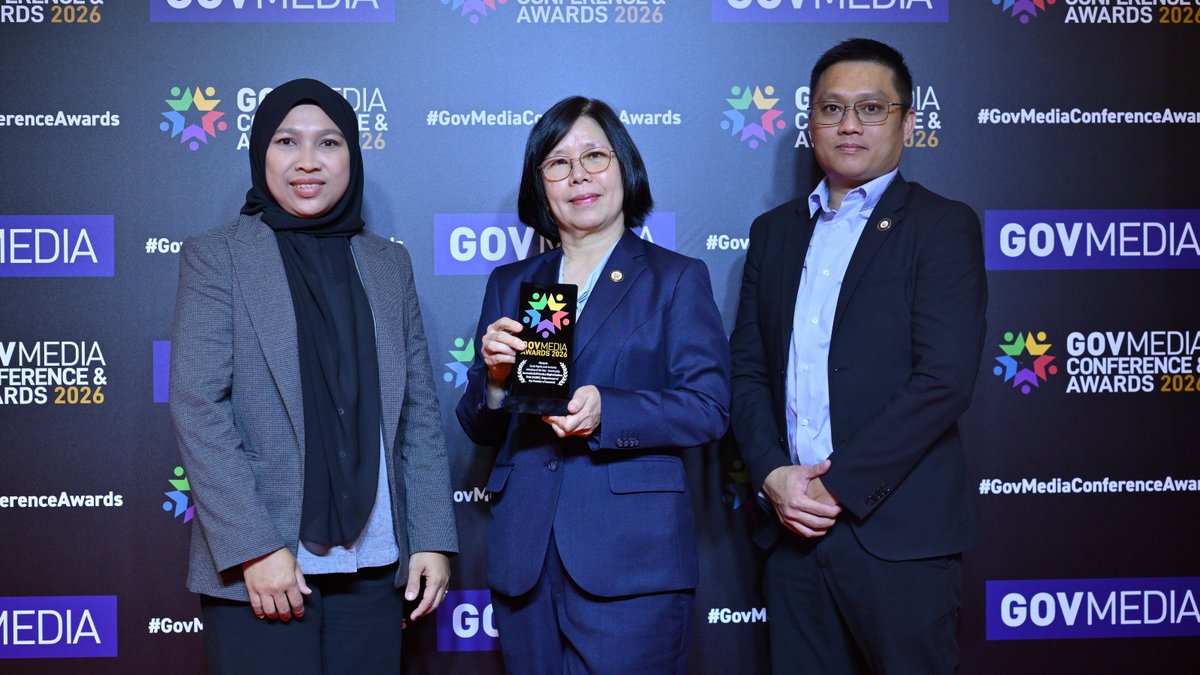
KUCHING (July 10): The Sarawak Civil Service Digitalisation Unit (SCSDU), under the Department of the Premier of Sarawak, has won the Malaysia Social Equity and Inclusion Initiative of the Year – Community category at the GovMedia Conference & Awards 2026 in Singapore.
The award recognised SCSDU’s Service Sarawak initiative, titled “One Government at Your Service – Bridging Communities through Inclusive Digital Transformation”, which integrates multiple government services into a single access point through physical, digital, and mobile channels.
Receiving the award was SCSDU director Datu Grace Huong Siew Hung, who was invited to participate in a panel discussion held in conjunction with the conference at the Marina Bay Sands Expo and Convention Centre in Singapore on Thursday (July 9).
SCSDU said the Service Sarawak initiative was developed as part of the Sarawak Civil Service Digital Transformation Journey to improve access to government services across the state’s vast geographical landscape, particularly for rural and remote communities.
It said citizens previously had to travel long distances and visit multiple agencies to complete government transactions, but Service Sarawak has streamlined these processes by providing a single gateway that caters to different user preferences and levels of digital access.
The initiative has benefited both rural and urban communities by reducing travel time, lowering associated costs, and improving service efficiency.
SCSDU said service counters operating under a client charter have reduced waiting times, with overall service delivery time shortened by up to 75 per cent.
To date, Service Sarawak has served more than 3.4 million customers and facilitated over 5.5 million transactions, generating total collections of RM6.1 billion across all service channels.
Customer satisfaction has also remained above 97 per cent over the past three years, reflecting the platform’s consistent service delivery performance.
As of May this year, Service Sarawak has expanded its presence across Kuching, Serian, Sri Aman, Betong, Sarikei, Sibu, Miri, and Lawas, improving access to government services in both urban and rural areas.
SCSDU said it will continue expanding service coverage, improving kiosk and mobile application interfaces, strengthening customer experience management, and integrating more government services to ensure that no one is left behind.
The initiative supports Sarawak’s Post Covid-19 Development Strategy 2030, particularly its emphasis on social inclusivity, while also contributing towards the United Nations Sustainable Development Goal 10 on reducing inequalities.
The GovMedia Conference & Awards is a Singapore-based regional awards programme that recognises outstanding public sector initiatives across the Asia-Pacific in government innovation, service delivery, and digital transformation.
Speaking at the panel discussion, Huong shared Sarawak’s digital transformation journey, strategic initiatives, and best practices with government and industry leaders from across the region.
Facts Only
* The Sarawak Civil Service Digitalisation Unit (SCSDU) won an award at the GovMedia Conference & Awards 2026 in Singapore for the Malaysia Social Equity and Inclusion Initiative of the Year – Community category.
* The recognized initiative is Service Sarawak, titled “One Government at Your Service – Bridging Communities through Inclusive Digital Transformation.”
* Service Sarawak integrates multiple government services into a single access point using physical, digital, and mobile channels.
* The initiative was developed as part of the Sarawak Civil Service Digital Transformation Journey.
* Service Sarawak aimed to improve access to government services in Sarawak's geographical landscape, particularly for rural and remote communities.
* The initiative streamlined processes by providing a single gateway for government transactions.
* Service counters operating under a client charter reduced overall service delivery time by up to 75 per cent.
* Service Sarawak has served more than 3.4 million customers and facilitated over 5.5 million transactions, collecting RM6.1 billion.
* Customer satisfaction remained above 97 per cent over the past three years.
* Service Sarawak expanded coverage to Kuching, Serian, Sri Aman, Betong, Sarikei, Sibu, Miri, and Lawas as of May this year.
Executive Summary
Full Take
The narrative positions digital transformation not merely as an efficiency gain but as a mechanism for addressing historical spatial inequalities in governance, directly linking operational success to broader social inclusion goals like the UN SDG 10. The measurable success—a 75% reduction in waiting times and high customer satisfaction figures—provides a strong factual anchor, yet the story risks settling into a pattern where high performance is presented as an inevitable outcome of digitalization rather than a deliberate structural choice prioritizing marginalized communities. The expansion across disparate regions demonstrates commitment to geographical equity, but it raises questions about whether this localized benefit translates into equitable quality or opportunity for all user segments within those areas. The integration of diverse channels (physical, digital, mobile) suggests a strategic attempt to overcome existing access barriers; the true implication lies in whether the architecture of the "single gateway" genuinely serves the most digitally marginalized populations, or if it merely reconfigures existing travel burdens into digital friction for those with limited digital literacy or infrastructure. Furthermore, while the growth metrics are impressive, focusing solely on transactional volume and satisfaction requires scrutiny regarding what constitutes a truly inclusive service experience beyond efficiency gains. The pattern suggests that successful public sector innovation often successfully quantifies efficiency (the 'what') but may obscure the ongoing work required to ensure deep social equity in implementation (the 'why' and 'how deep').
BRIDGE QUESTIONS:
How does the framework for "inclusive digital transformation" explicitly account for varying levels of digital literacy and infrastructure across the newly expanded regions? What metrics are being used to assess whether the reduction in travel time translates into tangible socio-economic uplift for rural vs. urban communities? What mechanisms are in place to ensure continuous expansion and interface improvement do not inadvertently create new forms of exclusion based on technological access?
Sentinel — Human
This text reads as a factual news report detailing an award win and the specifics of a government digital transformation initiative, exhibiting strong coherence with source-based reporting.