Business
Contractor Chosen for $1.3B Pork Processing Facility in South Dakota
The 1.1-million-sq-ft plant is planned to replace another facility in downtown Sioux Falls that is 117 years old
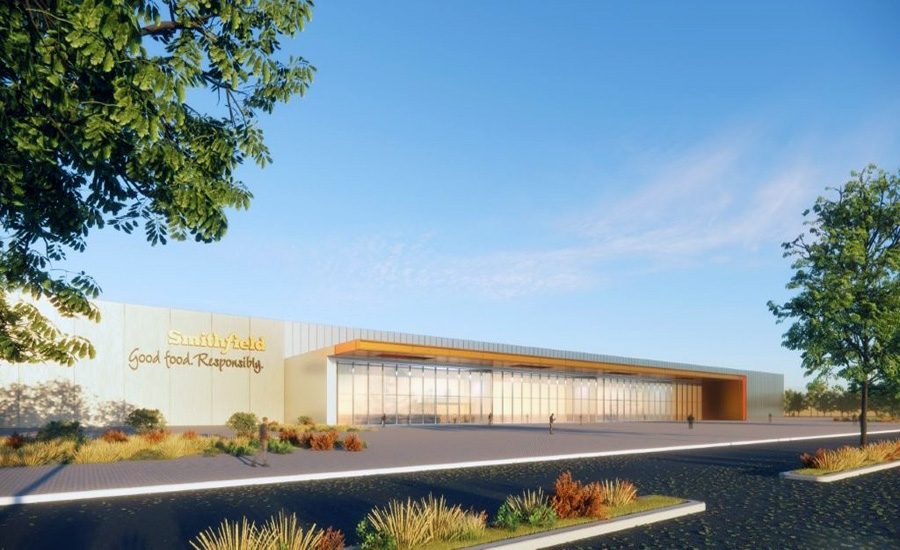
Smithfield Foods Inc. has selected Chicago-based Epstein as design-build contractor for a $1.3-billion packaged meat and fresh pork processing facility it plans to build in Sioux Falls, S.D., a 1.1-million-sq-ft project that the state calls the largest business investment in its history.
The new facility is planned for Foundation Park, a more than 1,000-acre heavy industrial park in northwest Sioux Falls, with the plant planned to replace Smithfield’s downtown factory that has operated for more than 100 years.
“The new facility will be the most modern of its kind in the U.S., featuring advanced automation technology and information systems,” said Shane Smith, Smithfield Foods president and CEO, at a press conference announcing the project.
Site work began last spring. A groundbreaking is expected for the roughly 211-acre site in the first half of 2027 and production would begin at the end of 2028.
“Our current facility in Sioux Falls is more than 100 years old,” said Smithfield spokesperson Ray Atkinson. “While we have invested in and enhanced the plant, it’s time to build a new facility from the ground up with advanced technology and a design that supports a streamlined, highly efficient processing flow.”
Smithfield project engineer Mark Wilhelm told the Sioux Falls City Council at a March meeting that the company’s goal is to minimize odors, control processes and support cleaner air.
Sioux Falls has approved a conditional use permit and $90 million in tax increment financing to offset the cost of building a new wastewater treatment plant to support the new location.
Sioux Falls Mayor Paul TenHaken said at the announcement that the city "could have easily lost this plant. We don’t want to just take for granted that it was assumed that Smithfield would stay here."
A group of 21 people in Minnehaha County, where most of Sioux Falls is located, is suing the city, alleging that it rushed the conditional use permit and did not adequately study potential traffic and odor impacts. They also fear their property values will decrease.
Smithfield's move to a new location is also spurred by philanthropist T. Denny Sanford, who founded PREMIER Bankcard and has committed $50 million through the Sioux Falls Area Community Foundation to enable purchase of the current Smithfield property once the new facility is complete.
Plans for redevelopment in the area, to be called The Sanford District, are not yet available, although the foundation promises a thorough master-planning process with community input. It is currently establishing a task force to study best practices and case studies of large, significant redevelopment areas.
Smithfield Foods processes more than 28 million hogs each year from 10,000 hog farms located in 30 states. It currently employs 3,200 people in Sioux Falls and accounts for $200 million in payroll annually, the company said.
The project is still subject to various approvals, Atkinson said.
Sentinel — Human
This content exhibits the structural complexity and specific attribution typical of human journalistic reporting on complex business and municipal developments.