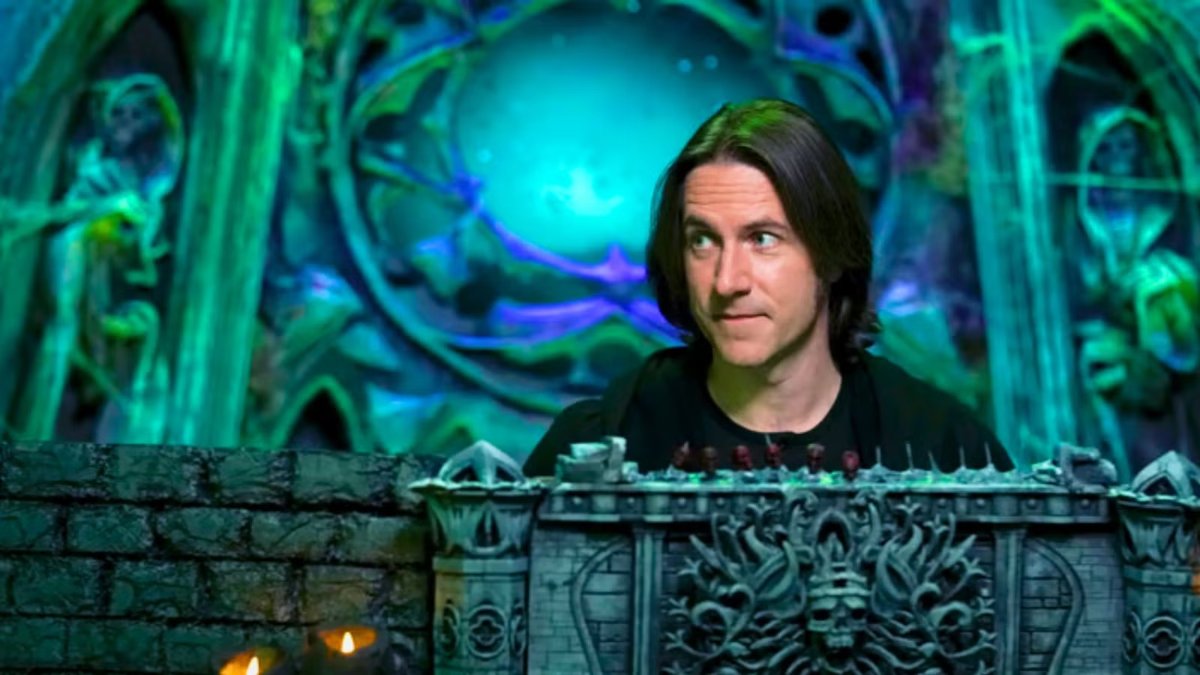
Months after its first announcement in May, Critical Role’s gothic and foreboding Age of Umbra: Sallowlands has arrived — and it’s just as creepy as we expected.
Coming shortly on the heels of Campaign 4, Sallowlands' arrival has felt like a breath of fresh air. Not only do we get to explore a new setting (The Halcyon Domain) with fresh faces like Baldur’s Gate 3’s Jennifer English and House of the Dragon star Abubakar Salim, but we also got a rather poignant reminder: TTRPG fans need to stop sleeping on Daggerheart in favor of Dungeons & Dragons.
It’s fair to say that Geek & Sundry’s 2015 broadcast of Critical Role’s Campaign 1: Vox Machina played a key role in introducing many people to Wizards of the Coast’s tabletop role-playing game, with some critics noting that Critical Role’s campaigns have helped bring D&D into mainstream culture. With popular voice actor Matthew Mercer as the Dungeon Master and other fan-favorite actors like Ashley Johnson and Laura Bailey as players, their adventures in Exandria’s fantasy world likely inspired viewers — some of whom had never heard of the dungeon-exploring game before — to try it themselves.
I was introduced to D&D through a friend’s love for Critical Role, even though I wasn't watching the actual play series at the time. Years later, despite having played a few other RPGs, such as Fantasy Flight Games' Star Wars and Possum Creek Games’ Wanderhome, D&D is still my TTRPG of choice.
Yet, after watching the first episode of Sallowlands, it’s clear that Critical Role and Darrington Press’s Daggerheart is a force to be reckoned with. This isn’t just D&D with a new coat of paint. Daggerheart delivers a fresh and spirited take on decades-old systems, mechanics, and features. Furthermore, it’s laser-focused on storytelling rather than lingering overtly long on stats and numbers.
From the moment we’re first introduced to the creeptastic characters of Sallowlands, the Daggerheart system — and the cast’s expert acting — is quick to differentiate each of them, both narratively and mechanically. Sister’s (Laura Bailey) use of magic as a hedge witch is vastly different from what Caguama (Vico Ortiz) can do as a seraph, with the latter focusing more on healing and diplomacy versus the former’s wily use of hexes. Even the more melee-focused characters, such as Dillwyn (English), Mercy (Salim) and Alphonse (Zachery Renauldo), are distinct in their classes and abilities, highlighting their unique roles within the narrative as a ranger, brawler, and blood hunter, respectively.
All of this isn’t all that different from D&D, though if we compare this to Critical Role’s Campaign 4, the distinctions between classes and their roles within the narrative structure aren’t as clear as they are with Sallowlands. However, that is to be expected with a 13-player cast versus Sallowland’s five.
One of the biggest differences between Critical Role’s D&D campaigns and their Daggerheart series, and what has me excited for the rest of Sallowlands, is the Hope and Fear mechanic. Instead of rolling D20s as in D&D, Daggerheart uses two D12s, one representing Hope and the other Fear. Players take the higher of the two dice, but there’s a catch — if they roll higher on the Hope die, they get a Hope point that can be used as a resource to spend on abilities or even to aid other players. However, if the Fear die is higher, that Fear goes to the Game Master, which can be used to trigger a number of nasty complications. They can be used to negatively influence the story directly, trigger various environmental effects, or even boost a monster’s abilities.
With the Hope and Fear system, both GMs and players can accumulate resources as pressure builds on either side. We see this beautifully in Mercy, whose high Hope rolls allow him to aid his allies multiple times throughout the premiere episode, like when he helps Dillwyn navigate the forest and later helps Alphonse take a shot from his weapon during combat. D&D also lets players aid one another with the Help action, but it doesn’t quite match the narrative flavor or tension of earning that help by rolling high on your Hope die, as Daggerheart does.
Brennan Lee Mulligan, DM of Critical Role Campaign 4, does attempt to add that level of pressure through the introduction of luck rolls, as well as a system where if players roll one on their d8s during urgent scenes or missions, the dice will downgrade from a d6 to a d4, and each roll of one will trigger a severe consequence. While not exactly the same as Hope and Fear, the homebrewed rule conveys the same narrative momentum for both players and the GM as the Daggerheart mechanic.
Furthermore, that same narrative drive is further enhanced when our adventurers find themselves in combat during Sallowlands. Unlike D&D, where players roll initiative and follow a rigid turn order, Daggerheart’s combat operates like a spotlight. It’ll either shine on the GM or the players, meaning players can pick and choose when to go. There's nothing more frustrating in D&D than having a big plan for a devastating move on your next turn, only for another player to suddenly end the battle right before you're supposed to go. Then, when your turn comes, you have to scramble to pivot to something else. As you desperately search for your next move, the flow of combat grinds to a halt. In Daggerheart, you go when you feel like it’s the best time, and while that may seem like a nightmare for introverted players, the Daggerheart guide includes alternative rules that adjust this so no player can take their turn more than three times before everyone else has had a go.
It’s this level of momentum that keeps combat exciting for viewers: you never know when a player is going to go, nor whether they’ll roll with Hope or Fear. That’s another gnarly feature — if you roll with Fear or fail a roll during combat, then the spotlight moves onto the GM. This helps establish a rhythm, one that dispels the concept of turn order and time, allowing players and the GM to simply be in the moment and enjoy the story they’re telling — even if that story is about how you brutally rip a man in two.
This isn’t the first time that Critical Role has played with its Daggerheart system; it’s done so in its previous Age of Umbra miniseries, as well as in one-shots at live shows with its Campaign 1-3 characters. But with Sallowlands coming out shortly after Critical Role has taken a break from Campaign 4, it’s a new opportunity to highlight the differences between the two systems and, as it did for me, entice new players who prefer a more flexible, creative game with a stronger narrative focus than D&D offers.
Age of Umbra: Sallowland premiered on July 9 on Twitch, YouTube, and Beacon.tv at 7 p.m. PDT. If you didn’t catch the episode live, don’t worry — Critical Role posts the episode to YouTube the following Monday at 3 p.m. EDT/12 p.m. PDT.
Facts Only
* Critical Role released Age of Umbra: Sallowlands months after its May announcement.
* The new setting is The Halcyon Domain.
* New faces include Jennifer English (Baldur’s Gate 3) and Abubakar Salim (House of the Dragon).
* The article references Critical Role’s Campaign 1: Vox Machina as an introduction to Dungeons & Dragons.
* Daggerheart delivers a take on older systems focusing on storytelling over stats.
* Daggerheart uses two D12s for Hope and Fear mechanics, where players choose the higher result or trigger consequences based on which die is higher.
* Combat in Daggerheart functions as a spotlight, allowing players to choose when to act rather than following rigid turn orders like in D&D.
* The system incorporates luck rolls with potential severe consequences during urgent scenes in Daggerheart.
* Age of Umbra: Sallowlands premiered on July 9 on Twitch, YouTube, and Beacon.tv.
Executive Summary
Full Take
Sentinel — Human
LIKELY_HUMAN (confidence: 0.15)