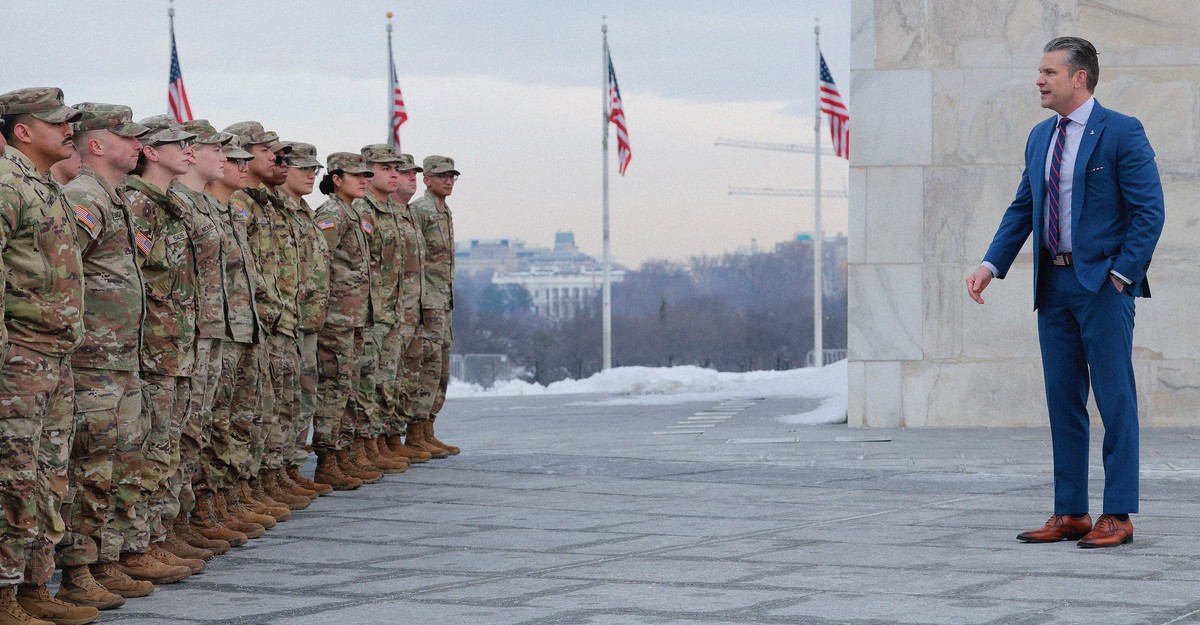
“Color-blind and merit-based” now seems to be anything but.
Service in wartime has long been a reliable path for Americans denied full citizenship to secure their rights. Black troops’ contributions to the Union cause during the Civil War helped convince Abraham Lincoln of the righteousness of extending suffrage to Black men. Women’s work on the home front during World War I persuaded a reluctant Woodrow Wilson to urge passage of the Nineteenth Amendment as a “war measure.” The military’s repeal of Don’t Ask, Don’t Tell was followed a few years later by the Supreme Court’s recognition of the marriage rights of same-sex couples.
Perhaps the Trump administration is hoping the process works just as well in reverse.
Despite the conflict with Iran and other recent military activity overseas, the Pentagon seems focused on purging minorities and women. Last week, NBC News reported that Defense Secretary Pete Hegseth had intervened to block or delay the promotions of more than a dozen Black and female senior officers. According to both NBC and The New York Times, some officials are concerned that officers are being targeted because of their race, gender, or perceived political affiliation. In one instance last year, Hegseth’s chief of staff, Ricky Buria, bluntly stated that “President Trump would not want to stand next to a Black female officer at military events,” the Times reported. (Buria denied this.)
The Pentagon told NBC and the Times that promotions under Hegseth are “apolitical and unbiased.” Nevertheless, the episode is part of a broader pattern. So far, Trump and Hegseth have dismissed or forced the retirements of several high-ranking Black and/or female officers: General C. Q. Brown as chairman of the Joint Chiefs of Staff; Admiral Lisa Franchetti as chief of naval operations; Lieutenant General Telita Crosland as head of the Defense Health Agency; and most recently Major General William Green as the Army’s chief of chaplains. Hegseth has publicly said that “our diversity is our strength” is the “dumbest phrase in military history.” By erasing Defense Department histories of nonwhite service members, and seeking to restore tributes to Confederate soldiers who took up arms against their country in defense of slavery, Hegseth has demonstrated a limited view of whose service is to be honored.
Trump is likely also seeking to ensure that remaining officers lack any qualms about following potentially illegal orders. Both he and Hegseth have long seen war crimes as worthy of admiration rather than scorn. As far back as 2016, Trump was regaling audiences at rallies with apocryphal stories about an American general shooting Muslims with bullets coated in pig’s blood. In 2020, he fantasized about turning the military’s guns on American citizens, but faced opposition from the leadership at the Pentagon. Yesterday morning, Trump publicly threatened to destroy Iran’s “whole civilization” and target civilian infrastructure, both war crimes. He subsequently backed down, handing Iran the ability to charge tolls for ships passing through the Strait of Hormuz; passage was free prior to the American attack.
Enlisted service members are disproportionately nonwhite compared with the U.S. population as a whole, while officers are disproportionately white. Women are also serving in larger numbers than ever before: About a fifth of active-duty military personnel are women. Yet Hegseth has long been dismissive of women’s service, particularly in combat roles, and once wrote that, under leaders like Brown, “black troops, at all levels, will be promoted simply based on their race” (this is called confession by accusation). Hegseth seems to want the pool of high-ranking officers to be even less diverse than it already is, having complained in his book that “America’s white sons and daughters are walking away” from the military. And he and Trump seem to be purging not only women and people of color, but officers who see them as equally capable—such as the Army chief of staff, General Randy George, who was fired after reportedly refusing to remove several Black and female officials from the promotion list to general.
Hegseth infamously claimed at the beginning of his tenure that promotions in the military would be “color-blind and merit-based.” It is now clear that this was not true. During his confirmation hearing, Hegseth was unable to provide any evidence whatsoever that the military had lowered standards in the name of diversity. If that is the case, then why have we seen so many well-qualified Black and female senior officers dismissed? Why did the Pentagon, for no plausible reason other than animus, expel trans service members after years of honorable service? “Color-blind and merit-based” now appears to have been a smoke screen for a politically motivated purge of not only Black people and women from leadership positions, but white officers who value their service.
The message being sent to lower-ranking officers is that they will be assessed on the basis of their gender, race, or politics, rather than their abilities—which will cause many officers to leave rather than stay and be mistreated, and many potential officers not to enlist to begin with. It is hard to deny the full benefits of citizenship to those who are willing to fight and die for their country; it is easier if that sacrifice is minimized or erased. Rewarding or punishing officers based on race, gender, or perceived political loyalty to Trump could also aid the administration’s larger project of undermining the claims of women and ethnic and religious minorities to equal treatment under the law in other parts of American society.
The progress earned by ethnic minorities and women in the armed services was hard-won. During the Civil War, Frederick Douglass argued that Black men’s service in the Union Army would strengthen their demands for equal rights. “Let the black man get upon his person the brass letters U.S.; let him get an eagle on his button, and a musket on his shoulder, and bullets in his pocket, and there is no power on the earth or under the earth which can deny that he has earned the right of citizenship in the United States,” Douglass said in 1863. “Nothing can be more plain, nothing more certain, than that the speediest and best possible way open to us to manhood, equal rights, and elevation is that we enter this service.”
Douglass was right, although the process was not as straightforward as he might have hoped. Black service helped justify the passage of the Reconstruction Amendments, but Reconstruction saw Black men disenfranchised and subjected to Jim Crow segregation. W. E. B. Du Bois made a similar argument for Black service in World War I. Returning Black veterans were subjected to horrific racist violence that ultimately strengthened Black resolve. Only after World War II—and over the objections of much of the brass—was the military integrated, and then only after an exhaustive internal investigation disproved racist assumptions that Black troops could only fill menial roles or serve in segregated units.
“Insofar as a service refused to a single Negro the technical training and job for which he was qualified, by just so much did the service waste potential skills and impair its own effectiveness. Quite apart from the question of equal opportunity, the Committee did not believe the country or the military services could afford this human wastage,” the final report from the Truman-era President’s Committee on Equality of Treatment and Opportunity in the Armed Services reads. “The Committee found, in fact, that inequality had contributed to inefficiency.”
Another way to put it is that overt racial discrimination and stereotyping made the military worse, not better. But that was before Hegseth, and his insistence that the problem with the armed services is that they are too diverse and too “woke.”
The result has been something like an inverse caricature of Republican complaints about diversity, equity, and inclusion, a system in which the incompetent rise not because of their abilities but because of their sycophancy. Authoritarian regimes behave as the Trump administration is behaving—optimizing for political loyalty rather than competence. Merit, in short, has little to do with it.
Hegseth is a prime example. Deeply unqualified for the job and convinced that brutality provides an easy path to victory, he has led the United States to the verge of a strategic defeat with a weaker adversary in Iran. The current cease-fire leaves Iran with a more hard-line government than before, one in total control of a shipping lane crucial to the world economy. The Islamic Republic is arguably in a stronger position today than it was when the war started, and probably in a stronger position than it was before Trump, in his first term, scrapped the Obama-era nuclear deal.
On Sunday, Trump posted on his social network a refrain that he and his toadies seem to think is insightful: “If you import The Third World, you become The Third World!” This archaic social Darwinism is the ideological mortar of the Trump project. It fuses Hegseth’s disdain for diversity in the military’s senior leadership and valorization of brutality with the administration’s attack on birthright citizenship and its deployment of federal agents to occupy American cities. It is a worldview that would assume an easy victory against a country like Iran, especially with America’s new, “unwoke” military. Bigotry isn’t just inefficient, as the U.S. military discovered in the 1940s. It also makes you stupid.
Facts Only
Defense Secretary Pete Hegseth has intervened to block or delay promotions of more than a dozen Black and female senior officers.
NBC News and The New York Times reported concerns from officials that officers are being targeted based on race, gender, or perceived political affiliation.
Hegseth’s chief of staff, Ricky Buria, allegedly stated that "President Trump would not want to stand next to a Black female officer at military events," though Buria denied this.
The Pentagon has dismissed or forced the retirements of several high-ranking Black and/or female officers, including General C. Q. Brown, Admiral Lisa Franchetti, Lieutenant General Telita Crosland, and Major General William Green.
Hegseth has publicly criticized the phrase "our diversity is our strength," calling it the "dumbest phrase in military history."
Hegseth has sought to erase Defense Department histories of nonwhite service members and restore tributes to Confederate soldiers.
Trump has previously praised war crimes, including apocryphal stories about a general using pig’s blood-coated bullets and threatening to target civilian infrastructure in Iran.
Enlisted service members are disproportionately nonwhite compared to the U.S. population, while officers are disproportionately white.
About 20% of active-duty military personnel are women.
Hegseth has dismissed women’s service in combat roles and claimed that Black troops are promoted "simply based on their race."
The Army chief of staff, General Randy George, was fired after reportedly refusing to remove Black and female officials from promotion lists.
The Pentagon has expelled transgender service members after years of honorable service.
Trump posted on his social network: "If you import The Third World, you become The Third World."
Executive Summary
The article examines allegations that Defense Secretary Pete Hegseth and the Trump administration are systematically removing Black and female senior officers from military leadership positions, despite claims of "color-blind and merit-based" promotions. Reports from NBC News and The New York Times suggest that Hegseth has blocked or delayed promotions of over a dozen officers, with some officials expressing concerns about racial, gender, or political bias. Notable dismissals include General C. Q. Brown, Admiral Lisa Franchetti, and Major General William Green. Hegseth has publicly criticized diversity initiatives, calling the phrase "our diversity is our strength" the "dumbest in military history," and has sought to erase histories of nonwhite service members while restoring tributes to Confederate soldiers. The article also highlights Trump’s history of praising war crimes and threatening illegal military actions, raising concerns about the administration’s broader agenda to undermine equal treatment under the law. The military’s progress in integrating women and minorities is framed as hard-won but now under threat, with potential long-term consequences for recruitment, morale, and national security.
The narrative presents a tension between the military’s stated commitment to meritocracy and the alleged politicization of promotions. While the Pentagon denies bias, the pattern of dismissals and Hegseth’s public statements suggest a deliberate shift toward a less diverse leadership. The article contrasts this with historical examples where military service by marginalized groups advanced civil rights, such as Black troops in the Civil War and women’s contributions in World War I. It argues that the current administration’s actions could weaken the military’s effectiveness and reinforce systemic discrimination, echoing past failures where bigotry undermined operational efficiency. The broader implications include potential erosion of trust in military institutions and a return to exclusionary practices that historically harmed both service members and national interests.
Full Take
The strongest version of this narrative is that the Trump administration, through Defense Secretary Pete Hegseth, is systematically purging Black and female officers from military leadership under the guise of "merit-based" promotions, while simultaneously undermining the military’s hard-won progress on diversity and inclusion. The article effectively documents a pattern of dismissals, public statements, and policy shifts that suggest a deliberate rollback of equity initiatives. It also ties this to broader authoritarian tendencies, such as Trump’s admiration for war crimes and his threats of illegal military actions, framing the military’s leadership purge as part of a larger project to centralize power and suppress dissent. The historical context provided—linking military integration to civil rights advances—lends weight to the argument that this reversal could have far-reaching consequences for both the military and society.
However, the narrative leans heavily on emotional exploitation (ARC-0003) and moral panic (ARC-0018), particularly in its framing of Hegseth’s actions as a return to segregationist policies. While the facts presented are concerning, the article risks overstating the immediacy and coordination of these efforts without definitive proof of a centralized directive. The use of phrases like "resegregate the military" and comparisons to Confederate apologia may inflame rather than inform, potentially obscuring the nuanced ways in which institutional bias operates. Additionally, the article assumes a direct causal link between diversity and military effectiveness, which, while supported by historical examples, is presented as an unassailable truth rather than a debated principle.
The root cause appears to be a clash between two paradigms: one that views diversity as a strategic asset and another that sees it as a threat to cohesion and loyalty. The latter paradigm, embodied by Hegseth and Trump, assumes that homogeneity and unquestioning obedience are prerequisites for military strength—a belief that echoes mid-20th-century segregationist arguments later disproven by the military’s own studies. The unstated assumption here is that meritocracy and diversity are incompatible, a false binary (ARC-0024) that ignores how systemic biases have historically shaped perceptions of "merit."
The implications for human agency are profound. If promotions are indeed being politicized, the message to service members is that their careers depend on allegiance to a specific ideological agenda rather than competence. This could deter talented individuals from enlisting or remaining in service, particularly women and minorities who have historically used military service as a path to full citizenship. The second-order consequences include a potential brain drain from the military, weakened institutional trust, and a reinforcement of hierarchical structures that prioritize loyalty over capability.
Bridge questions:
1. How might the military’s internal culture respond to these allegations—will rank-and-file service members push back, or will the purges create a chilling effect on dissent?
2. What evidence would be required to conclusively prove that these dismissals are part of a coordinated effort rather than isolated incidents?
3. How do other nations with diverse militaries balance meritocracy and representation, and what lessons might the U.S. learn from their approaches?
Counterstrike scan: If this narrative were part of a coordinated influence campaign, the playbook would involve amplifying isolated incidents into a systemic crisis, using emotionally charged language to polarize audiences, and framing opponents as either "woke" or "authoritarian" with no middle ground. The actual content aligns with this pattern in its selective emphasis on the most inflammatory statements and actions, though it stops short of fabricating evidence. The risk is that readers may dismiss the legitimate concerns raised due to the article’s rhetorical excesses. A more measured approach would acknowledge the complexity of military promotions while still holding leadership accountable for transparency and fairness.
Patterns detected: ARC-0003 Emotional Exploitation, ARC-0018 Moral Panic, ARC-0024 False Binary
Sentinel — Human
The analysis suggests the article is likely human-written, displaying passion, historical context, and a unique voice that are not typically associated with synthetic content.