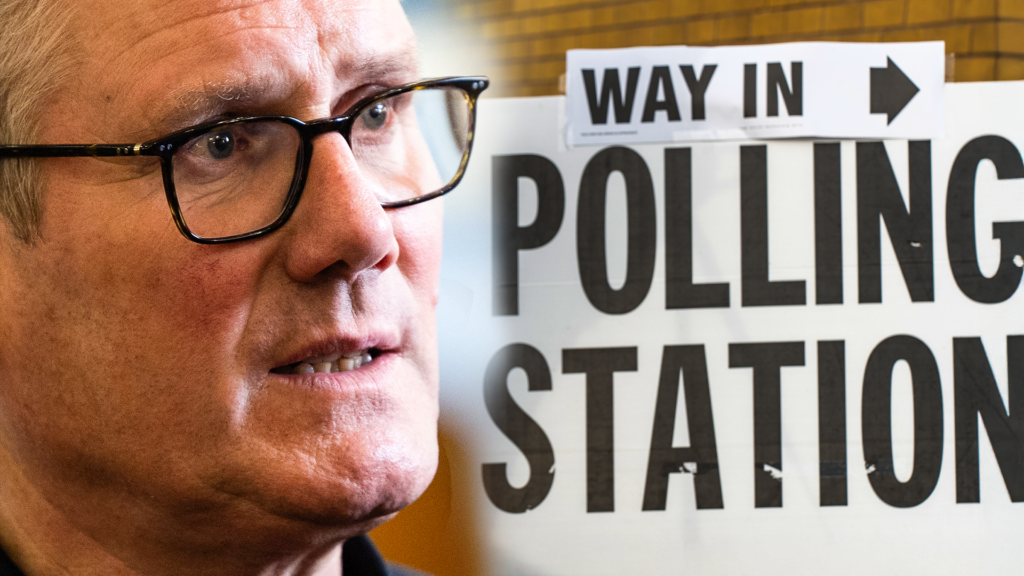
Labour and the Tories both suffered huge blows. Is a political realignment underway?
On Thursday, almost half of the United Kingdom was given the opportunity to vote in local elections. Usually, little attention is paid to local elections, whose winners are largely responsible for planning applications and trash collection. But British politics is far from usual at the moment.
Voters across England went to the polls to elect over 5,000 councillors in 136 local authorities. At the same time, six directly elected mayors will be chosen, as well as the Scottish and Welsh devolved parliaments. While these election results do not directly affect the British government, they are widely seen as a key test for all political parties and the biggest test for Prime Minister Keir Starmer since the 2024 parliamentary elections.
With the majority of the local council results in, it is clear that Starmer's Labour Party has had its support implode. At the time of writing, the party has lost over 900 council seats and lost control of almost 30 councils, including Westminster and Essex. The Conservative Party has also been dealt a blow, losing control of six councils and over 400 seats.
Nigel Farage's Reform U.K. is the real winner. The party has gained over 1,000 seats, marking a seismic realignment in the traditional two-party system.
Speaking to reporters on Friday morning, Farage said: "Labour are being wiped out by Reform in many of their most traditional areas, and what you're going to see later on today is the Conservative Party being wiped out in their heartlands."
Farage, now a close ally of U.S. President Donald Trump, once considered himself the only politician "keeping the flame of Thatcherism alive." The architect of Brexit often spoke highly of free trade deals, lower taxation, and less regulation. Since then, Farage has somewhat changed his tune. Earlier this year, he pledged to keep increasing public spending on the eye-watering 138 billion pounds ($183 billion) pension system, to nationalize the steel industry, and to increase welfare spending.
Reform U.K.'s exponential surge in popularity, however, is largely attributable to its hardline stance on immigration. According to an Ipsos poll, controlling immigration is the most important issue for Brits, and ahead of the local elections, YouGov polling found that Reform U.K. voters view immigration as their top priority locally.
The rise of Reform U.K. marks a dramatic shift in British electoral politics. Over the last century, British politics has been dominated by two political parties—the center-left Labour Party and the center-right Conservatives. Now, a party that barely existed two years ago has more local councillors than any other party in England, is the second-largest party in Scotland and Wales, and is raising more in donations than any other party.
Legally, a general election does not have to be held until 2029, but these local elections show that Reform U.K. has the ability to translate its popular polling into votes at the ballot box. If the local election results are anything to go by, Britain is now heading toward a five-, perhaps even six-party system.
If this were a parliamentary election, the U.K. would have a hung Parliament, meaning that no party would have a majority of seats (326). The National Equivalent Vote (NEV) share is an estimate of each party's vote share in local elections projected onto a nationwide vote. If a parliamentary election were held, Reform U.K. would win 284 seats, 42 seats short of a majority. The Conservative Party would win 96 seats, and Labour would win 110 seats. The Liberal Democrats would be fourth with 80 seats, followed by the Scottish National Party with 36 seats. Plaid Cymru and the Greens would each win 13 seats.
In other words, if Thursday's election were a general election, Farage would likely be prime minister.
It must be said that turnout tends to be much higher at parliamentary elections, tactical voting tends to affect more votes, and of course, a lot can change in three years.
That didn't stop celebrations at Reform HQ. Before any results had been announced, the party began on Thursday night, with the cocktail list including the "Rachel Reeves 'Rita, Growth Not Included"; "The Kemi Bounce Bellini, Short-Lived Sparkle, Now with 100% less sustained momentum"; and the "Nigel Negroni, Unmistakably Strong."
A source who attended the party at Reform HQ tells Reason that "Reform is a party with a lot to be confident about, and this was very much the mood of the party. There was no real sense of nervousness—the various party apparatchiks were calm, almost celebrating as though they had already won."
Another partygoer tells Reason the mood at Reform HQ was "buoyant and jubilant."
Not only does Reform's success suggest the end of the two-party system, but it is a telling sign of where political realignment has led the "right."
The tragic irony of Britain's political realignment is that the collapse in faith for the political establishment and the two main parties has not revived enthusiasm for a smaller state. Instead, voters appear increasingly drawn to politicians who promise to use state power more aggressively. It's perhaps a sign of what is to come for the political right.
Facts Only
* Voters in the United Kingdom participated in local elections.
* Over 5,000 councillors were elected in 136 local authorities.
* Six directly elected mayors were chosen.
* The Labour Party lost over 900 council seats and control of almost 30 councils, including Westminster and Essex.
* The Conservative Party lost control of six councils and over 400 seats.
* Reform U.K. gained over 1,000 seats.
* Reform U.K. gained the most local council seats in England.
* Reform U.K. voters view immigration as their top priority locally, according to YouGov polling.
* The local election results are seen as a test for political parties.
* Projections suggest Reform U.K. would win 284 seats in a hypothetical parliamentary election.
Executive Summary
Full Take
The narrative posits a dramatic collapse of the traditional two-party system, driven by the success of Reform U.K., which is framed as a response to a perceived failure of the established political order. The core implication is that voters are shifting away from established parties toward politicians who promise aggressive use of state power, suggesting a move toward a multi-party system. The analysis exploits the perceived irony of the right’s realignment, suggesting that the collapse in faith has led voters to favor radical alternatives promising strong state action. The focus on immigration as the primary driver for Reform's success functions as a powerful emotional wedge, simplifying complex socio-political dynamics into an issue of identity and control. This pattern relies heavily on emotional exploitation and the use of perceived systemic failure to justify the rise of an alternative. The narrative subtly assumes that the ultimate consequence of this realignment will be increased state authority, framing this shift as inevitable and positive for the emerging political right, thereby suggesting that distrust in the existing establishment is the necessary precursor to radical change.
Patterns detected: ARC-0015 Emotional exploitation, ARC-0043 Motte-and-Bailey, ARC-0024 Ambiguity, ARC-0051 Authority games
Sentinel — Human
The text is highly structured and opinionated, characteristic of political commentary, with strong evidence of human editorial synthesis applied to electoral data.