A nation must think before it acts.
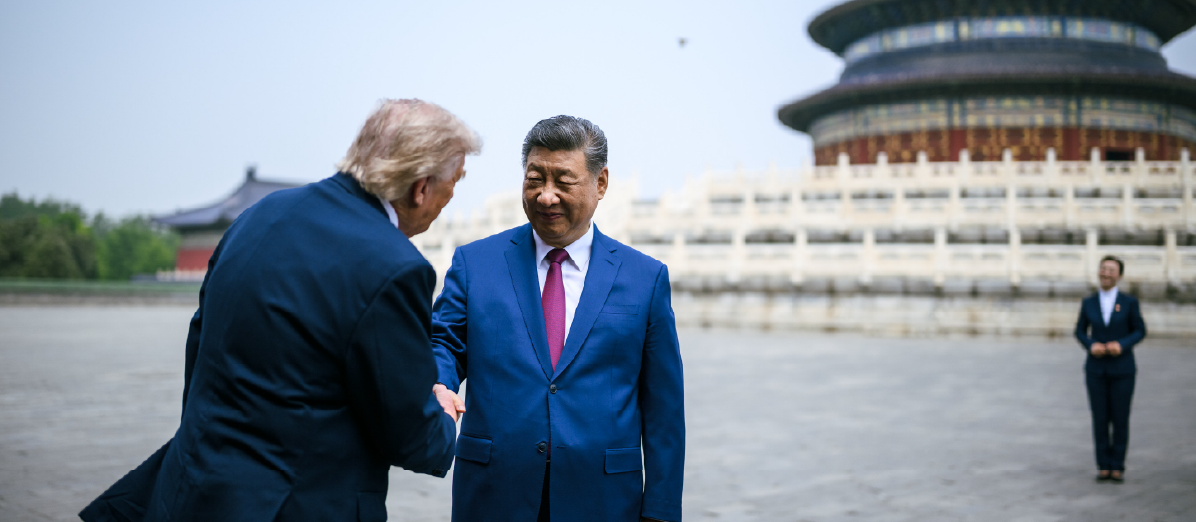
The much-anticipated meeting in Beijing between Donld Trump and Xi Jinping ended without any significant tangible breakthrough in relations between the United States and China. Behind the facade of cordial relations between the leaders, the differences between Washington and Beijing over trade, Taiwan, and Iran became apparent at the end of the two days.
The summit also made clear that neither side has a clear upper hand over the other either economically or politically and that whatever decisions are made between the world’s two largest economies will have repercussions far between the borders of their countries.
With President Trump facing political pressure back home ahead of the midterm elections, expectations had been high that he would push for a breakthrough in trade relations with Beijing and clinch a deal for China to buy more US goods that would be touted as a win. That speculation had been particularly high as the president was accompanied by some of the biggest titans of US industry including Nvidia chief executive officer (CEO) Jensen Huang, Apple CEO Tim Cook, and Tesla’s Elon Musk. Yet no such deal was to be seen, and even the agreement for China to purchase 200 Boeing aircraft fell far short of the 500 that investors had been expecting.
Meanwhile, the structural challenges for trade relations between the G2 remain. While a truce between the two sides over escalating tariffs remains in place until November 2026, the possibility of the return of the tariff war persists. Uncertainties remain about the United States’ own tariff policy after the Supreme Court struck down tariffs imposed under the International Emergency Economic Powers Act and the US Court of International Trade subsequently ruled that the tariffs imposed by Section 122 of the Trade Act of 1974 were unlawful. As Washington now continues to pursue Section 301 investigations to retaliate against foreign governments pursuing unfair trade practices, how this could impact US tariffs on China moving forward was not made clear during the summit.
What’s more, strategic challenges for US economic relations with China persist, as China continues to have a chokehold on key US industries by dominating the global supply chains for critical minerals and magnets in particular. So long as China has over 90 percent of the world’s magnet manufacturing capacity and dominates the refining process of rare earths, US competitiveness will be in jeopardy and US industries will remain vulnerable to Beijing’s coercive actions.
Trump will no doubt reciprocate the hospitality proffered by Xi with much pomp and circumstance when the Chinese leader visits the White House in September. But while both sides will want to avert a military conflict, economic warfare is well in play. A clear roadmap on what a US win should look like in managing economic relations with China needs to be drawn before then. That vision needs to prioritize resilience to Chinese economic coercion, which must include investing more in domestic capabilities.
Ahead of last week’s meetings in Beijing between US President Donald Trump and People’s Republic of China President Xi Jinping, many observers accurately predicted Indo-Pacific security issues would take a backseat to the day’s headlines: war in the Middle East, a fragile US-China trade truce, and more.
The exception, as many expected, was Taiwan, which the Chinese side described in a readout as “the most important issue” in the US-China relationship, warning the United States (and, indirectly, Taiwan) about potential conflict if the situation is not “handled properly.” Before last week, Beijing was reportedly preparing to push Washington to adjust longstanding US rhetoric on Taiwan toward more favorable language for Beijing. But an initial White House readout did not mention Taiwan at all. While US Secretary of State Marco Rubio told reporters later that US policy regarding Taiwan remains unchanged, the US government missed an important opportunity to publicly reiterate the US position in its official readout.
The agenda in Beijing may not have covered many Indo-Pacific security issues at length, but the calendar ahead will prove critical.
First, when will the US government use its full toolkit for strengthening Taiwan’s self-defense capabilities? Media reports suggested that the administration has waited to unveil a new $14 billion foreign military sales package until after Trump and Xi met. On Friday, Trump even described the package as a “very good bargaining chip” with China. But will the administration finally accede to lawmakers’ growing demands and approve the sales? Additionally, will Congress fund the administration’s budget requests for Presidential Drawdown Authority and the Taiwan Security Cooperation Initiative?
Second, how will the administration manage its strategic priorities in the Indo-Pacific amid renewed conflict in the Middle East? The US military has expended thousands of critical munitions against Iran and undertook massive deployments in the Persian Gulf and the Caribbean this year. Can upcoming US senior leader travel, military exercises, and other activities in the Indo-Pacific restore confidence in Washington’s ability to deliver on its regional goals?
Third, will regional players stay the course and increase defense spending this year? In Washington, the Trump administration has proposed record military funding levels. After protracted debate, Taiwan’s legislature recently passed $25 billion in additional defense spending. Japan, South Korea, and Australia are each aiming to spend more on defense in the near term. But the war in Iran is creating fiscal strain across the region; will Indo-Pacific leaders be able to follow through?
The Beijing summit raised these questions and more. The Trump administration, Congress, and regional capitals all have consequential roles to play in answering them, and what happens next matters most of all.
After months of questions, analysis, and hype surrounding what Donald Trump would say about Taiwan at the delayed summit with Xi Jinping, the two leaders met, and Trump did not make any major changes to longstanding US policy. Chairman Xi reportedly centered the entire summit and progress in the US-China relationship around Taiwan by saying, “The Taiwan question is the most important issue in China-US relations. . . . If mishandled, the two countries could face confrontation or even conflict, pushing the entire China-US relationship into a highly dangerous situation.” With such stark remarks, one would expect Trump to react to his host’s statement, as it was a clear sign that Xi expected some movement on Taiwan in exchange for the desired trade and investment deals. Instead, according to the Washington Post, “In the meeting, Trump did not respond to Xi’s comments about Taiwan and moved on to the next topic without acknowledging them at all.”
The narrative in the weeks prior to the summit emphasized the People’s Republic of China’s hopes that Trump would make changes to longstanding US policy, and that narrative devolved into an expectation that the administration would have to do something on Taiwan to appease Xi. Trump’s position at the summit had diminished given the state of the Iran war and its effects within the United States and around the globe. Prior to the summit’s delay, Trump may have had the upper hand in negotiations, but that dynamic flipped. Despite the power shift, Trump did not abandon Taiwan, nor did he publicly agree to delay or end arms sales to Taiwan. The administration did change its language to “oppose” Taiwan independence.
One his way from Beijing on Air Force One, Trump reaffirmed his usual response to the question of the US defense of Taiwan: “That question was asked to me today by President Xi. I said I don’t talk about that.” This has been Trump’s version of the longstanding US policy of strategic ambiguity. And on arms sales, Trump said, “I’ll be making a decision.” Secretary of State Marco Rubio emphasized: “US policy on the issue of Taiwan is unchanged as of today.” Nothing major seems to have changed, and there are no leaks contradicting anything that Trump or Rubio said publicly.
And for its part, Taiwan’s Legislative Yuan approved its long-delayed special defense budget, which would fund two large US arms sales packages, last week before Trump departed for Beijing. The budget—lower than the Lai Ching-te administration originally proposed—prioritizes the US arms sales over domestic Taiwanese defense industrial investment.
Now, it is important to see what Trump does after coming home from his summit in Beijing. He had previously delayed a second arms sale package to Taiwan that Congress approved in January so as to not derail the summit negotiations. Republican and Democratic senators have urged Trump to finalize the approval after he returns from Beijing. How quickly or slowly Trump approves the second arms package—which Taipei already has funded—will be the most indicator of how Trump perceives the outcomes of his meetings with Xi.
The outcomes from the Trump-Xi summit are mixed for Southeast Asia. On the one hand, much of the region will hope leader-level engagement can extend a period of temporary stability between the superpowers—as opposed to undesirable extremes of conflict or a G2 condominium—which in turn gives Southeast Asian states space to engage Beijing and Washington while also hedging their bets across wider multialignment approaches. Seen from this perspective, any advances on developments such as China’s proposal to make a new vision of a “constructive China-US relationship of strategic stability” and changes in economic ties will be carefully watched. We can expect to hear more about this dynamic in the next few weeks across major regional engagements including the Shangri-La Dialogue in Singapore and the Association of Southeast Asian Nations (ASEAN) Future Forum in Vietnam.
Generally, added temporary stability in US-China ties would be welcomed in key regional capitals given the wider global economic fallout from Middle East conflict that has already affected growth prospects in what is collectively the world’s fifth-largest economy. At the recent ASEAN summit meeting convened by the Philippines, leaders called for urgent measures to strengthen regional resilience, including in energy, supply chains, and macroeconomic policy.
On the other hand, much of the region will also keep the development in perspective given that it is unlikely to change the long-term structural competitive dynamics between China and the United States. Singapore Prime Minister Lawrence Wong captured a sentiment often heard from officials in the region when he said that the Trump-Xi engagements dominating 2026 ought to be viewed at best as part of a “temporary truce” to establish “guardrails” around the relationship even as “the rivalry” remains.
Looking ahead, Southeast Asian states will also be assessing how evolving US-China summitry is affecting US China policy, US–Southeast Asia ties, and implications for regional economic prospects. Some Southeast Asian countries have already been included in the Trump administration’s economic initiatives, be they Malaysia and Thailand, which signed critical mineral pacts with Washington, or the Philippines and Singapore, which are part of the “Pax Silica” umbrella. But the region has also seen the more coercive side of US policies, including tariff imposition and scam center sanctions. As such, much of Southeast Asia will be carefully assessing datapoints during the second half of 2026 including US-China engagement at the next round of ASEAN summitry as well as US-China twin hosting of the G-20 and the Asia-Pacific Economic Cooperation, respectively.
Featured image: White House/Flickr
Facts Only
U.S. President Donald Trump and Chinese President Xi Jinping met in Beijing for a two-day summit.
The summit ended without significant breakthroughs in U.S.-China relations.
Key differences remained over trade, Taiwan, and Iran.
No major trade deals were announced, including a Boeing aircraft purchase agreement that fell short of expectations.
The U.S. and China maintain a truce on escalating tariffs until November 2026.
The U.S. Supreme Court and the U.S. Court of International Trade ruled certain tariffs unlawful, creating uncertainty in U.S. tariff policy.
China dominates global supply chains for critical minerals and magnets, posing risks to U.S. industries.
Xi Jinping described Taiwan as the "most important issue" in U.S.-China relations, warning of potential conflict if mishandled.
Trump did not publicly respond to Xi's comments on Taiwan during the summit.
Taiwan's legislature approved a $25 billion defense budget to fund U.S. arms sales.
The Trump administration has delayed finalizing a second arms sale package to Taiwan.
Southeast Asian nations are monitoring U.S.-China relations for regional stability and economic impacts.
Executive Summary
Full Take
The summit between Trump and Xi Jinping reveals a complex dynamic where both sides seek to avoid outright conflict while competing for economic and strategic advantage. The lack of tangible outcomes underscores the deep structural challenges in U.S.-China relations, particularly in trade and Taiwan. Xi's emphasis on Taiwan as a potential flashpoint contrasts with Trump's strategic ambiguity, suggesting a calculated effort to maintain leverage without provoking escalation. The delayed arms sales to Taiwan and the approval of Taiwan's defense budget highlight the delicate balance between deterrence and diplomacy.
The narrative presents a "temporary truce" rather than a lasting resolution, which aligns with the broader pattern of managed competition. The focus on economic coercion and supply chain vulnerabilities reflects a shift toward resilience as a strategic priority. However, the article does not explore alternative perspectives, such as the potential for cooperative frameworks or the role of third-party mediators in easing tensions.
Root cause: The paradigm driving this narrative is one of great-power competition, where economic and military leverage are primary tools of statecraft. The unstated assumption is that conflict is inevitable unless managed through deterrence and strategic ambiguity.
Implications: The second-order consequences include heightened uncertainty for global markets, increased defense spending in the Indo-Pacific, and a potential arms race in critical technologies. Southeast Asian nations, caught between the two powers, face pressure to align while preserving their autonomy.
Bridge questions: What would a cooperative framework between the U.S. and China look like, and what concessions would be necessary? How might third-party mediators, such as ASEAN, shape the trajectory of U.S.-China relations? What are the long-term risks of relying on strategic ambiguity in Taiwan?
Counterstrike scan: If this narrative were part of a coordinated influence campaign, it would likely emphasize the inevitability of conflict to justify increased defense spending and economic decoupling. However, the content does not match this pattern, as it presents a nuanced view of temporary stability rather than outright confrontation.
Patterns detected: none
Sentinel — Human
The text exhibits strong human-like narrative flow and detailed sourcing, successfully integrating complex geopolitical events into a coherent analysis, suggesting a high probability of human authorship.