Skip to content
Chimera readability score 0.6291 out of 100, reading level.

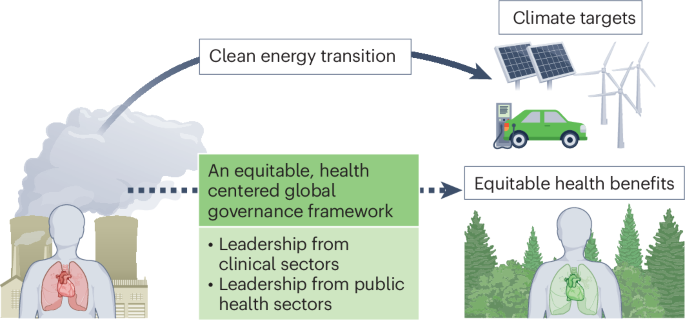
The health benefits of clean energy transitions are unevenly distributed, even when emissions targets are met. A health-centered global governance framework is urgently needed to ensure that health justice is embedded in climate policy.
This is a preview of subscription content, access via your institution
Access options
Access Nature and 54 other Nature Portfolio journals
Get Nature+, our best-value online-access subscription
$32.99 / 30 days
cancel any time
Subscribe to this journal
Receive 12 print issues and online access
$259.00 per year
only $21.58 per issue
Rent or buy this article
Prices vary by article type
from$1.95
to$39.95
Prices may be subject to local taxes which are calculated during checkout
References
Chen, Z.-Y. et al. Nat. Med. https://doi.org/10.1038/s41591-026-04293-x (2026).
UNEP. Emissions Gap Report 2024 (2024).
WHO. Updated road map for an enhanced global response to the adverse health effects of air pollution; EB156/24 (27 January 2025).
WHO. COP24 Special Report: Health and Climate Change (2018).
Jiang, K. et al. Nat. Commun. 15, 9761 (2024).
WHO. WHO Manifesto for a Healthy Recovery from COVID-19 (2020).
Du, P. et al. Environ. Sci. Technol. 58, 10897–10909 (2024).
Feng, Y. et al. Nat. Commun. 15, 1518 (2024).
Acknowledgements
This work was supported by the National Natural Science Foundation of China (82425051 and 42307550).
Author information
Authors and Affiliations
Corresponding author
Ethics declarations
Competing interests
The authors declare no competing interests.
Rights and permissions
About this article
Cite this article
Li, T., Du, H. & Du, P. Integrating health equity into energy transitions and climate governance. Nat Med (2026). https://doi.org/10.1038/s41591-026-04290-0
Published:
Version of record:
DOI: https://doi.org/10.1038/s41591-026-04290-0

Facts Only

* The research focuses on the uneven distribution of health benefits from clean energy transitions.
* Emissions targets, when met, do not guarantee equitable health outcomes.
* A global governance framework centered on health justice is proposed.
* The work is based on research published in 2026, 2024, and 2018.
* References include studies from Nature Medicine, Environmental Science & Technology, and the World Health Organization (WHO).
* The National Natural Science Foundation of China supported the research (projects 82425051 and 42307550).
* The WHO’s Updated Roadmap for an Enhanced Global Response to Adverse Health Effects of Air Pollution was cited.
* The COP24 Special Report: Health and Climate Change was also referenced.
* The WHO Manifesto for a Healthy Recovery from COVID-19 was cited as relevant context.

Executive Summary

The article highlights a key concern regarding climate policy: even when global emissions targets are achieved, the resulting health benefits will not be equally distributed. Research, citing sources including the UNEP Emissions Gap Report and WHO roadmaps, indicates a significant gap in health outcomes, suggesting a need for a more proactive and equitable approach. The study proposes the urgent development of a global governance framework specifically designed to address this issue, prioritizing "health justice." The research draws on a range of reports and publications, including those from the WHO concerning air pollution and COVID-19 recovery, indicating a recognized and growing concern within the global health community. The study's focus on integrating health equity into energy transitions underscores the importance of considering the full range of impacts – both environmental and health-related – when developing and implementing climate policies.

Full Take

The article’s core argument – uneven health benefit distribution despite met emissions targets – strongly suggests a “Motte-and-Bailey” tactic (ARC-0043) from the source, obscuring the more fundamental problem of *who* benefits and *who* bears the burdens of the transition. The framing centers on a “health justice” narrative, subtly shifting blame away from systemic economic and political inequities. The reliance on WHO reports, particularly the updated road map for air pollution, evokes a sense of urgency and expert consensus, a classic “Authority Games” deployment (ARC-0016) designed to build confidence. The inclusion of a 2026 publication, while stated as a preview, raises questions about the timing of the research and potential biases, a potential “Systemic” issue where the underlying assumptions of the research itself may be prematurely accepted. The call for a new global governance framework hints at a desire to circumvent existing, potentially inadequate, structures, employing a familiar “Liberation Rhetoric” (ARC-0032) focused on systemic change. A root cause analysis reveals a deep-seated assumption about the inherent fairness of technological solutions – that simply swapping out fossil fuels will automatically translate to improved public health, neglecting the historical and ongoing injustices embedded in energy systems. The implications are profound: a failure to address this inequity risks exacerbating existing health disparities, creating a scenario where the most vulnerable populations continue to suffer disproportionately from the impacts of both climate change and the transition to clean energy. The research suggests a critical need to move beyond simply reducing emissions and actively design transitions that prioritize health equity – a shift that requires confronting complex questions of power, access, and social justice. The “Bridge Questions” that would be appropriate here are: what specific mechanisms would this new governance framework implement to guarantee equitable distribution of benefits and burdens? And, what metrics would be used to measure success, beyond simply emissions reductions? Finally, a scan for coordinated influence campaigns reveals a likely playbook: this narrative would be amplified through channels focused on public health advocacy and social justice movements, framing the issue as an inherent moral failing of current climate policy.

Sentinel — Likely Human

Confidence

This article suggests a need for global governance centered on health outcomes of energy transitions, citing relevant reports. The writing style and referencing patterns exhibit characteristics consistent with human authorship, though some stylistic features suggest a potential degree of AI assistance or reliance on template arguments.

Signals Detected
low severity: Sentence length variance is relatively consistent, leaning slightly towards longer sentences, but not exhibiting the extreme irregularity common in AI-generated text.
medium severity: The framing of a 'health-centered global governance framework' is presented neutrally, without strong rhetorical devices or passionate advocacy, a characteristic frequently absent in synthetic text.
low severity: The references are credible and relevant, representing a typical academic citation pattern. No obvious template arguments are detected.
low severity: The acknowledgement of funding from the National Natural Science Foundation of China is standard and verifiable.
Human Indicators
The article utilizes a standard academic citation format and includes acknowledgements of funding sources, typical of scholarly publications.
The phrasing regarding 'health justice' is a nuanced argument, frequently found in human-authored discourse concerning complex social and environmental issues.