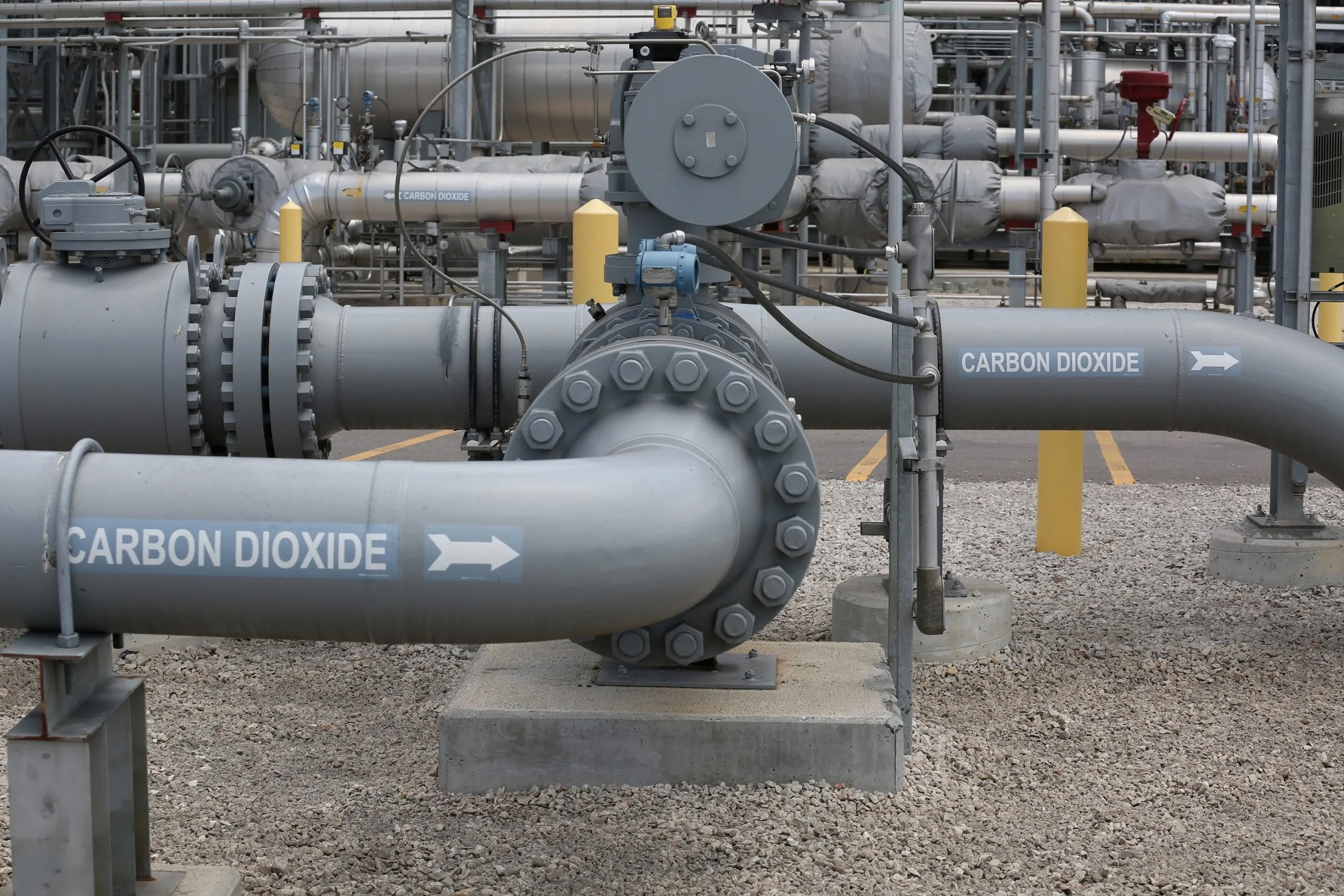
The Texas Railroad Commission spent two years working to secure the authority to issue the permits energy companies need to inject and store carbon dioxide underground, a power previously held by the federal government.
Last November, the Environmental Protection Agency approved that request, a development experts said will make it easier for energy companies to apply for such permits, called Class VI.
Both Democratic and Republican presidential administrations have approved generous tax incentives to energy companies to encourage carbon capture. While the effectiveness of the practice and benefits to the environment have been debated for years, the oil and gas industry has embraced it as a climate-friendly solution to pollution driven by industrial-scale fossil fuel production.
But proponents of carbon capture technology argued that the federal government took too long to approve permits.
The transfer of permitting to Texas isn’t likely to mean a rush of new projects, experts said, mainly because there hasn’t been a recent significant expansion of government incentives for direct air capture projects that trap carbon dioxide emissions, incinerate them and inject them deep underground.
Here’s what to know about Class VI permits in Texas:
What are Class VI permits?
Class VI authorizes companies to capture, inject and permanently store carbon dioxide (CO2) underground.
Carbon capture is a technology designed decades ago to reduce carbon dioxide emissions from large industrial sources such as power plants, steel manufacturing, cement production, and other industrial facilities that emit greenhouse gases. The primary intent of the technology is to prevent carbon dioxide from entering the atmosphere and contributing to climate change.
Through direct air capture, which is a specialized and expensive practice, CO2 is separated from other gases through a chemical process. It is then compressed and transported, usually through pipelines, to a storage location, then injected into deep underground rock formations where it can be permanently stored.
Who can issue Class VI permits?
Unless a state applies to take over, only federal regulators at the Environmental Protection Agency can issue Class VI permits. The Railroad Commission applied in December 2022 and was approved by the EPA in October, making Texas the sixth state to be granted that authority, known as primacy.
“In order to be granted primacy, a state program must meet federal requirements for the protection of underground sources of drinking water. The RRC has a long history of regulating various classes of injection wells, and is committed to strong oversight while protecting underground sources of drinking water,” a spokesperson for the commission said in a statement.
How is the Texas Railroad Commission’s office set up?
To be granted permitting authority, states must prove they can enforce the federal Safe Drinking Water Act while making filing paperwork easier for companies. The assumption is that Texas companies will be more familiar with the state commission’s processes.
The Railroad Commission has staffed its Class VI office with four technical reviewers, three engineering specialists and a geoscientist. To fund the newly created office, the commission is using a five-year, $1.9 million federal grant in addition to state funds. The state charges companies a $50,000 application fee, which goes toward the commission’s budget — amending an existing permit costs $25,000. And until the facility is closed, operators must pay an annual fee of $50,000 for each year they do not inject.
Companies must demonstrate that they are financially capable of covering the cost of their injection wells over their lifetimes.
How many companies have applied?
The commission has received 18 applications, the earliest one filed in 2022 by Oxy Low Carbon Ventures, LLC, which the commission approved in tandem with the EPA in October. The facility, which Oxy plans to build about 20 miles southwest of Odessa, is designed to store up to 8.5 million metric tons of carbon over 12 years.
This article first appeared on The Texas Tribune.
Photo: Texas oil and gas companies celebrated the state winning the authority to permit certain types of carbon capture projects that would inject carbon from the atmosphere into the ground. REUTERS/Trish Badger
Topics Texas
Was this article valuable?
Here are more articles you may enjoy.
Facts Only
* The Texas Railroad Commission (RRC) secured authority to issue Class VI permits for carbon dioxide storage.
* The EPA approved this request in October 2023.
* This transfer follows a two-year process.
* Class VI permits authorize companies to capture, inject, and permanently store CO2 underground.
* Carbon capture is a technology designed to reduce CO2 emissions from industrial sources.
* The RRC’s authority is based on demonstrating compliance with the Safe Drinking Water Act.
* The RRC’s Class VI office has four technical reviewers, three engineering specialists, and a geoscientist.
* The office is funded by a $1.9 million federal grant and state funds.
* The application fee for companies is $50,000, and an annual fee is $50,000 if the facility is not injected.
* Companies must demonstrate financial capability.
* There are currently 18 applications for Class VI permits.
* Oxy Low Carbon Ventures, LLC, filed the first application, approved in tandem with the EPA.
Executive Summary
Full Take
The RRC’s pursuit of Class VI permitting represents a strategic maneuver within a larger, contested landscape of climate policy. The narrative being carefully constructed here is one of localized, pragmatic governance – Texas asserting its capacity to manage a technically complex and potentially sensitive industry, leveraging existing regulatory infrastructure to demonstrate competence. The timing, coinciding with existing tax incentives for carbon capture, subtly frames this as an enabling move, rather than a radical shift. However, the reality is far more nuanced. The “easier” process touted by the RRC is heavily reliant on already established regulatory frameworks, and the projected uptake of these permits is significantly constrained by the lack of substantial, sustained government incentives for direct air capture – a critical component of the carbon capture value chain. This suggests a carefully calibrated attempt to demonstrate a willingness to engage with the technology without committing to long-term systemic change. The RRC’s emphasis on protecting underground water sources is a calculated move, appealing to anxieties surrounding potential environmental risks, a tactic reminiscent of the “Motte-and-Bailey” fallacy – bolstering a weaker argument with increasingly detailed assurances. Patterns detected: ARC-0043 Motte-and-Bailey, ARC-0024 Ambiguity.
Furthermore, the RRC’s framing of Texas companies as “more familiar” with the commission’s processes implicitly casts the EPA as bureaucratic and out of touch, subtly undermining the federal agency’s authority. This echoes a broader pattern of states positioning themselves as vanguard actors in addressing climate challenges, sometimes accompanied by claims of greater efficiency and responsiveness. The $1.9 million federal grant, while superficially reassuring, represents a relatively small investment, hinting at a prioritization of short-term gains over a truly transformative approach. The current application numbers – 18 – suggest a cautious, reactive approach, driven more by industry pressure than a genuine surge in interest. The underlying assumption—that companies will readily adopt this new regulatory framework— is a significant gamble, particularly given the industry’s historical resistance to regulatory oversight. The emphasis on financial viability raises concerns about potential market distortions, potentially favoring larger, more established companies with greater access to capital. Root Cause: The narrative is driven by the desire to maintain leverage in a politically contentious sector. The assumption is that state control can offer more favorable terms for the oil and gas industry. Implications: This localized approach risks fragmenting national climate policy, creating competing regulatory standards and hindering the development of a cohesive carbon market. Who benefits? Primarily oil and gas companies. Who bears costs? The potential for environmental risks and a delayed, less ambitious approach to climate mitigation.
Sentinel — Human
This article provides a factual overview of Texas's newly gained authority to issue carbon capture permits, outlining the process, the involved parties, and key financial considerations. The writing style and level of detail suggest a standard news report, rather than AI-generated content.