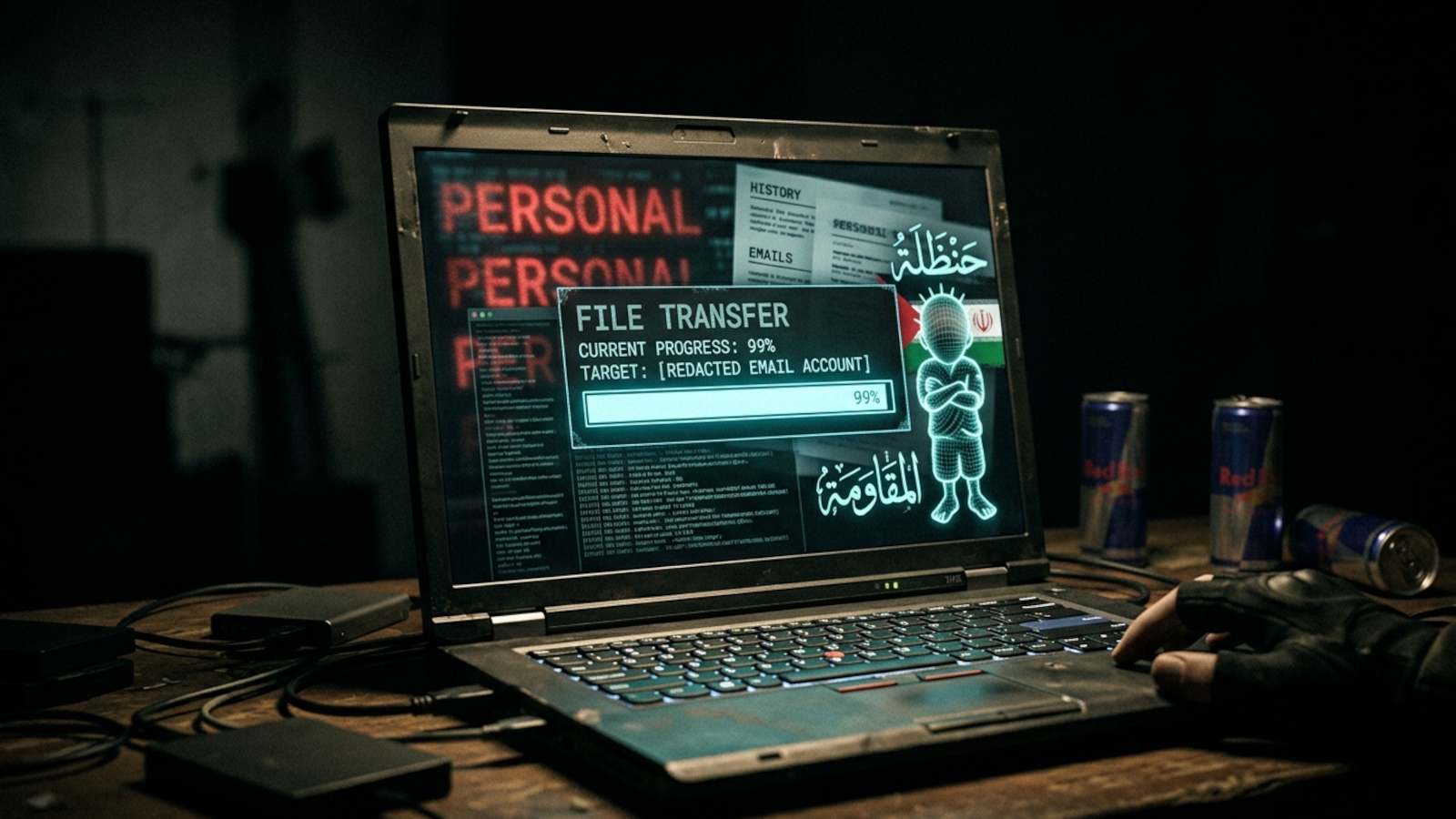
The Handala hackers associated with Iran have breached the personal email account of FBI Director Kash Patel and published photos and documents.
The FBI has confirmed the compromise, saying that the stolen data was not recent and did not include any government data.
On Friday, the Handala threat actor announced on one of their websites that Patel has been added to the list of their victims, alleging that they compromised “the so-called ‘impenetrable’ systems of the FBI” in just a few hours.
The hackers said that their action was in response to the FBI seizing Handala domains and the U.S. government offering a reward of up to $10 million for information on the threat group’s members.
However, the hackers had breached the FBI Director’s personal Gmail inbox.
“All personal and confidential information of Kash Patel, including emails, conversations, documents, and even classified files, is now available for public download,” the Handala hackers said before publishing proof of the breach.
Shortly after the announcement, the threat actor published a set of watermarked personal photos and documents extracted from Patel’s inbox, along with email correspondence from before becoming FBI director.
In a statement for BleepingComputer, the FBI said that it was aware of hackers “targeting Director Patel’s personal email information.”
The agency further notes that it has taken every necessary precaution to reduce any negative impact that may result from this activity.
“The FBI is aware of malicious actors targeting Director Patel’s personal email information, and we have taken all necessary steps to mitigate potential risks associated with this activity. The information in question is historical in nature and involves no government information,” - the Federal Bureau of Investigation
The Handala hacktivist group has previously breached the Microsoft environment of medical technology giant Stryker and wiped nearly 80,000 devices.
Also known as Handala Hack, Hatef, and Hamsa, the actor emerged in December 2023 and is a hacktivist persona carrying out cyber activities for Iran's Ministry of Intelligence and Security (MOIS).
In the statement on the compromise of Director Patel’s personal email account, the FBI reiterated the $10 million reward from the Department of State's Rewards for Justice “for information leading to the identification of the Handala Hack Team out of Iran.”
Automated Pentesting Covers Only 1 of 6 Surfaces.
Automated pentesting proves the path exists. BAS proves whether your controls stop it. Most teams run one without the other.
This whitepaper maps six validation surfaces, shows where coverage ends, and provides practitioners with three diagnostic questions for any tool evaluation.
Comments
ZeroDark_decoded - 2 hours ago
Let's remember this is the man that's supposed to protect our country. He has bad OP Sec apparently lol
Facts Only
The Handala hackers, associated with Iran, breached FBI Director Kash Patel’s personal Gmail account.
The hackers published photos and documents from Patel’s inbox on their website.
The FBI confirmed the breach but stated the stolen data was not recent and contained no government information.
The hackers claimed the breach was in response to the FBI seizing their domains and the U.S. government’s $10 million reward for information on their members.
Published materials included watermarked personal photos, documents, and pre-FBI-director email correspondence.
The FBI stated it had taken steps to mitigate risks from the breach.
Handala is linked to Iran’s Ministry of Intelligence and Security (MOIS) and emerged in December 2023.
The group previously breached Microsoft environments and wiped nearly 80,000 devices at medical technology firm Stryker.
The FBI reiterated the $10 million reward for information on Handala’s members.
Executive Summary
Full Take
The strongest version of this narrative highlights a calculated cyber retaliation by an Iran-linked group against a high-profile U.S. official, framed as a response to U.S. actions. The FBI’s swift acknowledgment and damage control—emphasizing the historical nature of the data—underscores the sensitivity of the breach, even if no government secrets were exposed. The hackers’ claim of penetrating "impenetrable" systems in hours serves as both a technical flex and a propaganda tool, amplifying their perceived capability while rallying support against U.S. cyber policies.
Patterns detected: ARC-0024 Ambiguity (vague claims of "classified files" without evidence), ARC-0043 Motte-and-Bailey (hackers oscillate between technical prowess claims and political grievances).
Root cause: The paradigm here is asymmetric cyber warfare, where state-aligned actors exploit personal vulnerabilities to signal capability and deter adversaries. The unstated assumption is that personal security lapses by officials undermine institutional credibility—a narrative that benefits adversaries seeking to erode trust in U.S. cyber defenses.
Implications: For human agency, this breach underscores the blurred line between personal and professional security in high-stakes roles. The cost is borne by Patel’s privacy and the FBI’s reputation, while the benefit accrues to Iran’s strategic messaging. Second-order consequences may include heightened scrutiny of officials’ personal cyber hygiene and escalating tit-for-tat cyber operations.
Bridge questions: How might this breach reshape U.S. policies on personal device security for officials? What countermeasures could mitigate such attacks without infringing on privacy? Would the narrative shift if the leaked data contained current government information?
Counterstrike scan: A coordinated influence campaign would amplify the breach as proof of systemic U.S. vulnerability, pairing it with calls to dismantle cyber policies. The actual content aligns partially—Handala’s framing leans into this—but lacks the orchestrated amplification typical of state-sponsored disinformation. The focus remains on technical bragging rather than broader destabilization.
Sentinel — Human
This text shows signs of human authorship, with erratic sentence length variance, idiosyncratic emphasis, and a unique argumentative structure. However, the stylometric signals are not definitive and there is still a possibility of AI assistance.