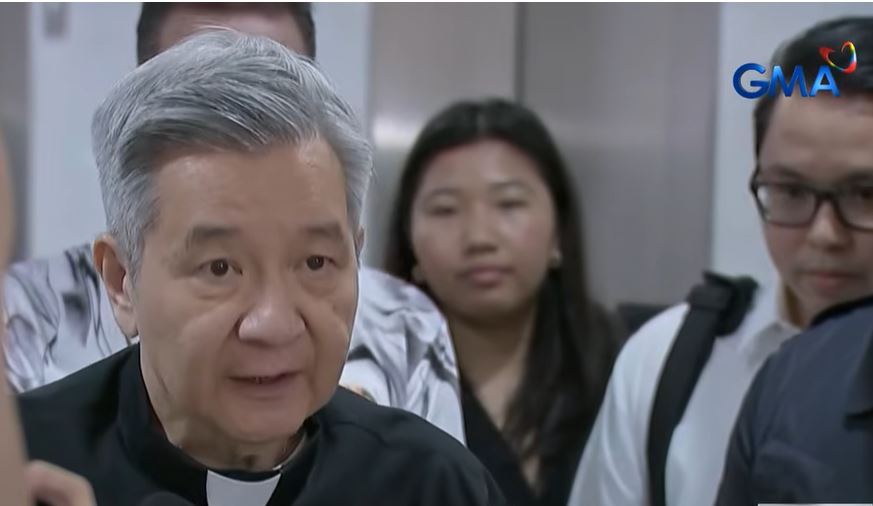
Father Roberto “Bobby” Yap, president of the Ateneo de Manila University, appeared before the National Bureau of Investigation on Friday in relation to the deaths of student-athletes Rene Baterbonia and Divine Adili.
According to a "24 Oras" report by John Consulta, a source said Yap answered the questions of the National Bureau of Investigation agents on the case, but did not directly answer other queries.
Yap maintained that the university has been assisting the families of Baterbonia and Adili.
“We have been, since day one, with the Baterbonia and Adili families. We have condoled with them, apologized, continue to condole with them, we continue to apologize. We have offered and have given support and assistance to them, and will continue to do so over several years,” Yap said.
Yap headed to the NBI Homicide Division to submit documents subpoenaed by authorities in relation to the drowning of Baterbonia and Adili during a team-building activity in Dipaculao, Aurora last June 8.
Five more people subpoenaed by the NBI are expected to appear on Monday, as well as additional documents from Yap's camp, to complete the ongoing investigation by the NBI homicide division.
Tab Baldwin, the Ateneo Blue Eagles coach when Baterbonia and Adili died, previously appeared before the NBI. He only answered four questions and submitted his sworn affidavit, according to the source.
The Criminal Investigation and Detection Group had recommended the filing of complaints for alleged violations of Republic Act No. 11053, or the Anti-Hazing Act, against 11 individuals, including Baldwin, in connection with the drowning deaths of two Ateneo de Manila University student-athletes during a team-building activity in Aurora.
NBI Director Melvin Matibag said they will treat those involved in the incident fairly.
“We will be fair, we will be professional. Kung ano at saan tayo dadalhin ng ebidensya, doon natin dadalhin yan,” he said.
(Whatever and wherever the evidence takes us, we will take it there.)
As regards whether the complaint filed by the CIDG and one filed by the NBI can be combined, Matibag said, “That is the option and prerogative of the Department of Justice… Kung ano man ang findings namin, we will finish it and submit it to the DOJ for them to use it to proper disposition kung ano man ang ma-file na kaso.”
(Whatever our findings are, we will finish it and submit it to the DOJ for them to use it to proper disposition whatever case may be filed.) —Jamil Santos/LDF, GMA News
Facts Only
* Father Roberto “Bobby” Yap, president of Ateneo de Manila University, appeared before the National Bureau of Investigation (NBI) on Friday.
* Yap submitted documents subpoenaed by authorities related to the deaths of student-athletes Rene Baterbonia and Divine Adili.
* The deaths occurred during a team-building activity in Dipaculao, Aurora, on June 8.
* Yap stated that the university has been assisting the families of Baterbonia and Adili since the incident.
* The Criminal Investigation and Detection Group (CIDG) recommended filing complaints for alleged violations of Republic Act No. 11053 (Anti-Hazing Act) against 11 individuals, including coach Tab Baldwin.
* NBI Director Melvin Matibag stated they would treat those involved in the incident fairly.
* Matibag indicated that the option to combine complaints from the CIDG and NBI is the prerogative of the Department of Justice (DOJ).
Executive Summary
The Ateneo de Manila University president, Father Roberto “Bobby” Yap, appeared before the National Bureau of Investigation (NBI) regarding the deaths of student-athletes Rene Baterbonia and Divine Adili. While Yap answered some questions posed by NBI agents, he maintained that the university has provided support and assistance to the families of the deceased since the incident. Yap also submitted subpoenaed documents to the NBI Homicide Division related to the drowning that occurred during a team-building activity in Dipaculao, Aurora, on June 8.
The Criminal Investigation and Detection Group (CIDG) recommended filing complaints under Republic Act No. 11053, the Anti-Hazing Act, against eleven individuals, including coach Tab Baldwin, in connection with the deaths. NBI Director Melvin Matibag stated that the agency intends to treat those involved in the incident fairly, emphasizing a commitment to following the evidence wherever it leads. Matibag clarified that the option for combining complaints filed by the CIDG and the NBI rests with the Department of Justice (DOJ).
Full Take
The handling of an investigation involving student deaths, institutional representation, and legal culpability exposes critical tensions between administrative action and criminal justice processes. The scenario highlights the power dynamics between a private educational institution, the law enforcement agency (NBI), and the government (DOJ) in determining accountability for tragic events.
The statement by the NBI Director—"Whatever and wherever the evidence takes us, we will take it there"—demonstrates an assertion of investigative autonomy, suggesting that the pursuit of facts supersedes institutional convenience. However, the focus on procedure, such as combining or separating complaints, reveals a formal structural hesitation to directly assign blame, reserving the final disposition for the DOJ. This mechanism allows the state machinery to manage multiple potential legal avenues without immediate confrontation over core ethical responsibility.
The institution’s response—offering ongoing support and apologies—balances public relations with an acknowledgment of suffering, yet this appears separate from the criminal process that follows. The pattern observed is the systematic separation of compassionate institutional action (support for families) from legal accountability (homicide/hazing complaints). This separation can unintentionally shift focus away from demanding complete transparency regarding the internal mechanisms and responsibility structures within the university itself, rather than solely focusing on external legal findings.
Patterns detected: ARC-0043 Motte-and-Bailey, ARC-0024 Ambiguity
Sentinel — Human
This text exhibits the typical structure and attribution patterns of formal journalistic reporting on an official investigation, suggesting a human journalistic origin rather than synthetic generation.