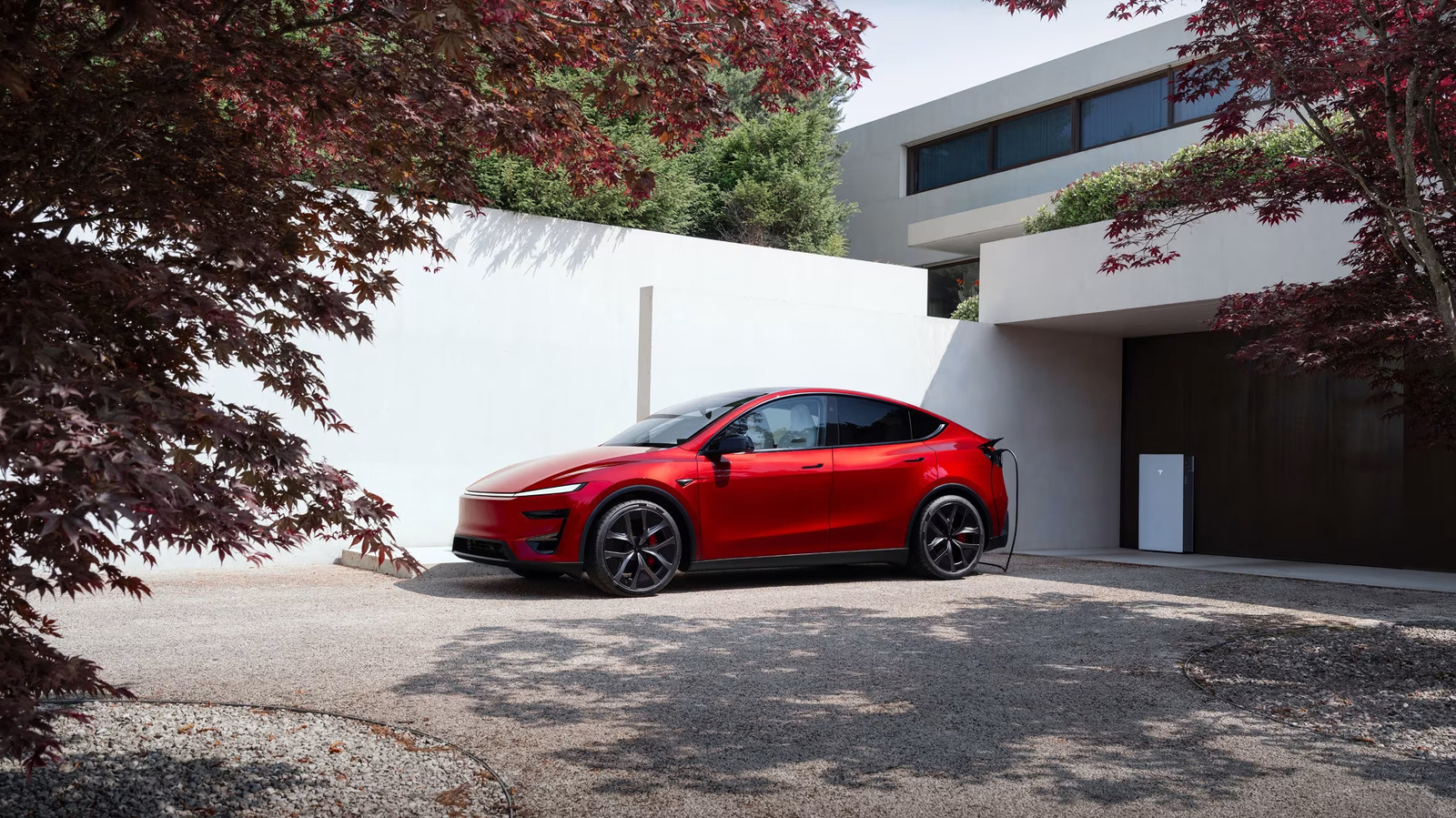
These little tricks will help you spend more time driving instead of charging.
Modern electric vehicles have come a long way since range anxiety was an actual concern. These days, EV makers have to clear an EPA-verified range of at least 300 miles to be taken seriously. Sorry, Fiat 500e. Some EVs even boast a range closer to 500 miles. Still, for longer road trips or if you plan to be passing through an EV charging desert, it might make sense to try some techniques to squeeze a little more range out of your EV's battery. Beyond the typical ways to get more mileage out of cars in general, here are five ways to keep your EV going for longer between charging.
Take advantage of regenerative braking
Instead of wasting all the kinetic energy generated from braking like in traditional internal combustion engine cars, hybrids and EVs can capture all that potentially lost energy and convert it into electricity that powers its battery. Each EV maker has its own way of doing regenerative braking, but the general idea is that the electric motors that propel the EV forward can also act as a generator that captures the electricity generated from slowing down.
In cases where emergency braking isn't needed, regenerative braking will step in and create small bursts of battery charge and bumps in EV range. It's hard to say exactly how many more miles you'll get thanks to this, but the US Department of Energy said that regenerative braking results in 22 percent energy recovery for EVs in combined city and highway driving.
Chill on the AC
Unlike older gasoline-powered cars that use a compressor to power the air conditioning, an EV will rely on its battery to pump cold air into the cabin. That means EVs are using the same power source that supplies you with both air conditioning and range.
Instead, you may want to precondition your EV while it's still plugged into an outlet at home. This way, all the heavy lifting of getting your cabin to the right temperature will be drawn from the power outlet and not the EV's battery. Of course, you'll still have to rely on the battery to keep you cool while driving, but it won't have to work as hard to get down to the perfect temps. Alternatively, you could employ basic techniques like using sun shades, flushing out the stale air by rolling down the windows, or even opt for ventilated seats instead of turning on the AC.
Avoid driving in the cold
On the other end of the thermometer, extreme cold weather conditions can also impact your EV range. In the winter, cold temperatures can slow down the chemical reactions in your EV battery that produce power. According to the Department of Energy, freezing temperatures can affect EV range by up to 32 percent.
Consumer Reports did real-world tests that showed that cold weather of around 16 degrees can reduce an EV's range by about 25 percent when driving at 70 mph, compared to driving in the same conditions but on a day in the mid-60 degrees. Just like running the AC on a summer day, driving in the frigid weather may cost you some range through needing to pump heat into the cabin, too.
Get rid of the junk in your trunk
While aerodynamics affects all cars and how efficiently they drive, it's a major contributing factor to how EVs calculate their range. Less drag means more range, which is why many EV makers boast about their low drag coefficient numbers, like the Lucid Air and its 0.197.
Considering that, it's important to remove any accessories from your EV that would affect its aerodynamics, including roof racks, bike racks, tonneau covers or crossbars. To eke out even more range, you can try to keep your trunk clean since any additional weight will also reduce your EV's efficiency.
Tame the need for speed
As much as all EV drivers want to show off their rapid acceleration, it's better to not have a lead foot when it comes to maximizing range. When you floor the accelerator, your EV has to burn a significant amount of power to achieve that burst of speed. If you add up that inefficient acceleration at every single intersection, you may end up spending more time charging your EV in the long run.
To get more range out of your EV, it's better to coast on cruise control or tap into your EV's eco mode. On top of that, the faster you go, the more air resistance you introduce. In tests conducted by Car and Driver, driving at 55 mph and at 75 mph contributed to more than 100 miles of range lost with the Kia EV9.
Facts Only
* Regenerative braking results in 22 percent energy recovery for EVs in combined city and highway driving.
* Freezing temperatures can affect EV range by up to 32 percent.
* Cold weather around 16 degrees reduced an EV's range by about 25 percent when driving at 70 mph compared to mid-60 degree conditions.
* EVs rely on the battery for air conditioning, unlike gasoline cars that use a compressor.
* Preconditioning the EV while plugged in draws power from the outlet instead of the battery to warm the cabin.
* Removing accessories like roof racks, bike racks, tonneau covers, or crossbars reduces drag.
* Adding weight to the trunk reduces EV efficiency.
* Driving at 55 mph and 75 mph contributed to more than 100 miles of range lost with a specific model in tests.
Executive Summary
Full Take
The advice provided frames range maximization primarily as a function of driver behavior, optimization of physical systems, and energy management. While the technical facts regarding energy recovery (22%) and thermal impact (32% loss) are verifiable, the guidance relies heavily on shifting responsibility for performance back onto the user through behavioral modifications. The emphasis on "taming the need for speed" suggests that inefficient acceleration is a primary consumer error, implicitly linking range anxiety to aggressive driving habits rather than systemic infrastructure or vehicle design limitations.
The patterns detected: ARC-0043 Motte-and-Bailey, ARC-0078 Slippery Slope, ARC-0112 Evasion.
The narrative leverages fear of range depletion to justify prescriptive behavioral changes. It establishes a false equivalence between individual driving habits and the underlying physics or engineering constraints of the vehicle system. The core assumption is that since EVs are mechanically superior in efficiency (low drag), any remaining loss must be attributable to external, controllable variables—the driver—rather than unavoidable factors like battery chemistry degradation, charging infrastructure latency, or thermal management inefficiencies inherent to the battery pack itself. This framing minimizes structural critique and places the burden of adaptation entirely on the consumer for what are fundamentally system-level issues.
The implications center on agency: range concerns are mitigated by user action, which can be perceived as empowering, yet this masks a potential systemic issue where resource distribution in the energy transition is implicitly tied to individual operational decisions rather than policy or technological standardization.
Sentinel — Human
The text displays the logical coherence of an LLM but uses specific, verifiable data points. It reads like well-researched content optimized for readability rather than purely synthetic generation.