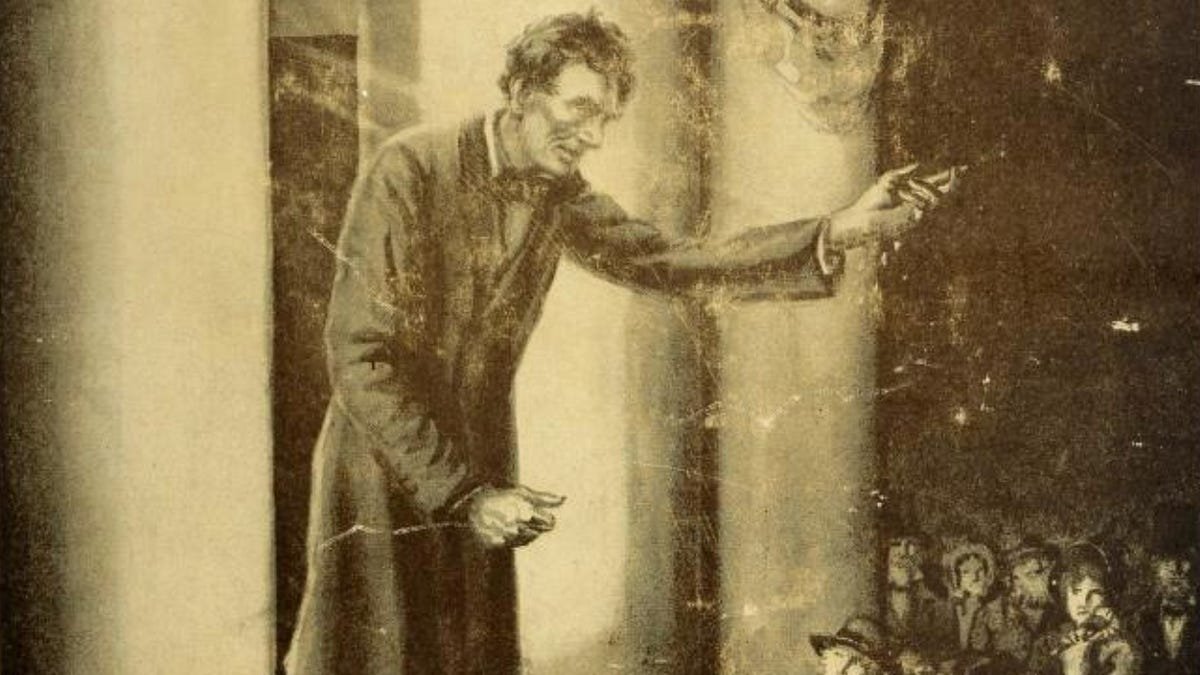
& the Declaration of Independence itself...
Lincoln’s Peoria Revolution: Re‑Adopting the Declaration in 1854 as it is “All Men Are Created Equal” vs. the sacred right to enslave who you can…
In 1854 Abraham Lincoln picked up the Declaration of Independence, dusted it off, and began the work of incorporating it into America’s fundamental Constitution.
The Kansas–Nebraska Act, Stephen Douglas’s great gift to the Slave Power, had been wrapped in the doctrine of “popular sovereignty,” the right of white people in a territory to govern themselves. Douglas claimed it as an advance of democracy: freedom of westerners to rule themselves independent of the East Coast establishment. But, Lincoln said, democracy is more than the right of some men to decide whether other men shall be slaves. It is more than the “right” of the strong in each locality to do what they wish, and to make the weak of that locality suffer what they must, without interference from elsewhere.
Lincoln refused cynicism, and refused self-congratulatory moral posturing as well. He granted that he does not know “what to do… as to the existing institution” of slavery. He acknowledgeed the weight of prejudice and the political difficulty of genuine equality. And yet he insisted that there is a bright line between self-government and despotism: when one man governs another without that other’s consent, that is not self-government, but its negation.
Read this speech, therefore, as an early, groping attempt to articulate a politics of non-domination in an actually existing, deeply compromised republic. Lincoln’s target is not just the expansion of slavery into Kansas and Nebraska, but the larger slide from the “Spirit of ’76” into a world in which exploitation clothes itself in the language of liberty. It is to recall that Americans are defined as a people who have fled the Old World and its society-of-domination mistakes in order to work together to create, in this New World, a prosperous and free society. That requires, in the words of Æneas’s father Anchises: “pacisque imponere morem,
parcere subiectis, et debellare superbos”—impose the ways of peace, be merciful to the subjected, and permanently subdue the haughty.
Lincoln’s remedy is disarmingly simple and radically demanding: re-adopt the Declaration of Independence, and with it, the practices, and policy, which harmonize with it:
Abraham Lincoln (1854): Peoria Speech (October 16) <https://www.nps.gov/liho/learn/historyculture/peoriaspeech.htm> ‘[Thomas] Jefferson… was, is, and perhaps will continue to be, the most distinguished politician of our history; a Virginian by birth and continued residence, and withal, a slave-holder; conceived the idea… to prevent slavery ever going into the north-western territory. He prevailed on the Virginia Legislature to adopt his views, and to cede the territory, making the prohibition of slavery therein, a condition of the deed. Congress accepted the cession, with the condition; and in the first Ordinance (which the acts of Congress were then called) for the government of the territory, provided that slavery should never be permitted therein.
This is the famed ordinance of ‘87 so often spoken of.…
Thus, with the author of the Declaration of Independence, the policy of prohibiting slavery in new territory originated. Thus, away back of the constitution, in the pure fresh, free breath of the revolution, the State of Virginia, and the National Congress put that policy in practice….
The repeal of the Missouri Compromise… is wrong; wrong in its direct effect, letting slavery into Kansas and Nebraska—and wrong in its prospective principle, allowing it to spread to every other part of the wide world, where men can be found inclined to take it. This declared indifference, but… covert real zeal for the spread of slavery, I can not but hate. I hate it because of the monstrous injustice of slavery itself. I hate it because it deprives our republican example of its just influence in the world—enables the enemies of free institutions, with plausibility, to taunt us as hypocrites—causes the real friends of freedom to doubt our sincerity, and especially because it forces so many really good men amongst ourselves into an open war with the very fundamental principles of civil liberty—criticising the Declaration of Independence, and insisting that there is no right principle of action but self-interest….
Let me say I think I have no prejudice against the Southern people. They are just what we would be in their situation. If slavery did not now exist amongst them, they would not introduce it. If it did now exist amongst us, we should not instantly give it up. This I believe of the masses north and south. Doubtless there are individuals, on both sides, who would not hold slaves under any circumstances; and others who would gladly introduce slavery anew, if it were out of existence. We know that some southern men do free their slaves, go north, and become tip-top abolitionists; while some northern ones go south, and become most cruel slave-masters.
When southern people tell us they are no more responsible for the origin of slavery, than we; I acknowledge the fact. When it is said that the institution exists; and that it is very difficult to get rid of it, in any satisfactory way, I can understand and appreciate the saying. I surely will not blame them for not doing what I should not know how to do myself. If all earthly power were given me, I should not know what to do, as to the existing institution.
My first impulse would be to free all the slaves, and send them to Liberia,—to their own native land. But a moment’s reflection would convince me, that whatever of high hope, (as I think there is) there may be in this, in the long run, its sudden execution is impossible…. What then?… I think I would not hold one in slavery, at any rate; yet the point is not clear enough for me to denounce people upon. What next? Free them, and make them politically and socially, our equals? My own feelings will not admit of this; and if mine would, we well know that those of the great mass of white people will not. Whether this feeling accords with justice and sound judgment, is not the sole question…. A universal feeling, whether well or ill-founded, can not be safely disregarded…. It does seem to me that systems of gradual emancipation might be adopted; but for their tardiness in this, I will not undertake to judge our brethren of the south….
I trust I understand, and truly estimate the right of self-government. My faith in the proposition that each man should do precisely as he pleases with all which is exclusively his own, lies at the foundation of the sense of justice there is in me. I extend the principles to communities of men, as well as to individuals. I so extend it, because it is politically wise, as well as naturally just…. The doctrine of self government is right—absolutely and eternally right—but… just application depends upon whether a negro is not or is a man…. If the negro is a man, is it not to that extent, a total destruction of self-government, to say that he too shall not govern himself? When the white man governs himself that is self-government; but when he governs himself, and also governs another man, that is more than self-government—that is despotism. If the negro is a man, why then my ancient faith teaches me that “all men are created equal;” and that there can be no moral right in connection with one man’s making a slave of another….
Our Declaration of Independence says: “We hold these truths to be self evident: that all men are created equal; that they are endowed by their Creator with certain inalienable rights; that among these are life, liberty and the pursuit of happiness. That to secure these rights, governments are instituted among men, DERIVING THEIR JUST POWERS FROM THE CONSENT OF THE GOVERNED…”
The relation of masters and slaves is, PRO TANTO, a total violation of this principle. The master not only governs the slave without his consent; but he governs him by a set of rules altogether different from those which he prescribes for himself. Allow ALL the governed an equal voice in the government, and that, and that only is self government….
Slavery is founded in the selfishness of man’s nature—opposition to it, in his love of justice. These principles are an eternal antagonism; and when brought into collision so fiercely, as slavery extension brings them, shocks, and throes, and convulsions must ceaselessly follow. Repeal the Missouri compromise—repeal all compromises—repeal the Declaration of Independence—repeal all past history, you still can not repeal human nature. It still will be the abundance of man’s heart, that slavery extension is wrong; and out of the abundance of his heart, his mouth will continue to speak….
Near eighty years ago we began by declaring that all men are created equal; but now from that beginning we have run down to the other declaration, that for SOME men to enslave OTHERS is a “sacred right of self-government.” These principles can not stand together. They are as opposite as God and mammon; and whoever holds to the one, must despise the other. When Pettit, in connection with his support of the Nebraska bill, called the Declaration of Independence “a self-evident lie” he only did what consistency and candor require all other Nebraska [Bill-supporting] men to do. Of the forty odd Nebraska Senators who sat present and heard him, no one rebuked him. Nor am I apprized that any Nebraska newspaper, or any Nebraska orator, in the whole nation, has ever yet rebuked him….
Let no one be deceived. The spirit of seventy-six and the spirit of Nebraska, are utter antagonisms; and the former is being rapidly displaced by the latter. Fellow countrymen---Americans south, as well as north, shall we make no effort to arrest this? Already the liberal party throughout the world, express the apprehension “that the one retrograde institution in America, is undermining the principles of progress, and fatally violating the noblest political system the world ever saw.” This is not the taunt of enemies, but the warning of friends. Is it quite safe to disregard it—to despise it? Is there no danger to liberty itself, in discarding the earliest practice, and first precept of our ancient faith? In our greedy chase to make profit of the negro, let us beware, lest we “cancel and tear to pieces” even the white man’s charter of freedom.
Our republican robe is soiled, and trailed in the dust. Let us repurify it. Let us turn and wash it white, in the spirit, if not the blood, of the Revolution. Let us turn slavery from its claims of “moral right,” back upon its existing legal rights, and its arguments of “necessity.” Let us return it to the position our fathers gave it; and there let it rest in peace. Let us re-adopt the Declaration of Independence, and with it, the practices, and policy, which harmonize with it…
The Unanimous Declaration of the Thirteen United States of America
When in the Course of human events, it becomes necessary for one people to dissolve the political bands which have connected them with another, and to assume among the powers of the earth, the separate and equal station to which the Laws of Nature and of Nature’s God entitle them, a decent respect to the opinions of mankind requires that they should declare the causes which impel them to the separation.
We hold these truths to be self-evident,
that all men are created equal,
that they are endowed by their Creator with certain unalienable Rights,
that among these are Life, Liberty and the pursuit of Happiness.
--That to secure these rights, Governments are instituted among Men, deriving their just powers from the consent of the governed,
--That whenever any Form of Government becomes destructive of these ends, it is the Right of the People to alter or to abolish it, and to institute new Government, laying its foundation on such principles and organizing its powers in such form, as to them shall seem most likely to effect their Safety and Happiness.
Prudence, indeed, will dictate that Governments long established should not be changed for light and transient causes; and accordingly all experience hath shewn, that mankind are more disposed to suffer, while evils are sufferable, than to right themselves by abolishing the forms to which they are accustomed. But when a long train of abuses and usurpations, pursuing invariably the same Object evinces a design to reduce them under absolute Despotism, it is their right, it is their duty, to throw off such Government, and to provide new Guards for their future security.
--Such has been the patient sufferance of these Colonies; and such is now the necessity which constrains them to alter their former Systems of Government. The history of the present King of Great Britain is a history of repeated injuries and usurpations, all having in direct object the establishment of an absolute Tyranny over these States.
To prove this, let Facts be submitted to a candid world.
He has refused his Assent to Laws, the most wholesome and necessary for the public good.
He has forbidden his Governors to pass Laws of immediate and pressing importance, unless suspended in their operation till his Assent should be obtained; and when so suspended, he has utterly neglected to attend to them.
He has refused to pass other Laws for the accommodation of large districts of people, unless those people would relinquish the right of Representation in the Legislature, a right inestimable to them and formidable to tyrants only.
He has called together legislative bodies at places unusual, uncomfortable, and distant from the depository of their public Records, for the sole purpose of fatiguing them into compliance with his measures.
He has dissolved Representative Houses repeatedly, for opposing with manly firmness his invasions on the rights of the people.
He has refused for a long time, after such dissolutions, to cause others to be elected; whereby the Legislative powers, incapable of Annihilation, have returned to the People at large for their exercise; the State remaining in the mean time exposed to all the dangers of invasion from without, and convulsions within.
He has endeavoured to prevent the population of these States; for that purpose obstructing the Laws for Naturalization of Foreigners; refusing to pass others to encourage their migrations hither, and raising the conditions of new Appropriations of Lands.
He has obstructed the Administration of Justice, by refusing his Assent to Laws for establishing Judiciary powers.
He has made Judges dependent on his Will alone, for the tenure of their offices, and the amount and payment of their salaries.
He has erected a multitude of New Offices, and sent hither swarms of Officers to harrass our people, and eat out their substance.
He has kept among us, in times of peace, Standing Armies without the Consent of our legislatures.
He has affected to render the Military independent of and superior to the Civil power.
He has combined with others to subject us to a jurisdiction foreign to our constitution, and unacknowledged by our laws; giving his Assent to their Acts of pretended Legislation:
For Quartering large bodies of armed troops among us:
For protecting them, by a mock Trial, from punishment for any Murders which they should commit on the Inhabitants of these States:
For cutting off our Trade with all parts of the world:
For imposing Taxes on us without our Consent:
For depriving us in many cases, of the benefits of Trial by Jury:
For transporting us beyond Seas to be tried for pretended offences:
For abolishing the free System of English Laws in a neighbouring Province, establishing therein an Arbitrary government, and enlarging its Boundaries so as to render it at once an example and fit instrument for introducing the same absolute rule into these Colonies:
For taking away our Charters, abolishing our most valuable Laws, and altering fundamentally the Forms of our Governments:
For suspending our own Legislatures, and declaring themselves invested with power to legislate for us in all cases whatsoever.
He has abdicated Government here, by declaring us out of his Protection and waging War against us.
He has plundered our seas, ravaged our Coasts, burnt our towns, and destroyed the lives of our people.
He is at this time transporting large Armies of foreign Mercenaries to compleat the works of death, desolation and tyranny, already begun with circumstances of Cruelty & perfidy scarcely paralleled in the most barbarous ages, and totally unworthy the Head of a civilized nation.
He has constrained our fellow Citizens taken Captive on the high Seas to bear Arms against their Country, to become the executioners of their friends and Brethren, or to fall themselves by their Hands.
He has excited domestic insurrections amongst us, and has endeavoured to bring on the inhabitants of our frontiers, the merciless Indian Savages, whose known rule of warfare, is an undistinguished destruction of all ages, sexes and conditions.
In every stage of these Oppressions We have Petitioned for Redress in the most humble terms: Our repeated Petitions have been answered only by repeated injury. A Prince, whose character is thus marked by every act which may define a Tyrant, is unfit to be the ruler of a free people.
Nor have We been wanting in attentions to our Brittish brethren.
We have warned them from time to time of attempts by their legislature to extend an unwarrantable jurisdiction over us. We have reminded them of the circumstances of our emigration and settlement here. We have appealed to their native justice and magnanimity, and we have conjured them by the ties of our common kindred to disavow these usurpations, which, would inevitably interrupt our connections and correspondence. They too have been deaf to the voice of justice and of consanguinity. We must, therefore, acquiesce in the necessity, which denounces our Separation, and hold them, as we hold the rest of mankind, Enemies in War, in Peace Friends.
We, therefore, the Representatives of the United States of America, in General Congress, Assembled, appealing to the Supreme Judge of the world for the rectitude of our intentions, do, in the Name, and by Authority of the good People of these Colonies, solemnly publish and declare:
that these United Colonies are, and of Right ought to be Free and Independent States;
that they are Absolved from all Allegiance to the British Crown,
and that all political connection between them and the State of Great Britain, is and ought to be totally dissolved;
and that as Free and Independent States, they have full Power to levy War, conclude Peace, contract Alliances, establish Commerce, and to do all other Acts and Things which Independent States may of right do.
And for the support of this Declaration, with a firm reliance on the protection of divine Providence, we mutually pledge to each other our Lives, our Fortunes and our sacred Honor.
Appendix: More from Lincoln’s Peoria Speech: His Anticipatory Rebuttal of Stephen Douglas:
At Springfield, twelve days ago… Judge Douglas replied to me—and as he is to reply to me here, I shall attempt to anticipate him, by noticing some of the points he made there.
He commenced by stating I had assumed… that the… Nebraska bill, would have the effect of extending slavery. He denied that this was INTENDED, or that this EFFECT would follow….
Next he says, congressional intervention never prevented slavery, any where—that it did not prevent it in the north west territory, nor in Illinois—that in fact, Illinois came into the Union as a slave State—that the principle of the Nebraska bill expelled it from Illinois, from several old States, from every where. Now this is mere quibbling all the way through. If the ordinance of ‘87 did not keep slavery out of the north west territory, how happens it that the north west shore of the Ohio river is entirely free from it; while the south east shore, less than a mile distant, along nearly the whole length of the river, is entirely covered with it? If that ordinance did not keep it out of Illinois, what was it that made the difference?…
In the course of my main argument [before], Judge Douglas interrupted me to say, that the principle [of] the Nebraska bill was very old; that it originated when God made man and placed good and evil before him, allowing him to choose for himself, being responsible for the choice he should make. At the time I thought this was merely playful; and I answered it accordingly. But in his reply to me he renewed it, as a serious argument.
In seriousness then, the facts of this proposition are not true as stated. God did not place good and evil before man, telling him to make his choice. On the contrary, he did tell him there was one tree, of the fruit of which, he should not eat, upon pain of certain death. I should scarcely wish so strong a prohibition against slavery in Nebraska. But this argument strikes me as not a little remarkable in another particular—in its strong resemblance to the old argument for the “Divine right of Kings.” By the latter, the King is to do just as he pleases with his white subjects, being responsible to God alone. By the former the white man is to do just as he pleases with his black slaves, being responsible to God alone. The two things are precisely alike; and it is but natural that they should find similar arguments to sustain them…
What an amazing man. Less than a year of formal education, completely self taught, rose from the wilderness living in poverty to ascend to the presidency. Could have been anyone else, but it happened to be him. The happiest accident that ever happened to this country and perhaps humanity. Where would this world be today if someone else had come along who lacked the intelligence , character and fortitude to defend what was at the time a great experiment in self government and settle the question for posterity? There’s a lot of work left to be done, but I can’t imagine what this world would have been like without him.
Thank you for this. With Frederick Douglass's 1852 peroration on the meaning of July 4th to the enslaved, it's all I need for my own, very private celebration of our nation's founding. Here, to give you some idea of my own take on the course of American empire, is what I posted 15 years ago. I can't say I've changed my opinion in any significant way since:
https://dogtownessays.com/2011/02/saved-from-the-american-conflagration/