Back in 2005, US economist Fred Bergsten coined the term “Group of 2” or “G2”, proposing a stronger partnership between what are now the world’s two largest economies – the United States and China.
In the aftermath of the global financial crisis a few years later, economic cooperation between these two countries briefly seemed to attest to the success of efforts at integrating China into a liberal rules-based order.
To be sure, the ostensible G2 was not meant to replace the larger, formalised G20 group of major economies, so much as strengthen it. Underpinning the broader G20’s response to the global financial crisis, the US enacted an initial US$787 billion fiscal stimulus, while China provided its own US$586 billion stimulus. This helped avert a much larger global economic catastrophe.
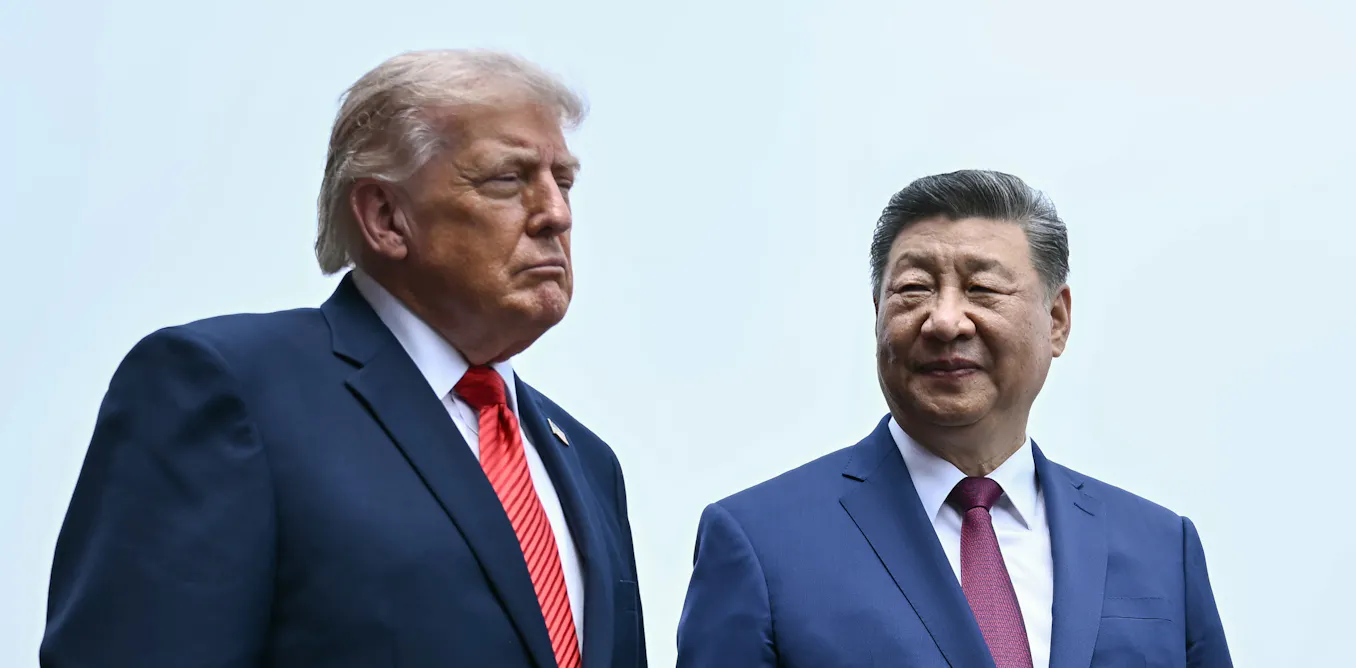
This week’s summit between US President Donald Trump and Chinese President Xi Jinping heralds a different sort of G2. On Friday, Trump claimed the countries had struck some “fantastic trade deals”. But anyone hoping for details of such deals – on tariffs, rare earths or Iran – was left disappointed on Friday afternoon.
Whatever may have transpired, US–China cooperation no longer automatically implies positive spillover effects for the rest of the world. Instead, in 2026, the G2 appears, at best, to be a private bargain between two great powers, imposing hidden costs on those outside, looking in.
The Trump administration has ushered in a noticeable shift in how the US views its economic interests: no longer premised on shared liberal values, but on spheres of influence among great powers. The key question, therefore, is not whether the US and China can cooperate. It is what kind of order their cooperation will produce.
Read more: Trump-Xi summit: 3 ways the US and China can compete without going to war
West and East
An older economic contrast is useful here.
In the wake of the second world war, the Western bloc (led across the US, the United Kingdom, and Western European states) was united by a shared commitment to a Keynesian global order (under the Bretton Woods system) that sought freer trade in goods while preserving national economic autonomy.
In contrast, the Eastern bloc (led by the Soviet Union) organised trade through what was called the Council for Mutual Economic Assistance (Comecon), trading many goods between countries through planned barter arrangements, instead of for cash.
The irony for the present day is that the Trump–Xi agenda looks more like the old Eastern bloc’s approach.
In this light, the clearest sign that a G2 may be working outside the G20 or larger rules-based order is not that Washington and Beijing are talking. It is the range of issues that may be managed, tying together such concerns as tariff relief, airplane orders, rare-earths access, chip restrictions, Taiwan and Iran.
In each of these cases, it’s reasonable the two countries would want to coordinate their policies. But together, they point to a new global order where two superpowers increasingly call the shots in their own interests.
Chips and rare earths
Rare earths and advanced chips are the clearest example. Beijing wants access to the advanced semiconductors necessary to dominate the artificial intelligence race.
Washington wants rare earths and critical minerals whose importance has become more acute as the conflict with Iran has strained US stocks of missiles, drones, air-defence systems and other high-end military technologies.
If these are traded against one another, the summit is not about economic liberalisation. It is about whether strategic technologies remain national-security constraints or become bargaining chips in a bilateral deal.
An entourage of executives
The business delegations that have accompanied Trump on this trip point in the same direction.
The presence of executives such as Nvidia’s Jensen Huang, Apple’s Tim Cook, Tesla and SpaceX’s Elon Musk (not to mention others from Qualcomm, Citigroup and Boeing) gave the summit the appearance of a commercial negotiation.
Reported agreements on aircraft orders, agricultural purchases, investment forums and corporate access may all be presented as signs of economic normalisation.
But the question is not only whether US firms gain market access. It is whether commercial wins help stabilise a great-power bargain whose geopolitical costs are borne elsewhere.
Any deal the countries eventually reach on tariffs will likely have the biggest market impacts. But the deal itself could matter less than the optics, allowing Trump to claim a business victory.
This might calm markets in the short term, but it highlights the potential for a retreat from rules-based multilateral liberalisation in the longer term.
A warning on Taiwan, near silence on Iran
The question of Taiwan loomed large over this week’s summit. On Thursday, Xi gave an unusually direct warning to Trump, saying if the issue was not handled properly, the two countries could see “clashes and even conflicts”.
In a larger sense, the danger is not necessarily a formal US concession on Taiwan. It is that Taiwan and other regional actors bear the external costs of a private bargain.
If Taiwan becomes one variable in a wider negotiation, the costs of US–China cooperation may fall on those not in the room.
Iran and oil broaden the same logic. If Trump has pressed Xi to use China’s influence over Tehran, he is not simply asking for diplomatic help. He is treating Beijing as a co-hegemon in a great-power bargain based on order for some – the US and China – and exclusion for others.
This kind of G2 can undermine the global public good. It will also test whether middle powers like Australia, Canada and European countries can keep their seat at the table where decisions are made or, as Canadian Prime Minister Mark Carney put it, risk being “on the menu”.
Facts Only
* In 2005, Fred Bergsten coined the term “Group of 2” or “G2” between the United States and China.
* Following the global financial crisis, the US enacted a US$787 billion fiscal stimulus, and China provided a US$586 billion stimulus.
* A summit between US President Donald Trump and Chinese President Xi Jinping took place this week.
* The summit involved executives from companies including Nvidia, Apple, Tesla, SpaceX, Qualcomm, Citigroup, and Boeing.
* The areas of cooperation discussed include tariff relief, airplane orders, rare-earths access, chip restrictions, Taiwan, and Iran.
* The article references historical economic contrasts between the Western bloc (Keynesian order) and the Eastern bloc (Comecon).
* The text notes a warning from Xi to Trump regarding potential clashes and conflicts if the Taiwan issue is not handled properly.
Executive Summary
Full Take
Sentinel — Likely Human
The text exhibits high coherence and strong argumentative structure, suggesting sophisticated AI assistance, though it is grounded in verifiable public knowledge.