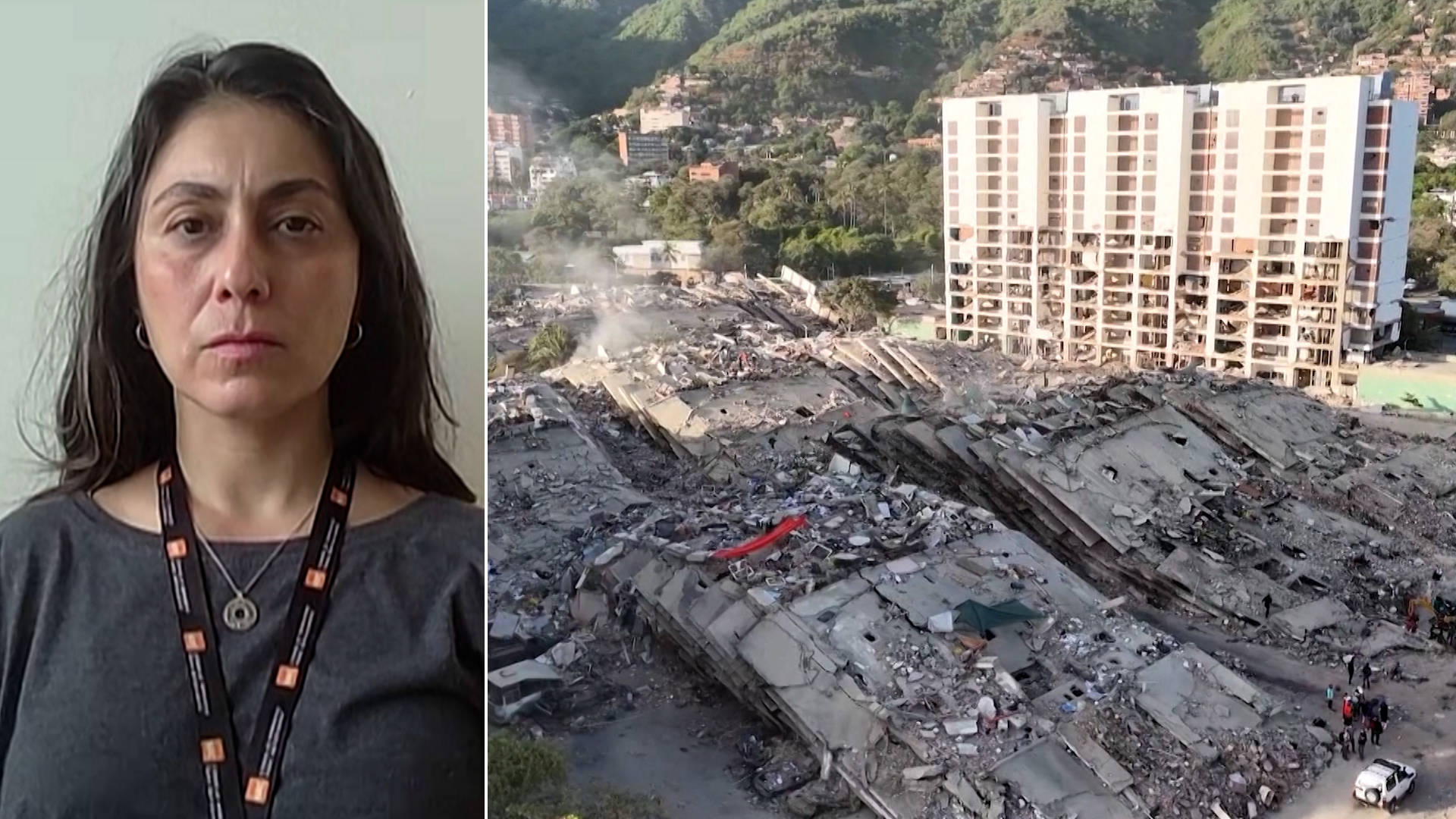
Rescue efforts in Venezuela continue as thousands of people remain missing — trapped under the rubble of flattened homes and buildings nearly a week after two back-to-back earthquakes devastated the capital, Caracas, and the nearby city of La Guaira. Rescue teams are desperately searching for survivors, with Venezuelan health officials saying Monday that over 1,700 people are confirmed dead. The toll is expected to rise dramatically as the window for finding survivors closes.
In the face of the wreckage, “we’re seeing also a lot of solidarity from the Venezuelan people” who are sharing space and resources with those displaced by the quakes, says Beatriz Ochoa, Latin America head of advocacy for the Norwegian Refugee Council. Looking ahead, “We will need to transition to more medium- and longer-term solutions, so that people can have affordable housing and a more dignified place to sleep and to be able to rebuild their lives,” says Ochoa, calling for more international support.
Transcript
AMY GOODMAN: This is Democracy Now!, democracynow.org. I’m Amy Goodman, with Juan González, as we turn now to Venezuela, where rescue efforts continue as tens of thousands of people remain missing, trapped under the rubble of flattened homes and buildings, nearly a week after two back-to-back earthquakes devastated La Guaira and Caracas. Rescue teams are desperately searching for survivors, with Venezuelan health officials saying Monday over 1,700 people are confirmed dead, with the toll expected to soar. The U.N. has said they are procuring 10,000 body bags.
This all comes as the Associated Press reports it’s believed more than a hundred Venezuelans who were deported from the United States to Caracas, hours before the earthquakes, have died. Very few survivors of that group describe being left in a hotel in La Guaira and having to crawl out of the rubble.
For more, we go to Caracas, where we’re joined by Beatriz Ochoa, the Norwegian Refugee Council’s Latin America head of advocacy.
Describe what’s happening as you sit there today, Beatriz.
BEATRIZ OCHOA: Thank you very much for having me and the Norwegian Refugee Council.
What we are seeing is a lot of devastation, not only in Caracas, but also in other parts of the country, and particularly in the coastal town of La Guaira and surroundings. We are seeing also a lot of solidarity from the Venezuelan people. This is some of the things that have surprised me the most, in a good way, people sharing sometimes very little what they have, but everybody wants to help. Everybody wants to support their neighbors, their friends, of course, their family members.
But we’re also seeing that, of course, this is going to be something that needs support for the long term. We’re seeing people staying in parks as shelters, in schools also as temporary shelters. And this is, of course, a good step into the right direction, because people are safe. They are not sleeping in the streets. But this is only — or, this can only be a temporary measure. We will need to transition to more medium- and longer-term solutions, so that people can have affordable housing and a more dignified place to sleep and to be able to rebuild their lives.
JUAN GONZÁLEZ: And, Beatriz, I wanted to ask you — the U.S. sanctions against Venezuela are largely still in place. What has been the impact of these sanctions on the ability of the Venezuelan government to deliver assistance to their citizens?
BEATRIZ OCHOA: This has something that has been in place for many years. And in the past, the sanctions have impacted the humanitarian operations in a way that there’s a lot of due diligence from the banks, from the financial institutions. There’s a lot of difficulties to process payments for our staff, for suppliers, so it’s more difficult, more expensive, more bureaucratic to do procurement.
Now, we welcome the general license that was issued a few days ago, that it’s supposed to allow operations that are intended for humanitarian operations. This has only been in place for a few days. And I think what it’s going to be most important is that financial institutions and banks are able to follow this license. Sometimes they are very afraid and then become, like, averse to process any operation that has attacked Venezuela, because they have fines, huge amount of fines. So, we welcome this waiver, so that banks and other financial institutions could feel more relief. And this is a very positive step. I think it can be a little bit too soon to test it, but for sure it’s a very positive development.
JUAN GONZÁLEZ: And I wanted to ask you, as well, about the — the Bolivarian Revolution always emphasized organizing at the neighborhood or grassroots levels, development of communes. Has this type of a grassroots organization demonstrated itself in terms of the rescue and operations that have occurred so far since the earthquakes?
BEATRIZ OCHOA: Yeah, it’s been a lot of the neighbors and the community that have organized themselves. And recently, I was in a school where — that is being used as a temporary shelter, and we were told that it was organized by communes and that they were trying to help the people that are already, like, in their neighborhoods and so on. And, of course, this is a way to organize, maybe not the only way, but that’s how the school was organizing themselves. I also visited parks, and they were organizing in a different way. It was more volunteers, neighbors and the community themselves that was doing — for instance, like, who’s cleaning the toilets, who is making sure that meals are distributed in a more equitable way. So, this is — there are different ways that the community are organizing themselves. I can tell you that.
AMY GOODMAN: And can you talk about your call, the Norwegian Refugee Council’s call, and so many others, for more support from the international community? What would that look like?
BEATRIZ OCHOA: Of course. Thank you. The Norwegian Refugee Council is calling for the international community to keep supporting the Venezuelan people. Already before the crisis, there were 7 million people in need of humanitarian assistance, and the funding situation had fallen very short in the last few years. So, this needs to stop.
The support, it’s been great. There’s been already a few countries that have sent search and rescue teams, that have already pledged certain amounts of money. This is very generous. We all very much welcome this. We need the money to provide lifesaving assistance, as I said at the beginning, a safe or safer places to sleep with dignity, where people can have privacy, where people can take showers and have minimum standards of hygiene. But we also will need support for children. Schools are being used as temporary shelters. This is the case in many other crises; this is not just for this one. Children will need access to education, to temporary learning spaces, where they can sense — where they can have a sense of normality, but also some psychosocial support, some basic tools that can make a difference between processing the traumatic experiences that they have gone through and being more resilient in the short, medium and long term.
Another message from the Norwegian Refugee Council is that the support from the international community needs to be sustained over time, so, again, not only in the short term, but this will need a long run. I see it as a marathon, not as a sprint, so we will need support for the months and years to come.
AMY GOODMAN: Beatriz Ochoa, we want to thank you for being with us, Norwegian Refugee Council’s Latin America head of advocacy, joining us from Caracas, Venezuela. Again, it’s believed over a hundred Venezuelans deported to Venezuela just hours before the earthquakes have perished.
That does it for our show. We’ll post a Spanish interview with Beatriz at democracynow.org. Also, we’re hiring an education program manager and fundraising and outreach interns. Find out more at democracynow.org/jobs. I’m Amy Goodman, with Juan González, for another edition of Democracy Now!
Media Options
Sentinel — Human
This content exhibits strong human journalistic characteristics, including attributed quotes and a focused narrative flow, suggesting it was written by an editor or journalist reporting on the events.