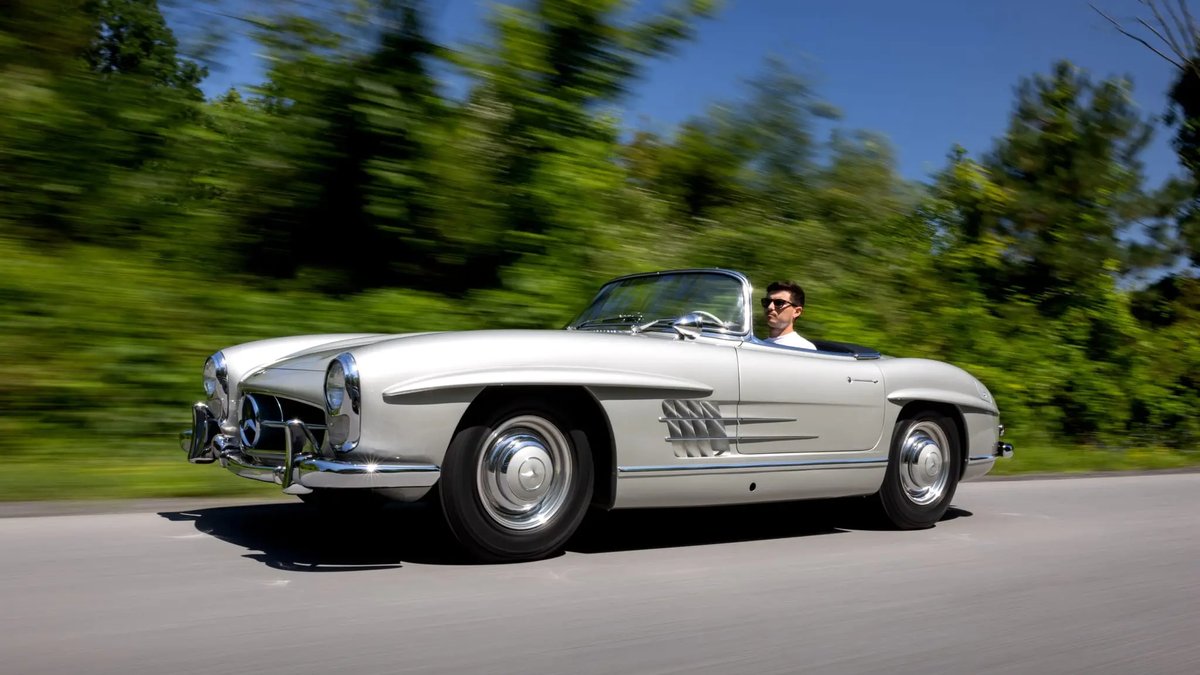
1962 Mercedes-Benz 300SL Alloy-Block Roadster
This 1962 Mercedes-Benz 300SL Roadster is one of 210 examples manufactured with an alloy engine block and four-wheel disc brakes during the final months of the model’s production. Chassis 003139 spent time with two New York owners before moving to Maryland in 1989 and remained with a collector in New Jersey from 1998 until the selling dealer’s acquisition in 2026. Refinished in silver with a matching hardtop, the car is powered by a 3.0-liter M198 inline-six that features Bosch mechanical fuel injection and dry-sump lubrication. Additional features include a four-speed manual transmission, four-wheel independent suspension with a low-pivot rear axle, a black convertible top, black leather upholstery, and a Becker Mexico radio. This alloy-block W198 roadster is now offered in North Salem, New York, with copies of its data card and a clean New Jersey title.
The roadster variant of the 300SL entered production two months after its debut at the March 1957 Geneva Motor Show, superseding the coupe model as the final Gullwings left the factory. Construction incorporated a reconfigured version of the coupe’s tubular space frame with the sill trusses lowered to accommodate conventional doors and the rear segment revised to create usable trunk space. Like its predecessor, the roadster featured steel bodywork with aluminum utilized for the hood, trunk lid, door skins, sills, floors, and bulkhead.
This example was originally finished in Fire Engine Red with a black removable hardtop and underwent a color change to silver with a matching hardtop under previous ownership. Features include US-market headlights, front and rear bumper guards, a fender-mounted driver-side mirror, pivot-out door handles, narrow-profile rear rocker panel end flanges, large-nut windshield-wiper arms, rear reflectors, and a black convertible top. Paint-meter readings can be viewed in the photo gallery below.
Chrome-finished wheels wear polished hubcaps with body-color centers and are wrapped in 6.70-15 Michelin X tires, as is a matching spare housed in the trunk. Four-wheel servo-assisted Dunlop disc brakes were introduced in 1961 beginning with chassis 002780. A brake fluid flush was performed in preparation for the sale.
The cabin is trimmed in black leather over the bucket seats, door panels, dashboard, center tunnel, sills, and aluminum top cover. Additional features include charcoal square-weave carpeting, an ivory-color shift knob, roll-up windows, lap belts, a clock, a dash-mounted rearview mirror, a lockable glovebox, a dash-mounted ashtray, and a Becker Mexico radio.
The ivory-color steering wheel sits ahead of VDO instrumentation including a 160-mph speedometer, a 7k-rpm tachometer, and a rectangular combination gauge with English lettering. The five-digit odometer shows 55k miles.
The 300SL roadster model’s 3.0-liter M198 inline-six was carried over from the fixed-roof variant and shares its canted orientation, Bosch mechanical direct fuel injection, dry-sump lubrication, and aluminum cylinder head. The competition camshaft that was optional on the coupe was made standard for the roadster, which also gained a dual-point/dual-coil ignition system and various fuel system refinements. Mid-way through 1962, the iron block previously used throughout 300SL production was replaced with an alloy unit that remained in use through the final 300SL chassis as the model’s production ended in 1963. Maintenance in preparation for the sale included an oil change and a fuel system flush.
Power is sent to the rear wheels via a four-speed manual transmission. The roadster’s four-wheel independent suspension utilizes a single-pivot rear axle with a compensator spring for improved stability over the coupe’s double-pivot design.
Engine number 198982-10-000108 is shown stamped on the engine block and tag above, and a corresponding number is isted on the factory data card. Additional stamps shown in the gallery include chassis number 198042-10-003139 stamped on the front crossmember, body number 198042-10-00151 on a tag in the left footwell, transmission number 003394, and rear axle number 003332.
The data card lists the original color combination and component numbers as well as options including a hardtop, a black convertible top, US-market equipment, and a radio.
Road Tests
Photo Gallery
Bid on This Listing
| Current Bid | USD $500,000 by the_car_museum |
| Time Left |
Auction end time will be extended if bids are received in the final 2 minutes. The auction ends 2 minutes after the last bid is received.
|
| Ends On |
Tuesday, July 21 at 10:00am PT
Remind me
|
| Bids | 8 |
| Place Bid | Register to Bid |
BaT Essentials
- Chassis: 19804210003139
- 55k Miles Shown
- 3.0-Liter M198 Inline-Six
- Alloy Engine Block
- Bosch Direct Fuel Injection
- Dry-Sump Lubrication
- Four-Speed Manual Transmission
- Repainted Silver
- Black Leather Upholstery
- Servo-Assisted Four-Wheel Disc Brakes
- Four-Wheel Independent Suspension
- 15" Chrome Wheels
- Becker Mexico Radio
- Copies of Data Card
15 Comments
Loading more comments…
Please enable JavaScript to engage in the discussion on this site.
Confirm Your Comment
Did you mean to enter this number as a bid? If so please use the bidding box above.
Error Posting Comment
There was an error posting your comment.
Facts Only
* Chassis number is 003139.
* Manufactured with an alloy engine block and four-wheel disc brakes.
* Powered by a 3.0-liter M198 inline-six.
* Engine features Bosch mechanical fuel injection and dry-sump lubrication.
* Transmission is a four-speed manual.
* Suspension is four-wheel independent with a low-pivot rear axle.
* Original finish was Fire Engine Red, later changed to silver with a matching hardtop.
* Interior features black leather upholstery and charcoal carpeting.
* The engine block was replaced with an alloy unit mid-1962.
* Four-wheel servo-assisted Dunlop disc brakes were introduced in 1961.
Executive Summary
Full Take
Sentinel — Human
This text functions primarily as an extremely dense, fact-heavy description of a specific vehicle, exhibiting the high level of detail and specificity characteristic of human archival or editorial reporting.