Economics
Data Centers Drive Construction Growth But Tariffs, Interest Rates Pose Challenges Ahead
Manufacturing employment drops as CHIPS Act subsidies sunset
Growth is expected throughout 2026 but rising interest rates and effects from tariffs and immigration are sources of “real risk”, Anirban Basu, chief economist for the Associated Builders and Contractors, explained in a midyear economic update webinar July 8.
Between June 2024 and June 2026, construction employment has risen 1.6% overall, largely due to data center construction, which continues to dominate the sector. Overall non-residential employment rose 4.5%, while residential construction employment fell 2.5%. “The industry is busy, but it’s lopsided,” said Basu, noting that contractors have told him data center construction accounts for 35% of their work, up from 5% just a few years ago.
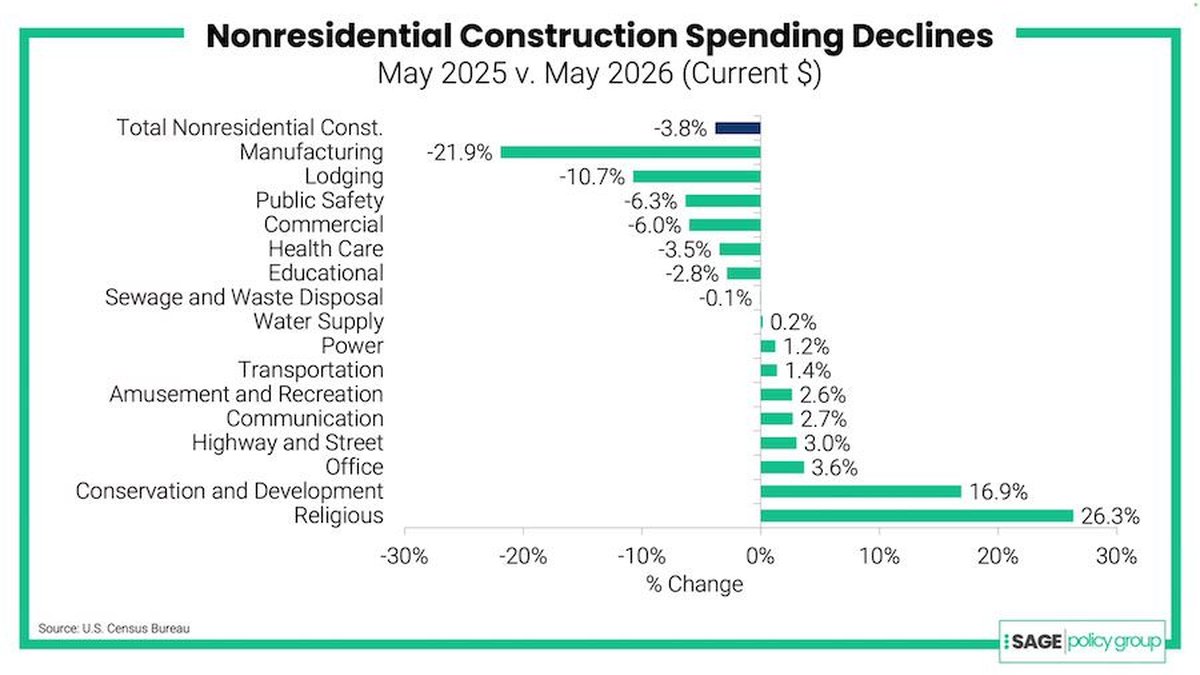
Many other segments, however, are held back by high interest rates and by high materials costs, causing an overall 3.8% decline in construction spending year-over-year as of May 2026. Manufacturing dropped 21.9%, which Basu attributed to the nearing expiration of the Biden-era CHIPS and Science Act which provided subsidies in this sector for the past several years. Hotel construction also dropped, at a rate of 10.7%. “Hotel occupancy is up, and hotel construction is down,” said Basu, due to high labor and material costs.
Overall, material costs have risen 55.5% since Feb. 2020, the last month before the COVID-19 pandemic. This is largely due to more recent events, such as the conflict in Iran, causing crude petroleum and crude energy materials prices to soar, at a rate of 128.5% and 116.4%, respectively. Tariffs also played a significant part, as nonferrous wire and cable prices rose 91.4% and steel mill products experienced a 86% jump in prices.
For the remainder of 2026, “I think there’s enough demand between artificial intelligence [and] corporate investment … to keep the U.S. economy going from a top line GDP perspective, but there are some real risks out there, including for construction,” said Basu, particularly an interest rate hike in 2027.
Looking for quick answers on construction and engineering topics?
Try Ask ENR, our new smart AI search tool.
Ask ENR →
Sentinel — Human
The text reads like standard economic reporting, attributing statistics and commentary to an identified economist while synthesizing complex data flows.