In brief
- Florida Gov. Ron DeSantis, a vocal critic of government surveillance via CBDCs, could sign a bill that gives Florida the ability to regulate stablecoins independently.
- The legislation includes transaction monitoring requirements that mirror federal anti-money laundering rules that some libertarians have opposed.
- Sen. Ted Cruz is among CBDC skeptics that remain cautious, arguing a temporary ban included in a recently passed housing bill is insufficient.
Not long before Ron DeSantis began shaping his bid for the 2024 Republican presidential nomination, the Florida governor described a dystopian future looming on the horizon.
He warned that a central bank digital currency, or CBDC, could enable the federal government to inject “woke politics” into Americans’ everyday lives—whether that involved restricting gas purchases to combat climate change or monitoring individuals’ firearm purchases. At the time, he described the Biden administration’s efforts to research a CBDC as ominous.
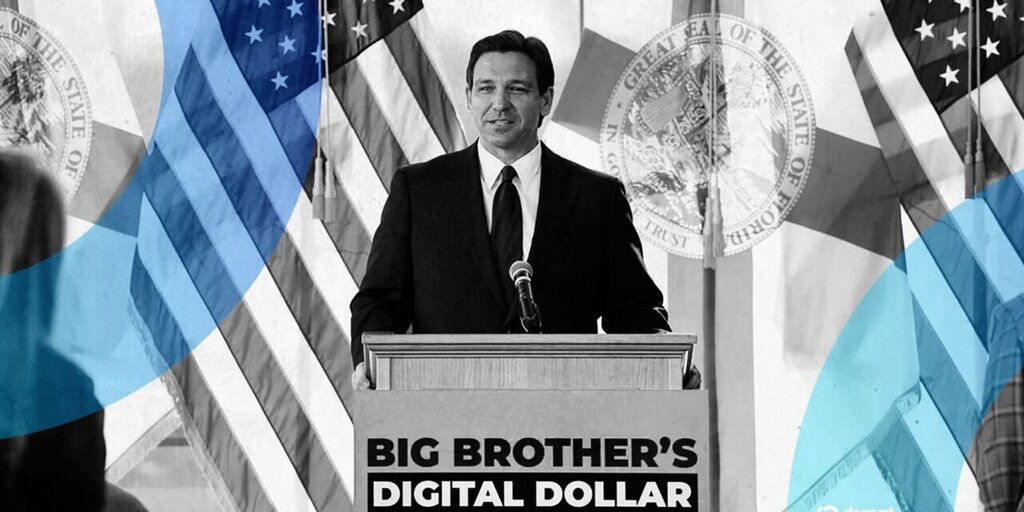
Nearly three years after the governor stood behind a podium that decried “Big Brother’s Digital Dollar,” DeSantis appears poised to sign a bill that creates a regulatory framework for stablecoins within Florida, expanding the state’s control over digital assets. The legislation, Bill 314, was passed unanimously on March 6 by the Florida State Senate.
By requiring companies that issue stablecoins in the Sunshine State to record transactions with a value greater than $10,000, the legislation parallels existing anti-money laundering rules. However, it may also complicate DeSantis’ stance against potential government overreach.
Since the governor has yet to see the bill in its final form, a spokesperson for DeSantis told Decrypt on Thursday that he’s unable to comment on potential conflicts. To be clear, DeSantis hasn’t indicated whether he’ll sign the bill yet, which represents one of the earliest state-level efforts to establish rules that align with the federal GENIUS Act.
Nonetheless, it’s becoming increasingly common for politicians to vocalize concerns toward CBDCs while supporting efforts involving piecemeal surveillance and control, according to Nicholas Anthony, a policy analyst at the Cato Institute, a libertarian think tank in Washington.
“It’s much harder to square in DeSantis’ case,” he told Decrypt. “He built a campaign on standing up to ‘Big Brother’ and the federal government, but he’s kind of handing them the keys to the castle in this sense.”
While stablecoins are issued by private companies like Circle on public networks like Ethereum, CBDCs are digital assets issued by governments to act as cash equivalents. Stablecoins in the U.S. are often anchored to the dollar through reserves of cash and U.S. Treasuries, while a CBDC would carry the “full faith and credit” of the federal government.
As DeSantis warned of CBDCs in 2023, he signed a bill banning a “centralized digital dollar” in Florida. Just this past Thursday, the U.S. Senate passed a housing bill that would ban the creation of a CBDC until 2030, if the bill is ultimately signed into law by President Donald Trump—though it faces potential hurdles to get to that point.
Earlier this week, Florida State Senator Colleen Burton, who sponsored Bill 314, told Decrypt that lawmakers moved quickly to pass the legislation. She cited a July deadline, when states can apply to regulate certain stablecoins independently.
“Obviously, we have to go to the federal government [and] work with them so that we have the ability to regulate stablecoins here,” she said. “One of the things we did was draft this bill with that in mind every step of the way, and we’re not looking to get our application rejected.”
Decrypt has reached out to Burton for further comment.
A green light would empower Florida’s Office of Financial Regulation, or OFR, to become a primary regulator within state borders. That comes with the authority to revoke licenses under circumstances related to regulatory compliance, financial reporting, and criminal activity.
In 2022, the OFR published a paper on regulatory issues surrounding crypto, describing the seizure of digital assets as difficult due to the self-custodial nature of most crypto wallets. However, companies like Circle have historically frozen stablecoins using a blacklist, while working with law enforcement to address bad actors.
Decrypt has reached out to the OFR for comment.
“CBDCs create a lot of problems with financial surveillance and control, but they don’t invent the problems out of thin air,” Cato’s Anthony said. “It’s important to make sure [the public] knows that there are other avenues for it as well.”
When it comes to the GENIUS Act, former U.S. Representative Marjorie Taylor Greene (R-GA) alleged on X in December that the legislation contains a provision that would allow the government to introduce a CBDC through a back door.
“I support crypto, but I will never support giving the government the ability to turn off your ability to have full control of your money and to buy and sell,” she added.
Although DeSantis has rallied against CBDCs alongside other conservative figures like Trump and Sen. Ted Cruz (R-TX), House Majority Whip Tom Emmer (R-MN) has been among the most outspoken critics. He reintroduced a bill last year to outlaw CBDCs.
On Thursday, Cruz expressed concern that the restrictions toward CBDCs included in the 21st Century ROAD to Housing Act were temporary, indicating his fight isn’t over yet.
“It only pauses the development until December 31, 2030,” he said in a press release. “My Anti-CBDC Act takes the correct approach by permanently prohibiting the Federal Reserve from ever issuing a CBDC, directly or indirectly.”
Facts Only
* Florida Governor Ron DeSantis is considering a bill to regulate stablecoins independently.
* The bill requires transactions over $10,000 to be monitored.
* This mirrors federal anti-money laundering rules.
* Sen. Ted Cruz remains skeptical of CBDCs.
* Bill 314 was passed unanimously by the Florida State Senate on March 6.
* The OFR will be responsible for enforcing the regulations.
* Circle issues stablecoins on Ethereum.
* CBDCs are digital assets issued by governments.
* The GENIUS Act seeks to limit government control over digital assets.
* Marjorie Taylor Greene raised concerns about backdoor CBDC provisions.
* Tom Emmer has been a vocal critic of CBDCs.
Executive Summary
Full Take
The article presents a concerning, though ultimately limited, glimpse into a sustained effort to contain the perceived threat of CBDCs, primarily through regulatory control of stablecoins. DeSantis's actions—seemingly a pragmatic move to protect Florida's digital asset market—reveal a deep-seated anxiety about government overreach, skillfully leveraging the "Big Brother" framing to galvanize opposition. The bill's mirroring of existing AML rules is a tactical move, attempting to legitimize regulation while simultaneously raising questions about potential surveillance. However, the crucial element is the unspoken assumption: that unregulated, decentralized systems represent a greater danger than a carefully controlled, albeit potentially intrusive, regulatory framework. This resonates with a broader conservative narrative, exemplified by Cruz’s insistence on permanent bans and Greene's “backdoor” anxieties—all predicated on a distrust of governmental power, a pattern potentially amplified by strategic messaging campaigns. The simultaneous pursuit of state-level regulation and the GENIUS Act highlights a fundamental strategic alignment: a desire to preempt a future where the federal government unilaterally controls digital currency. The article hints at a larger, unstated battle over control—not just of money, but of information and individual autonomy. The speed with which Florida enacted this legislation, driven by a July deadline, suggests a deliberate attempt to gain regulatory ground, hinting at a coordinated effort within the conservative movement.
Patterns detected: ARC-0043 Motte-and-Bailey, ARC-0024 Ambiguity, ARC-0017 False Framing.
Sentinel — Likely Human
The article presents a balanced account of Florida's move to regulate stablecoins, incorporating perspectives from various stakeholders and referencing relevant legislative actions. The analysis suggests a potentially human-authored report due to symmetrical phrasing and reliance on attribution, but doesn’t definitively identify synthetic generation.