Writing Tip: Surround Yourself With Beloved Objects
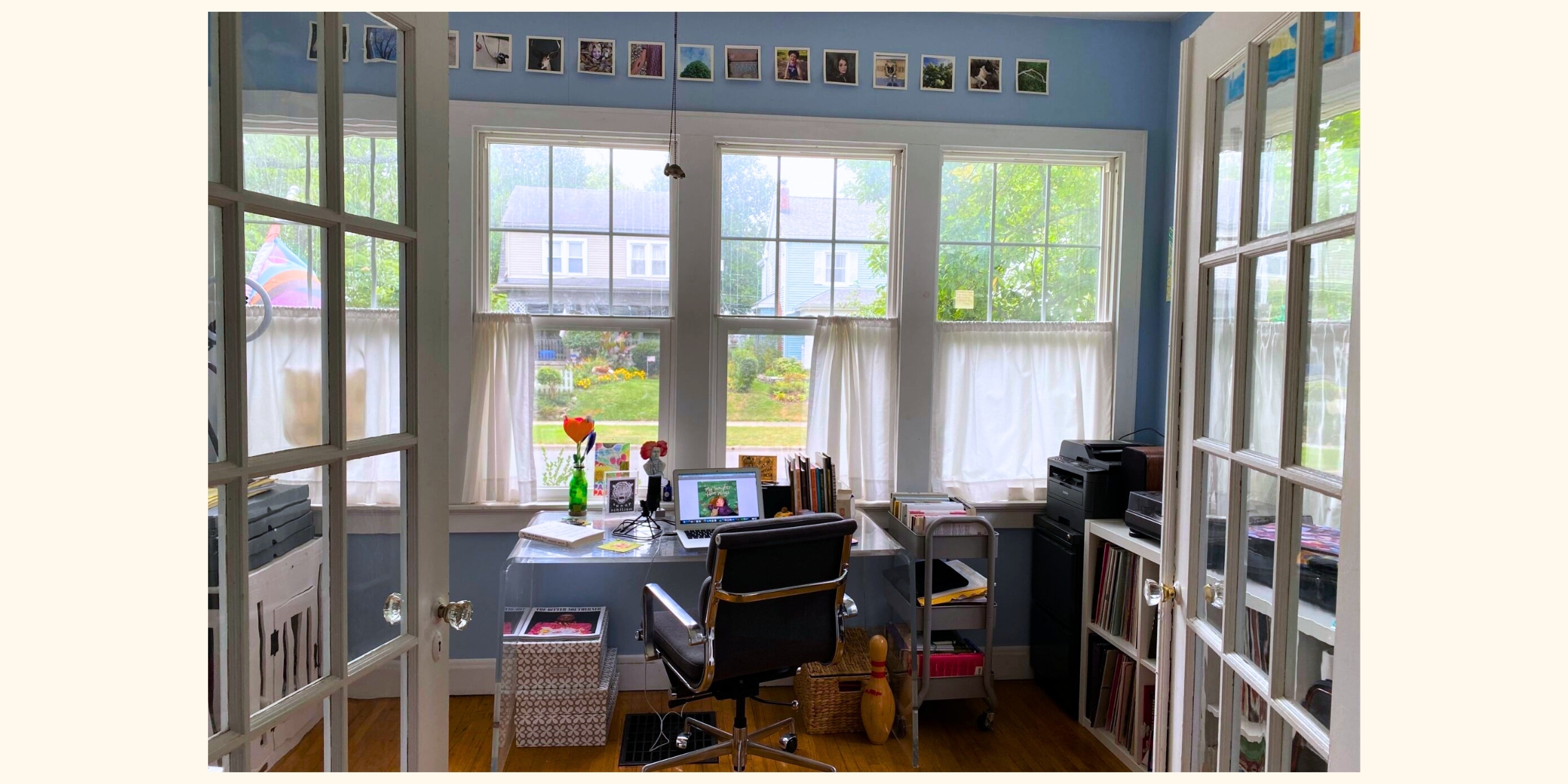
My writing space was once my kids’ playroom. It’s a small room separated from our living room by glass-paned French doors, and the other three walls are completely wrapped in windows, so I’m surrounded by glass when I’m working in there. I love being able to look out onto the street from my desk, seeing the people walking their dogs, and kids on bikes, and parents pushing strollers. I’m alone but not alone. (That said, because of all of the windows and my proximity to the street, when I record episodes of The Slowdown, I don’t do it at my desk. That magic happens upstairs in my daughter’s cozy bedroom!)
DESK
I bought this clear acrylic desk from CB2 because it takes up less visual space in the room. I keep a number of beloved objects on it, so I’m surrounded by them as I work. Each one is a sort of talisman. There’s a framed Audre Lorde postcard that reads, “I am who I am, doing what I came to do.” My friend Marie Myung-Ok Lee sent it to me when I was in the thick of my divorce. I keep a fortune cookie slip propped beside it—“Do what you love and the necessary resources will follow”—and both are essential reminders for the self-employed writer. There’s also a card that my high school English teacher, Jim Grannis, gave me when I graduated. It’s Mozart with pink hair, and he wrote on the inside, “We’re not afraid to be ourselves, eh?” All of these things, and others, buoy me when I’m writing.
Books
I have a few book shelves in my office, but on a little rolling cart beside my desk I keep books related to my current projects: craft books, research, comp titles. Some I’ve already read and keep close at hand for reference; others I want to read because I think they’ll help me think more deeply into my own writing. When an interviewer or podcast host asks what I’m reading, or when students I’m zooming with want recommendations, it’s handy to have books I can easily see and grab without getting up from my desk.
Music
In addition to the book storage in my office, I also keep my turntable and my records in that room. I’m almost always listening to music, including when I’m writing, so it’s nice to have my vinyl close by when I’m at home. The room is small enough that the sound really fills it. I stream music from my phone and laptop when I’m on the go, and I make playlists for every book, full of songs that inspired me while I was writing, or that seem to fit the work thematically or tonally. Those playlists are available on my Spotify, including the latest playlist for my new book of poems, A Suit or a Suitcase.
Art
On my desk there’s some childhood art by my son and daughter when they were younger: a clay piece and some heart “flowers” by Rhett and a milk carton model of our house and a collage by Violet. Hanging above the windows are photos from my phone, printed Polaroid-style, and along the walls. Unseen in these photos are some music posters (Superchunk and Mac McCaughan solo) and multiple paintings and collages by my children. In one of the front windows is a Post-It note that’s been there for years now. On it I wrote some of my favorite lines by Rilke: “Let everything happen to you: beauty and terror. Just keep going. No feeling is final.”
Writing Materials
I use a MacBook Air that has many, many miles on it, but so far (*knocks wood*) it’s still running. With poems, essays, and shorter forms, though, I usually write longhand first, in a notebook or on a yellow legal pad, until the piece begins to take shape. Once the form starts to become clear, I move to a Word document on my laptop. This might not be the most efficient process, but I find that my mind works better when I’m writing by hand vs. hunting and pecking. Confession: I never learned how to properly type, so while I’m relatively quick with only my two index fingers, I’m much faster with a pen. My go-to is the Uni-Ball Vision Elite in black.
_______________________________________
A Suit or a Suitcase by Maggie Smith is available via Washington Square Press.
Maggie Smith
Maggie Smith is the award-winning New York Times bestselling author of eight books of poetry and prose, including You Could Make This Place Beautiful, Good Bones, Goldenrod, Keep Moving, and My Thoughts Have Wings. A 2011 recipient of a Creative Writing Fellowship from the National Endowment for the Arts, Smith has also received a Pushcart Prize, and numerous grants and awards from the Academy of American Poets, the Sustainable Arts Foundation, the Ohio Arts Council, the Greater Columbus Arts Council, and the Virginia Center for the Creative Arts. She has been widely published, appearing in The New Yorker, The Paris Review, The Nation, The New York Times, The Atlantic, The Best American Poetry, and more. You can follow her on social media @MaggieSmithPoet.
Facts Only
Maggie Smith is the author of eight books of poetry and prose.
Her current projects include poems, essays, and shorter forms.
She uses a MacBook Air for most of her writing.
Smith handwrites her work first before moving to a Word document on her laptop.
Her writing space was once her children's playroom.
The room is separated from the living room by glass-paned French doors and has windows wrapping three walls, allowing for street views.
She keeps beloved objects such as postcards, fortune cookie slips, cards, and childhood art on her desk.
Books related to her current projects are stored in a rolling cart beside her desk.
Music and records are also kept in the room, with Smith often listening to music while writing.
Art pieces, including paintings and collages by her children, decorate the walls of her office.
Executive Summary
Full Take
By examining Smith's writing space, we can observe patterns that reveal her creative process and sources of inspiration. The presence of beloved objects on her desk serves as talismans, reminding her of encouragement she received during challenging times. This suggests an emotional connection to these items, which may help maintain motivation and focus during the creative process.
The inclusion of books related to current projects highlights Smith's ongoing research and development, demonstrating her commitment to expanding her knowledge in order to deepen her work. The proximity of her turntable and records indicates a desire for musical accompaniment while writing, possibly serving as a mood-setting tool or distraction from potential obstacles.
The artwork displayed throughout the room showcases not only Smith's personal history but also that of her children, underscoring the interplay between family life and artistic pursuits. The Post-It note featuring lines by Rilke hanging in one of the front windows serves as a continuous reminder of Smith's creative mission, emphasizing the importance of perseverance in both beauty and terror.
Overall, Smith's writing space reflects her passion for literature, music, and art, while also incorporating elements from her personal life that contribute to her inspiration and productivity.