Skip to content
Chimera readability score 0.5584 out of 100, reading level.

Australian scientists have demonstrated proof-of-concept for a quantum battery.
Like conventional batteries, it charges, stores and discharges energy. However, unlike conventional batteries, it leverages unique properties of quantum mechanics such as superposition and entanglement rather than chemical reactions.
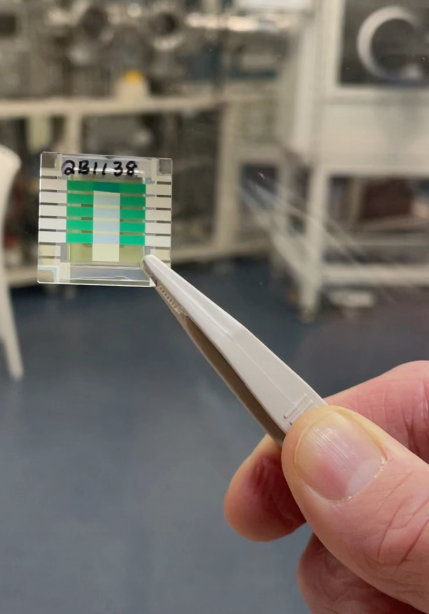
The battery has a multi-layered organic microcavity and is wirelessly charged with a laser. It has been demonstrated to have rapid, scalable charging and energy storage at room temperature.
The research by CSIRO, Australia's national science agency, and collaborators RMIT University and the University of Melbourne, is being led by Dr James Quach, quantum science leader at CSIRO.
“Our findings confirm a fundamental quantum effect that's completely counterintuitive: quantum batteries charge faster as they get larger,” says Quach.
Fully functioning quantum batteries don’t yet exist, but they hold the potential to transform how energy is used and stored in the future.
“My ultimate ambition is a future where we can charge electric cars much faster than fuel petrol cars, or charge devices over long distances wirelessly,” Quach said.
And in principle, if it can power a car, it can power maritime vehicles as well.
One of the potential applications is remote charging. “If we had a quantum battery on a drone, for example, we could charge it remotely by shining a laser at it so it doesn't have to park. We could actually do the same thing for other autonomous vehicles in or near water.”
Unlike quantum computers that need to be cooled down to cryogenic temperatures to precisely control individual qubits, the quantum battery makes use of collective effects which are more robust to environmental “noise.”
The team used advanced spectroscopy techniques to demonstrate that the prototype battery retained stored energy six orders of magnitude longer than it took to charge.
“The next step for quantum batteries right now is extending their energy storage time. If we can overcome that hurdle, we’d be that bit closer to commercially viable quantum batteries," says Quach.
CSIRO is seeking interest from potential development partners.

Facts Only

* CSIRO, RMIT University, and the University of Melbourne are conducting research.
* The research focuses on a quantum battery prototype.
* The battery utilizes a multi-layered organic microcavity.
* It is wirelessly charged using a laser.
* The battery demonstrates rapid, scalable charging and energy storage at room temperature.
* The charging speed increases as the battery size increases – a counterintuitive quantum effect.
* The prototype retains stored energy six orders of magnitude longer than the charging time.
* Fully functioning quantum batteries do not yet exist.
* Dr. James Quach leads the research at CSIRO.
* CSIRO is seeking interest from development partners.

Executive Summary

The research team at CSIRO, in collaboration with RMIT University and the University of Melbourne, has developed a prototype quantum battery. This battery utilizes a novel design, employing a multi-layered organic microcavity and wireless charging via laser. Notably, the battery’s charging speed increases proportionally with its size, a phenomenon that contradicts conventional battery behavior. While the prototype shows promise in rapid, scalable energy storage at room temperature and retains energy efficiently, it's important to recognize that this is a proof-of-concept. Dr. Quach’s research suggests a fundamental quantum effect, though functional, commercially viable quantum batteries are still under development. The potential applications highlighted include faster electric vehicle charging and remote charging for autonomous vehicles and drones, representing a significant shift in energy storage technology. The team is actively seeking development partners to further explore the technology’s capabilities.

Full Take

The article presents a compelling, if preliminary, demonstration of a quantum battery, framing it as a potential game-changer for energy storage. The “bigger the battery, the quicker it charges” statement is a critical element—a deliberately provocative claim designed to capture attention. The core narrative relies heavily on the promise of disruptive innovation, leveraging quantum mechanics for radically faster charging and scalability, a powerful “moonshot” narrative. The use of terms like “robust to environmental noise” echoes a common tactic in emerging technology marketing, employing technical-sounding language to create an impression of stability and reliability – a potential case of jargon as a smokescreen. We see a classic “first-mover advantage” framing, where CSIRO’s research is positioned as laying the groundwork for transformative future technologies. The emphasis on remote charging for drones and maritime vehicles speaks to a broader pattern of seeking specialized applications—niche markets where rapid charging could represent a decisive advantage. The fact that the research is still at the proof-of-concept stage is carefully managed, minimizing immediate expectations while simultaneously generating excitement. The team’s search for development partners suggests a calculated move towards eventual commercialization. The “next step is extending their energy storage time” reflects a standard progression in technological development—a common bottleneck identified in early-stage research. There’s a subtle shift in focus, from demonstrating a phenomenon to solving a practical limitation. Patterns detected: ARC-0024 Ambiguity (overstating the current state of the technology), ARC-0043 Motte-and-Bailey (presenting a counterintuitive effect while acknowledging it's a “proof-of-concept”).