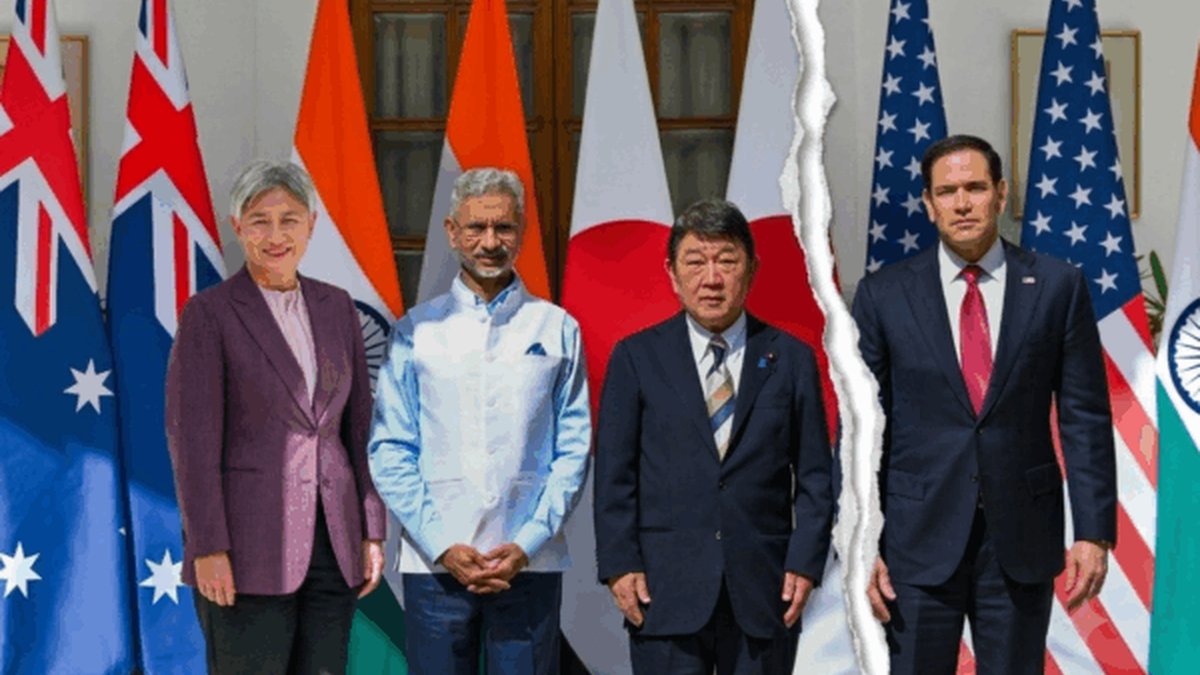
Last month, the United States changed the name of U.S. Indo-Pacific Command to just Pacific Command, a reversal from its 2018 decision. Back in 2018, Washington was continuing its “pivot to Asia” and developing institutional embeddedness in the context of its “Free and Open Indo-Pacific” strategy. This effort was embodied by the Quad, which began on the foreign minister track in 2019 and finally elevated to leader level summits in 2021.
However, the priorities of the second Trump administration have shifted radically from those of Trump’s first administration, causing rising distrust among Indo-Pacific allies. Against that backdrop, the return to a purely Pacific Command reinforced concerns that the United States is uninterested in the Indo-Pacific. The diminishing of U.S. influence, coupled with China’s economic rise, increases China’s potential to become a regional hegemon.
But the other regional powers will have a say in future developments, and they have been busy. Indian Prime Minister Narendra Modi is currently wrapping up a three-country tour of Indonesia, Australia, and New Zealand. South Korean President Lee Jae-myung visited India and Vietnam in April and is in Mongolia at the moment. Japan’s Prime Minister Takaichi Sanae visited Vietnam, Australia, and South Korea in May, and India in the first week of July. The packed diplomatic calendar is a reminder that we must also consider how these countries are trying to deter China – even without the United States.
Can these countries, all with significant ties with the United States, collectively deter China themselves, minus U.S. involvement?
The honest answer is a qualified no. What Japan, South Korea, India, Australia, and Indonesia can already do together is deter by denial at sea. These five countries sit astride the First Island Chain, as well as the Malacca, Sunda and Lombok straits – the sea lanes carrying most of China’s energy imports. Japan is fielding counterstrike missiles on a defense budget reaching 2 percent of GDP. Seoul plans to lift its defense spending from 2.3 to 3.5 percent of GDP by 2035 on top of one of the world’s most productive defense industries. India can keep a large share of Chinese forces pinned on the Himalayan frontier while exporting BrahMos batteries to Jakarta.
What they cannot do, minus the United States, is deter a major war. There is no mutual defense obligation among any of the five, no unified command, no shared war plan, and no substitute for U.S. extended nuclear deterrence over Tokyo and Seoul. South Korea’s forces, in any case, remain fixed on Pyongyang.
This suggests that cooperation should start from four primary areas. First, maritime domain awareness. A shared operating picture across two oceans is the most cost-effective way to achieve collective capability.
Second, logistics and access. Widen the web of reciprocal access and mutual logistics agreements so ports, airfields and fuel are usable during a crisis.
Third, defense-industrial co-production. This is already underway. Korean K9 guns are being built in India as the Vajra, while Hanwha is delivering Huntsman howitzers and Redback vehicles to Australia. Australia’s first Japanese-built Mogami frigate is expected to arrive in 2029 with a shipbuilding base planned.
Fourth, collective resilience against economic coercion. Economic dependence is Beijing’s true battleground, meaning these partners must achieve a level of independence in the critical mineral supply chain.
Deterring China together will require an institutional apparatus developed by these countries, bilaterally and multilaterally. As of now, the institutional framework is uneven.
Australia-Japan forms the core, with a Reciprocal Access Agreement and a Framework for Strategic Defense Coordination, effective from December 2025 across all levels and situations. India maintains 2+2 dialogues with Tokyo and Canberra but not with Seoul or Jakarta. Furthermore the Japan-South Korea relationship remains hampered by historical issues, with intelligence-sharing politically precarious.
As an added challenge, threat perceptions vis-a-vis China vary widely. Tokyo perceives an existential maritime challenge while New Delhi sees a continental one. Canberra views China as a distant but growing threat and Seoul prioritizes North Korean issues. Meanwhile, Jakarta, despite purchasing BrahMos missiles, refuses to identify a specific threat and continues strengthening trade with Beijing.
A calibrated response cannot mean each country hedging alone; it must add up to something collective. India, Japan, and Australia – the Quad minus the U.S. – need to cast a wider net of strategic institutional embeddedness among themselves, and extend it outwards to South Korea, Indonesia, Vietnam, and the Philippines.
That web, not any single alliance, may develop as the deterrent, even if the U.S. drifts away from the Indo-Pacific.
Facts Only
* The United States changed the name of U.S. Indo-Pacific Command to Pacific Command last month.
* In 2018, the U.S. developed an "Free and Open Indo-Pacific" strategy.
* The Quad began on the foreign minister track in 2019 and elevated to leader level summits in 2021.
* Priorities of the second Trump administration shifted from the first.
* The return to Pacific Command reinforced concerns about U.S. interest in the Indo-Pacific.
* China’s economic rise increases its potential to become a regional hegemon.
* Indian Prime Minister Narendra Modi completed a three-country tour of Indonesia, Australia, and New Zealand.
* South Korean President Lee Jae-myung visited India and Vietnam in April and is currently in Mongolia.
* Japan's Prime Minister Takaichi Sanae visited Vietnam, Australia, and South Korea in May, and India in the first week of July.
* Five countries (Japan, South Korea, India, Australia, Indonesia) can deter by denial at sea across the First Island Chain and straits.
* Japan is fielding counterstrike missiles on a defense budget reaching 2 percent of GDP.
* South Korea plans to increase defense spending from 2.3 to 3.5 percent of GDP by 2035.
* India exports BrahMos batteries to Jakarta.
* Cooperation areas proposed are maritime domain awareness, logistics/access, defense-industrial co-production, and collective resilience against economic coercion.
Executive Summary
The United States changed the name of U.S. Indo-Pacific Command to Pacific Command last month, reversing a 2018 decision. This shift occurred against a backdrop where priorities of the second Trump administration differed from the first, leading to increased distrust among Indo-Pacific allies. The reversion to Pacific Command reinforced concerns that the U.S. is uninterested in the Indo-Pacific, which increases China’s potential to become a regional hegemon due to diminishing U.S. influence and China's economic rise.
Regional powers are actively pursuing their own deterrence efforts through diplomatic engagement, with leaders from India, South Korea, Japan, Australia, and Indonesia engaged in extensive travel. These nations are trying to deter China independently. While the US involvement is removed, these five countries can collectively deter by denial at sea, controlling critical sea lanes like the Malacca, Sunda, and Lombok straits. However, they lack a mutual defense obligation or unified command against major war. Deterrence requires cooperation across four areas: maritime domain awareness, logistics/access, defense-industrial co-production, and collective resilience against economic coercion. Current institutional frameworks are uneven, with Australia-Japan forming the core, while other bilateral relations remain strained.
Full Take
The narrative presents a critical tension between the formal institutional structure established by the United States and the evolving realities of regional power dynamics shaped by shifting geopolitical priorities. The core observation is that institutional commitment—as seen in the U.S. command name change—is not sufficient to guarantee strategic stability, especially when external leadership wavers. The move away from a broad Indo-Pacific strategy suggests a prioritization of domestic or other strategic goals over coordinated regional engagement, which creates an information deficit for allies regarding reliable security guarantees.
The analysis pivots from the limitations of formal alliance structures (the lack of mutual defense or unified command) to the necessity of building functional, albeit provisional, cooperative frameworks among regional actors. The focus on shared capabilities—maritime awareness and industrial co-production—suggests a paradigm shift where collective action must substitute for singular great-power guarantees. However, the existing institutional architecture is characterized by deep structural fissures: varying threat perceptions among states (existential maritime vs. continental), unresolved historical grievances hindering intelligence sharing, and divergent economic dependencies that complicate the construction of unified resilience against economic coercion.
The pattern suggests a reversion from an overarching, explicitly defined strategic partnership to a more transactional, capability-focused engagement where immediate shared interests—specifically deterring China’s naval dominance and managing supply chain risks—drive nascent cooperation. The real challenge lies in institutionalizing these pragmatic cooperative steps into a durable structure that transcends the volatility of single administrations, demanding not just bilateral agreements but deep, cross-cutting embeddedness to effectively counteract the emergent risk of regional hegemonic shift.
Sentinel — Human
This text functions as sophisticated geopolitical analysis, synthesizing factual shifts with complex strategic implications, demonstrating the characteristic depth of human policy writing rather than simple aggregation.