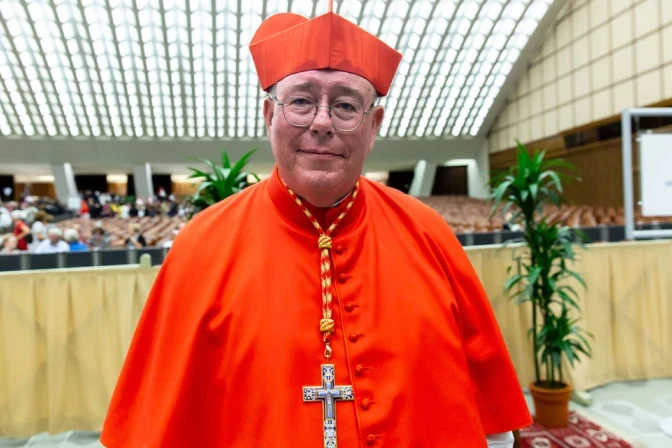
Cardinal Jean-Claude Hollerich, SJ, the former general relator of the Synod on Synodality, has publicly called for the ordination of women, arguing that the Church cannot long endure if half of the people of God lacks access to ordained ministry.
“I cannot imagine in the long run how a Church can survive if half of the people of God suffers because they have no access to ordained ministry,” Hollerich said Thursday at a symposium on synodality and Praedicate Evangelium at the University of Bonn, according to news agency KNA.
The archbishop of Luxembourg, who previously described himself as more conservative on the question, said his views had changed. “I have also learned as a bishop that this is not just a desire of a few left-wing women’s associations,” he claimed.
While calling for patience with other cultures who may see the ordination debate as an “artificial problem,” Hollerich cited what he asserted was widespread support for women’s ordination in his parishes.
“When I speak with the women in the parishes, 90% among us have the same opinion,” he said, adding that bishops are obliged to listen to such voices.
Church’s definitive teaching
In his 1994 apostolic letter Ordinatio Sacerdotalis, Pope John Paul II declared definitively that “the Church has no authority whatsoever to confer priestly ordination on women and that this judgment is to be definitively held by all the Church’s faithful.”
Since holy orders is a single sacrament with three degrees, that ruling covers the diaconate and episcopate equally.
Curia reform and papal succession
Hollerich also praised the late Pope Francis’ impact on the Roman Curia. Through his apostolic constitution Praedicate Evangelium, Francis — who served as pope from 2013 until his death in 2025 — opened leadership positions in the Vatican to women. Hollerich said this trajectory would continue under Pope Leo XIV. “It would be my deepest wish that the whole Church rejoices in this,” he said.
The symposium was organized by the University of Bonn’s Department of Moral Theology under theologian Jochen Sautermeister. Also speaking were Cardinals Óscar Rodríguez Maradiaga and Oswald Gracias, along with Bishops Franz-Josef Overbeck of Essen, Germany, and Klaus Krämer of Rottenburg-Stuttgart, Germany.
This story was first published by CNA Deutsch, the German-language sister service of EWTN News, and has been translated and adapted by EWTN News English.
The Holy See urged a “holistic approach” to justice for women and girls centered on human dignity as the U.N. gender debate deepens.
Facts Only
Cardinal Jean-Claude Hollerich called for the ordination of women
The Church has no authority to confer priestly ordination on women (Pope John Paul II's declaration in 1994)
Pope Francis' impact on the Roman Curia, particularly opening leadership positions to women
Cardinal Hollerich stated that bishops must listen to voices supporting women's ordination
The symposium was organized by the University of Bonn's Department of Moral Theology
Cardinals Óscar Rodríguez Maradiaga and Oswald Gracias, along with Bishops Franz-Josef Overbeck of Essen, Germany, and Klaus Krämer of Rottenburg-Stuttgart, Germany, also spoke at the symposium
Executive Summary
Full Take
Patterns detected: ARC-0043 Motte-and-Bailey (Hollerich presents a strong argument for women's ordination while acknowledging cultural differences), ARC-0024 Ambiguity (the article does not clarify what Pope Leo XIV refers to, or the exact role of women in leadership positions in the Vatican).
Steelman: Cardinal Jean-Claude Hollerich is advocating for the ordination of women in the Catholic Church, citing widespread support among women in his parishes and expressing a desire for bishops to listen to these voices. He acknowledges cultural differences but believes that half of the people of God cannot long endure if they lack access to ordained ministry.
Root Cause: This narrative reflects ongoing debates within the Catholic Church about gender roles and the inclusion of women in leadership positions.
Implications: The call for women's ordination challenges traditional Catholic teaching on priestly ordination, potentially leading to significant changes within the Church if supported by future leaders. The opening of leadership positions to women in the Vatican represents a step towards increased gender equality but may not fully address the issue of women's exclusion from the priesthood.
Bridge Questions: How might cultural differences impact the Church's decision on women's ordination? What other perspectives should be considered in this debate, and what would change your mind about women's ordination in the Catholic Church?
Sentinel — Human
The text appears to be written by a human journalist based on its use of idiosyncratic phrases and varied sentence structure.