Did you know that Truthout is a nonprofit and independently funded by readers like you? If you value what we do, please support our work with a donation.
Israeli forces are using extremely destructive 2,000-pound bombs on residential areas in Tehran, reports say, slaughtering dozens and violating international law barring the use of such weapons in areas where a disproportionate amount of civilians may be harmed.
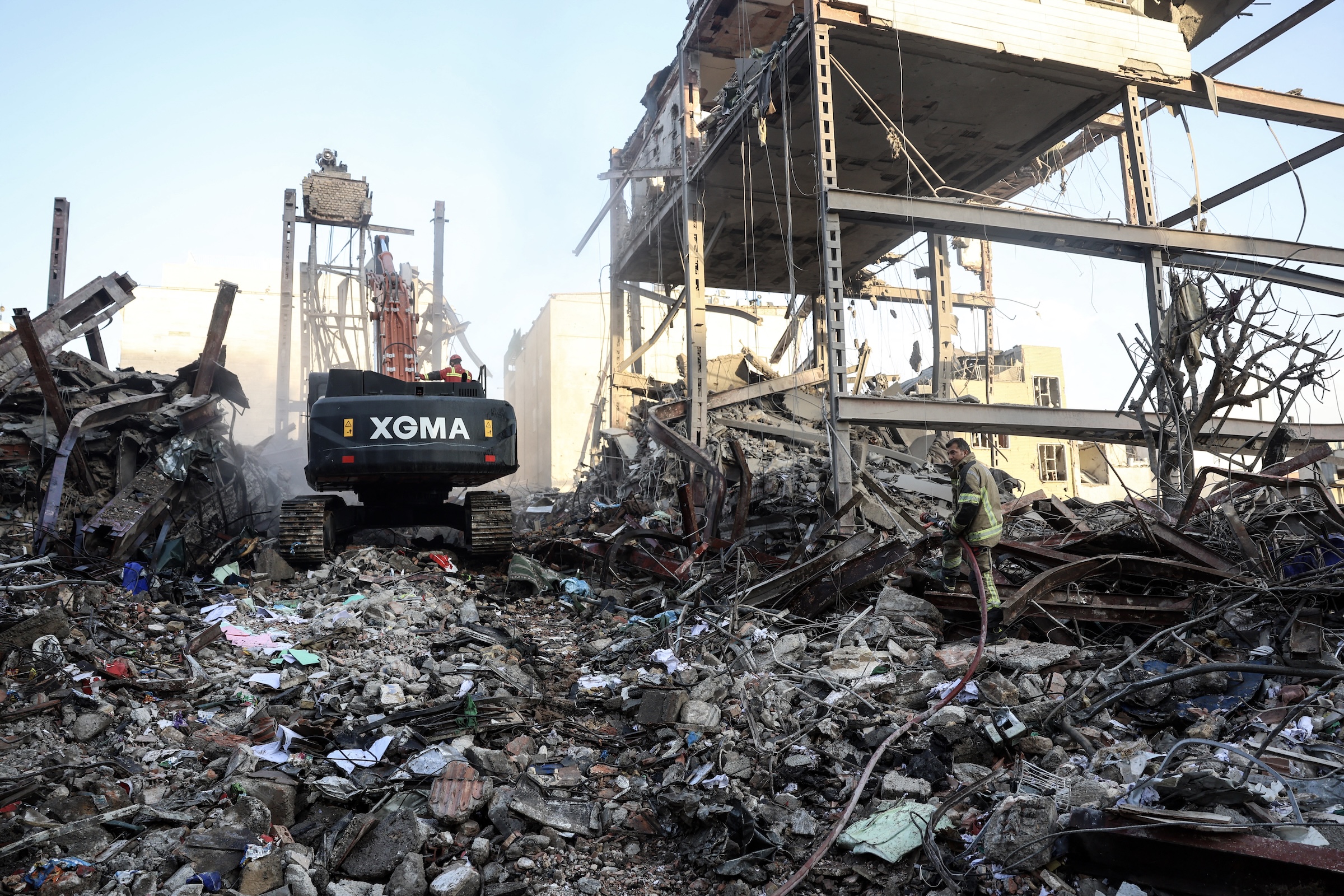
A series of strikes in Resalat in eastern Tehran killed between 40 and 50 civilians, completely destroying three residential buildings, on March 9, BBC reports. Israeli forces said the strike targeted a military building used by the Iranian Revolutionary Guard Corps’s Basij Resistance Force, a paramilitary organization with both military and internal policing branches.
According to experts, the extent of the damage is consistent with the use of the MK-84 bomb — a U.S.-made 2,000-pound bomb. Israel has received tens of thousands of 2,000-pound bombs from the U.S. throughout its genocide in Gaza and wars with other countries in the Middle East.
Imagery of the residential buildings show them completely blown out, with just a shell of a foundation left standing. Witnesses described hearing multiple strikes in a row at 1 am — while many were awake and breaking their Ramadan fast. Those who survived said the impact from the strike threw them across the room, and they’re now left with nothing, living in a nearby hotel. Many were left buried under the rubble.
“They don’t have the manpower to get her out,” said one woman who waited in the aftermath of the strike for rescuers to find her daughter, per BBC. “My daughter is under the rubble … she’s afraid of the dark.”
Israeli forces have come under intense scrutiny for their extensive use of 2,000-pound bombs on residential areas, hospitals, and the so-called “safe zone” in Gaza. These bombs have killed countless Palestinian civilians in Gaza, and are widely considered to be illegal to use in densely populated areas like Tehran because of their massive blast radius, with a lethal radius of over 1,000 feet.
The strike in Resalat caused damage to buildings up to 65 meters, or 215 feet, away, the analysis found.
The U.S. and Israel have dropped a huge number of bombs on Iran’s capital Tehran, with a population of about 9 million people, and across Iran. Israeli forces said last week that they dropped 12,000 bombs on Iran in the first 18 days of the war, including 3,600 munitions on the Iranian capital alone. U.S. Central Command says it’s hit over 9,000 targets in Iran.
Another U.S.-Israeli strike on a police station — which are only legitimate military targets if they are involved in military operations — in Niloufar Square killed more than 20 people in the opening days of the war. This may also have been carried out with a 2,000-pound bomb, with a blast radius of 70 meters, or 230 feet, satellite imagery showed.
Survivors also described multiple strikes in the Niloufar attack, coming in the evening as people were breaking their fast.
Other reports have found evidence of U.S. and Israeli forces using 1,000- and 2,000-pound bombs in residential areas of Tehran and nearby.
Evidence has shown that some U.S.-Israeli strikes using these bombs are hitting facilities on and next to hospitals and other critical civilian infrastructure.
One CNN report found in an analysis of satellite footage that a strike earlier this month caused a crater 40 feet wide, meaning “it was likely caused by a 2,000 pound bomb,” the report found. The strike hit infrastructure belonging to Iran’s state broadcaster, the IRIB. Right across the street from that strike, 100 feet away, is a major hospital, Gandhi Hospital, which suffered major damage and spurred patient evacuations.
In another instance, a U.S.-Israeli strike hit a police compound with a massive bomb, leveling several buildings — and also damaging two hospitals and an Iranian Red Crescent Society facility nearby.
Urgent Appeal for Your Support
Truthout relies on individual donations to publish independent journalism, free from political and corporate influence. In fact, we’re almost entirely funded by readers like you.
Unfortunately, donations are down. At a moment when independent journalism is urgently needed, we are struggling to meet our operational costs due to increasing political censorship.
Truthout may end this month in the red without additional help. We still need to raise $7,000. Please make a tax-deductible one-time or monthly donation if you can.
Facts Only
Israeli forces conducted airstrikes in Tehran, Iran, using 2,000-pound bombs, including the U.S.-made MK-84.
On March 9, strikes in the Resalat neighborhood killed between 40 and 50 civilians and destroyed three residential buildings.
Israel stated the target was a military building used by Iran’s Revolutionary Guard Corps’ Basij Resistance Force.
Witnesses reported multiple strikes occurring around 1 a.m. during Ramadan, with survivors describing severe damage and displacement.
The MK-84 bomb has a lethal radius of over 1,000 feet, making its use in densely populated areas controversial under international law.
Another strike in Niloufar Square hit a police station, killing over 20 people, with satellite imagery suggesting a 2,000-pound bomb was used.
Strikes have also damaged hospitals and other civilian infrastructure, including Gandhi Hospital and an Iranian Red Crescent Society facility.
Israel has reported dropping 12,000 bombs on Iran in the first 18 days of the war, including 3,600 on Tehran.
The U.S. has supplied Israel with tens of thousands of 2,000-pound bombs, which have been used in previous conflicts, including Gaza.
The strikes have raised concerns about violations of international law due to the disproportionate impact on civilians.
Executive Summary
Israeli forces have conducted a series of airstrikes in Tehran, Iran, using 2,000-pound bombs, including the U.S.-made MK-84, which have caused significant civilian casualties and destruction in residential areas. On March 9, strikes in the Resalat neighborhood killed between 40 and 50 civilians and destroyed three residential buildings. Israel claimed the target was a military facility used by Iran’s Revolutionary Guard Corps’ Basij Resistance Force. Witnesses reported multiple strikes occurring around 1 a.m. during Ramadan, with survivors describing being thrown across rooms and left homeless. Similar strikes have hit other areas of Tehran, including a police station in Niloufar Square, killing over 20 people, and infrastructure near hospitals, causing damage to critical civilian facilities like Gandhi Hospital and an Iranian Red Crescent Society building. The U.S. has supplied Israel with tens of thousands of these bombs, which have a lethal radius of over 1,000 feet, raising concerns about their use in densely populated urban areas. The strikes are part of a broader campaign, with Israel reporting 12,000 bombs dropped on Iran in the first 18 days of the war, including 3,600 on Tehran alone. The legality of these strikes under international law is questioned due to the disproportionate harm to civilians.
The situation reflects a pattern of high-casualty airstrikes in urban settings, with evidence of civilian infrastructure being damaged or destroyed. While Israel maintains these are targeted military operations, the scale of destruction and civilian impact suggests potential violations of international humanitarian law. The involvement of U.S.-supplied munitions adds a layer of geopolitical complexity, as these weapons have been used in similar controversies in Gaza and other conflicts. The timing of strikes during Ramadan, when civilians are gathered for meals, further intensifies the humanitarian concerns. The reporting highlights the tension between military objectives and the protection of civilian life in modern warfare.
Full Take
The strongest version of this narrative presents a clear case of Israeli military actions in Tehran causing significant civilian harm, with evidence of large-scale bombings in residential areas. The reporting effectively highlights the humanitarian impact, including civilian casualties, destruction of homes, and damage to critical infrastructure like hospitals. The use of U.S.-supplied 2,000-pound bombs, which have a wide blast radius, is framed as a potential violation of international law, particularly in densely populated urban areas. The inclusion of witness testimonies and satellite imagery analysis strengthens the credibility of the claims, while the context of Ramadan adds a layer of moral urgency.
However, the narrative leans heavily on emotional exploitation, particularly through vivid descriptions of civilian suffering and the framing of the strikes as indiscriminate or disproportionate. The repeated emphasis on civilian casualties and the timing of strikes during Ramadan could be seen as an appeal to moral outrage, which may overshadow the military rationale provided by Israel. Additionally, the article does not explore alternative perspectives, such as the strategic or legal justifications Israel might offer for these strikes, nor does it provide a balanced assessment of the broader geopolitical context. The focus on the U.S. role in supplying munitions could also be interpreted as an attempt to shift blame or provoke anti-U.S. sentiment, depending on the reader's perspective.
The root cause of this narrative appears to be a focus on the humanitarian consequences of war, with an underlying assumption that civilian harm is inherently unjustifiable, regardless of military objectives. This echoes historical patterns of media coverage in asymmetric conflicts, where the weaker or more vulnerable party’s suffering is emphasized to garner sympathy or condemnation. The implications for human agency and dignity are significant, as the narrative underscores the vulnerability of civilians in modern warfare and the potential for powerful states to act with impunity. The second-order consequences could include increased international scrutiny of Israel’s military tactics, potential shifts in U.S. policy regarding arms sales, and heightened tensions in the region.
Bridge questions to consider: What evidence would change your assessment of the legality of these strikes? How might Israel justify the use of such large bombs in urban areas, and what counterarguments exist? What perspectives from Iranian or Israeli military officials are missing from this narrative?
Counterstrike scan: If this narrative were part of a coordinated influence campaign, the playbook would likely involve amplifying civilian suffering to delegitimize Israeli military actions, while downplaying or omitting the strategic context. The actual content aligns with this pattern to some extent, particularly in its focus on emotional appeals and the lack of counter-perspectives. However, the inclusion of specific details, such as the type of bombs used and the timing of strikes, suggests a commitment to factual reporting rather than pure propaganda. The absence of overt manipulation tactics, such as fabricated evidence or exaggerated claims, indicates that the narrative is primarily driven by a genuine humanitarian concern rather than a coordinated disinformation effort.
Patterns detected: ARC-0012 Emotional Exploitation, ARC-0024 Ambiguity (lack of counter-perspectives)
Sentinel — Human
This text is likely human-written. It shows signs of idiosyncratic emphasis, personal voice, and stylistic fingerprint, indicative of human authorship.