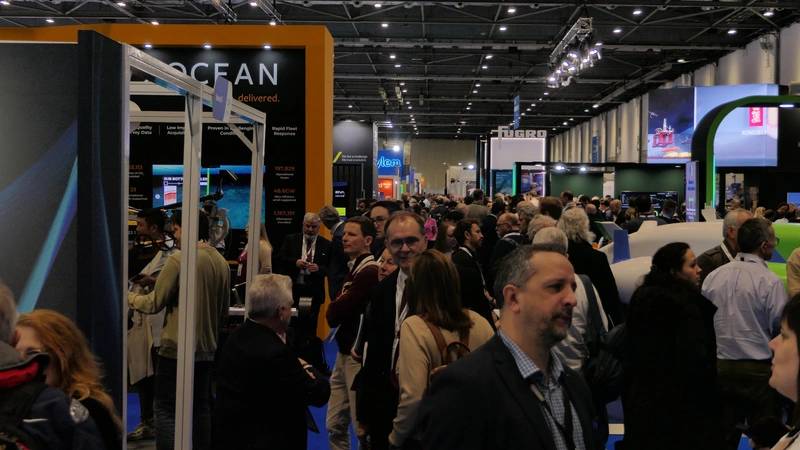
Major industry announcements and new product launches continued to drive significant visitor numbers and plentiful business activity as Oceanology International 2026 (Oi26) surpassed expectations on the second day at Excel London.
Among the companies taking center stage, expanding platform OceanSight used Oi to unveil its new collection of ocean technology brands built to advance marine sensing and subsea intelligence, celebrating an exciting new chapter focused on accelerating innovation and strategic growth.
OceanSight, unveiled by XPV Water Partners earlier this month, is building a differentiated platform focused on technologies that enable greater understanding and visibility beneath the ocean surface.
The company announced the acquisition of Sound Metrics, a leading developer and manufacturer of high-resolution acoustic imaging sonar systems used in underwater inspection, monitoring, and security applications.
“Sound Metrics brings highly differentiated technology and a strong reputation for innovation in underwater imaging,” said Mike Read, Chief Executive Officer of OceanSight. “Together with Ocean Floor Geophysics and Neptune Sonar, Sound Metrics strengthens OceanSight’s ability to provide a comprehensive suite of subsea sensing and imaging solutions that help customers better understand and operate in challenging underwater environments.”
Hampidjan Advant, a specialist in crafting premium HMPE and Aramid ropes, introduced TechIce, a fiber rope that outperforms all other ropes, and steel wire. Unique among synthetic fiber ropes, the next generation winch rope can accommodate very high working temperatures without suffering strength loss or permanent elongation.
David Waage, Chairman, Hampidjan Advant, said: “TechIce is the first fibre rope in the world to be able to withstand the most challenging conditions, with the same strength as steel wires, and represents a breakthrough in safety. We have particularly appreciated the chance to discuss the product with winch companies attending this year.”
Deep tech company WSense launched WCloud, its live, cloud‑based platform that powers next‑generation wireless underwater monitoring and communication systems. The wireless underwater network is capable of integrating and visualizing dozens of sensors at once, delivering real time underwater visualization, advanced analytics for smarter decisions and generative AI powered insights and KPIs.
On the booth, visitors explored actual data streams, immersive dashboards, and the tools that transform underwater data into actionable intelligence for environmental, industrial, and security applications.
Teledyne Marine continued its high-profile presence at this year’s event with the introduction of the new SeaBat T51-S Integrated Dual Head and SeaBat T51-R Integrated Dual Head. The latest evolution of the proven T51 platform integrates dual sonar heads into a single processor. This configuration increases along-track density and swath coverage while reducing onboard hardware footprint, cabling complexity and installation cost, enabling more efficient, high-resolution survey operations.
RBR introduced the Generation⁴ compact logger family – the next evolution of its most widely deployed instruments. Built on decades of field-proven performance, the RBRsolo⁴ (single sensor) and RBRduet⁴ (dual sensor) compact loggers introduce multi-rate sampling regimes, faster data downloads, and virtually infinite memory.
The company also announced the arrival of the RBRduraturo⁴, the newest addition to the RBR instrument family. Built in a larger 100mm form factor and designed for longer, more data-intensive measurement campaigns, the RBRduraturo⁴ delivers the flexibility and performance required for very long-term deployments or applications where high-frequency data is desired.
RBR also launched the RBRcoda chl-a sensor – a real-time chlorophyll-a sensor engineered for exceptional sensitivity, efficiency, and reliability, even at extreme ocean depths.
EIVA’s main announcement on Wednesday was the introduction of NaviSuite ROV Autonomy, standardizing ROV inspections.
Hoytek, manufacturer of electric thrust ROVs from observation to heavy work class, showcased its compact and versatile Myra ROV. The 600m depth rated, powerful, but small observation class ROV has capability to add various payloads in five minutes.
Tethys Robotics ran in-water demonstrations of the Tethys ONE ROV, designed for asset owners, offshore operators, and subsea service providers looking to enhance their inspection capabilities.
During the session, they showcased omnidirectional maneuverability and precise station-keeping, exceptional stability for high-quality data capture, rapid deployment and compact logistics footprint, and real-time video and inspection data performance.
Attendees witnessed how Tethys ONE enables efficient subsea inspections while reducing operational complexity and downtime.
Voyis Imaging Inc. announced the launch of the Discovery Stereo Perception Series, a new class of subsea stereo vision systems engineered to enhance piloting awareness and enable autonomous underwater operations through real-time 3D perception.
Designed to function as the eyes of subsea vehicles, the system replaces traditional single-camera configurations with real-time stereo vision and 3D depth perception. Wide-angle stereo imaging combined with onboard processing generates dense depth maps and live point clouds, delivering reliable spatial awareness in complex underwater environments.
Facts Only
Oceanology International 2026 (Oi26) took place at Excel London.
OceanSight, a platform by XPV Water Partners, announced the acquisition of Sound Metrics.
Sound Metrics specializes in high-resolution acoustic imaging sonar systems.
OceanSight also owns Ocean Floor Geophysics and Neptune Sonar.
Hampidjan Advant introduced TechIce, a synthetic fiber rope with steel-like strength.
TechIce is designed for winch applications and resists high temperatures.
WSense launched WCloud, a cloud-based platform for underwater monitoring and AI analytics.
Teledyne Marine introduced the SeaBat T51-S and T51-R dual-head sonar systems.
RBR launched the Generation⁴ compact logger family and the RBRcoda chl-a sensor.
EIVA announced NaviSuite ROV Autonomy for standardized ROV inspections.
Hoytek showcased the Myra ROV, a compact observation-class vehicle.
Tethys Robotics demonstrated the Tethys ONE ROV’s inspection capabilities.
Voyis Imaging Inc. launched the Discovery Stereo Perception Series for 3D underwater vision.
Executive Summary
Full Take
The strongest version of this narrative highlights a surge in subsea technology innovation, driven by industry collaboration and competitive differentiation. Companies like OceanSight, Hampidjan Advant, and WSense are positioning themselves as leaders in marine sensing, materials science, and real-time data analytics, respectively. The event underscores a broader trend toward automation, efficiency, and safety in underwater operations, with products like TechIce and WCloud addressing long-standing challenges in durability and data processing.
Pattern scan: The article leans heavily on industry press release framing, emphasizing breakthroughs and "first-of-its-kind" claims without independent verification. While not overtly manipulative, the lack of critical scrutiny or comparative analysis could subtly amplify corporate messaging (ARC-0024 Ambiguity). The focus on technological advancements may also obscure broader questions about environmental impact or regulatory oversight.
Root cause: The narrative reflects a paradigm of technological solutionism, where innovation is framed as inherently progressive. Unstated assumptions include the inevitability of automation in subsea operations and the prioritization of commercial applications over scientific or conservation needs.
Implications: For human agency, these advancements could democratize access to underwater data but may also concentrate power among firms with proprietary technologies. Second-order consequences include potential job displacement in traditional surveying roles and increased reliance on AI-driven decision-making in critical infrastructure.
Bridge questions: How might these technologies alter the balance between commercial exploitation and marine conservation? What safeguards are needed to prevent data monopolies in subsea sensing? Would independent testing of these products change their perceived value?
Counterstrike scan: A coordinated influence campaign would likely amplify the "revolutionary" nature of these products while downplaying limitations or risks. The actual content aligns with standard industry promotion but does not exhibit overt manipulation. No further flags.
Patterns detected: ARC-0024 Ambiguity
Sentinel — Human
The article shows strong signs of human authorship, with industry-specific details, natural quotes, and technical depth inconsistent with typical AI generation patterns.