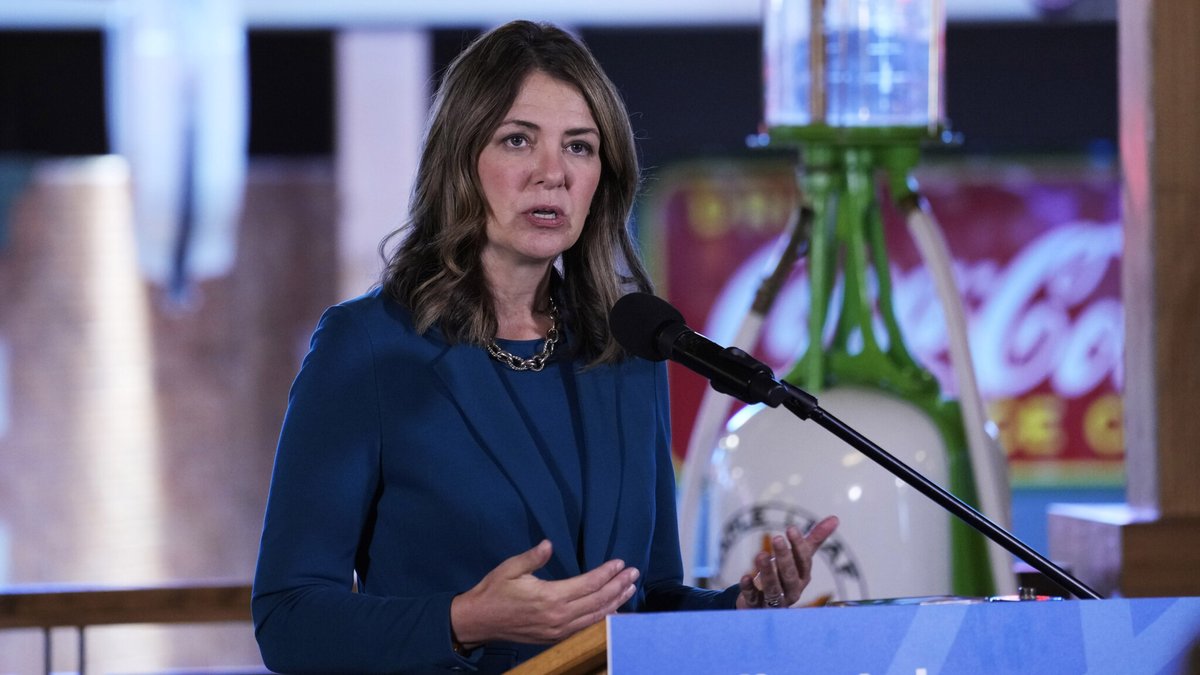
Alberta’s proposed West Coast pipeline crossed an important threshold Thursday.
What many skeptics had dismissed as little more than an aspiration now has a preferred route, experienced pipeline partners, a formal submission to the newly created Major Projects Office, and an unusually broad political coalition behind it.
“The window of opportunity is open now,” Premier Danielle Smith said alongside Prime Minister Mark Carney in Calgary. “We must go all in and seize that. Canada cannot lose another decade or more to delay and inaction.”
At the heart of the proposal is a new pipeline capable of sending more than one million barrels of oil per day from Alberta’s Industrial Heartland northeast of Edmonton to the Port of Vancouver’s Roberts Bank terminal, largely following the existing Trans Mountain corridor. The project is expected to involve close collaboration between Alberta, Ottawa, the Crown-owned Trans Mountain Corporation, Pembina Pipeline, and Indigenous partners, although the arrangement is non-binding and the precise structure has yet to be disclosed.
That’s considerably more substance than many expected.
But it doesn’t settle the bigger question of whether the project ultimately makes economic sense.
Community consultations are only beginning, there are still no publicly announced shipper commitments, no final investment decision, and no announced equity or benefit-sharing agreements with First Nations (or the province of B.C.). Alberta will need billions of dollars in new upstream investment, successful execution of the Pathways carbon capture megaproject, and sufficient production growth to fill the extra export capacity.
Even the choice of a southern route, which appears to satisfy B.C. Premier David Eby’s insistence that the federal North Coast tanker ban remain in place, opens an entirely new set of questions around marine terminal capacity, tanker traffic, environmental opposition, and the regulatory approvals still ahead.
It is also nothing close to a privately financed pipeline.
Both levels of government are expected to remain deeply involved every step of the way. Smith argues that public participation is necessary to de-risk a project after Northern Gateway, Keystone XL, and Energy East all collapsed despite years of development work.
Others will inevitably ask a different question. If governments must shoulder so much of the risk, does that suggest the commercial case isn’t strong enough on its own?
These are legitimate concerns.
Reasonable people can disagree about whether Alberta is getting ahead of itself.
But history also suggests caution against another temptation.
Assuming today’s market—or even the one we can reasonably foresee—will still define the world a decade or two from now is to assume we know far more about the future than we actually do.
More than a decade ago, critics raised many of the same questions about the last Trans Mountain pipeline expansion (TMX). Would there be enough demand in Asia? Would the economics justify the investment? Would Canadian producers ever need another route beyond the United States?
Some of those warnings proved correct.
Pipe for the Trans Mountain pipeline is unloaded in Edson, Alta., June 18, 2019. Jason Franson/The Canadian Press.
Costs ballooned and timelines stretched out. Boy, did they ever—with Ottawa ultimately becoming the owner and overseer.
Yet the broader strategic bet that Canada would eventually benefit from another outlet to global markets looks considerably stronger today than it did when the project was first proposed. So much so that TMX is already preparing to expand again, with optimization projects expected to squeeze up to another 300,000 barrels per day through the existing system by the end of 2028, increasing total capacity to roughly 1.19 million barrels.
Energy markets are funny that way.
Few foresaw the U.S. shale revolution, Europe’s scramble for energy security after Russia’s invasion of Ukraine, or the extent to which artificial intelligence would reignite demand for reliable, around-the-clock electricity—boosting interest in natural gas, nuclear power, and even extending the life of some coal plants.
The so-called energy transition, then, is not so simple. Renewables are growing rapidly, yet global consumption of fossil fuels continues to rise alongside them rather than simply being displaced.
Again and again, some of the biggest shifts have come from the events almost nobody predicted.
Crude, in particular, tells a fascinating story.
While gasoline demand has softened in some advanced economies as electric vehicles gain market share, global oil consumption continues to reach record highs. Much of that growth now comes from sectors that are far harder to electrify, such as aviation, petrochemicals, shipping, and heavy industry, as well as the mining and manufacturing supply chains behind the energy transition itself. Add rising demand from emerging economies where millions of people are entering the middle class, and the picture becomes far more complicated than a simple shift to rooftop solar panels and EVs.
Graphic Credit: Janice Nelson.
Instead of asking whether the world would burn more gasoline, we should’ve asked whether it would continue to need more hydrocarbons in a broader range of applications.
Hindsight is always easier than time travel.
But never mind what could change over a decade. Consider how difficult it has been to predict even a single year.
This time last year, few people would have predicted the U.S. using military force against Venezuela and Iran. Donald Trump built much of his MAGA brand criticizing George W. Bush’s Iraq War and promising to avoid new foreign entanglements. Yet here we are.
There is a reason prediction markets such as Polymarket have become multi-billion-dollar businesses. Even with millions of participants and enormous amounts of information (optimized by AI, no less), the future remains stubbornly difficult to forecast.
Energy is no exception.
For centuries, we have repeatedly convinced ourselves that new technologies would reduce the need for old forms of energy, only to watch overall consumption rise instead. The British economist William Stanley Jevons noticed the phenomenon in the 1860s when more efficient steam engines increased—rather than reduced—Britain’s coal consumption.
Coal piles sit near a chemical plant in Datong, China on Saturday, March 14, 2026. Ng Han Guan/AP Photo.
More than 150 years later, we continue to underestimate humanity’s ability to find new uses for abundant energy.
That doesn’t mean Alberta should build every pipeline it can imagine. Nor does it mean commercial discipline suddenly stops mattering. A multi-billion-dollar piece of infrastructure still has to attract private capital and customers.
But there is another way to think about the proposal that sees it less as a bet on one forecast than as a hedge against our inability to get it right at all.
“An oil pipeline from Alberta to British Columbia’s West Coast should be viewed as insurance, providing optionality in an uncertain world for both Canada and crude oil buyers,” wrote Jackie Forrest, executive director of the ARC Energy Research Institute, in an article published in May.
Canada’s current export strategy still depends overwhelmingly on a single customer in the U.S. Much of Alberta’s planned egress growth also hinges on expanding pipelines that continue to flow south.
That may prove entirely sufficient. Or it may not.
That’s why the real question isn’t simply whether a second West Coast pipeline makes perfect commercial sense in July 2026 or by the end of this decade. It’s whether a country should build long-lived strategic infrastructure based solely on foreseeable assumptions—or whether, in an increasingly unpredictable world, some projects are worth viewing as insurance.
Of course, insurance always looks like a waste of money—right up until the day you actually need it.
Alberta’s proposed West Coast bitumen pipeline has moved significantly beyond the concept stage, with a preferred southern route, experienced pipeline partners and a formal submission to Ottawa’s Major Projects Office. Yet major questions remain over shipper commitments, financing, Indigenous partnerships, and the project’s ultimate commercial viability. Those concerns are legitimate, but history suggests long-lived energy infrastructure is often judged using forecasts that later prove wrong. From the Trans Mountain expansion to the resurgence of energy security, the biggest shifts have frequently come from events few anticipated. Rather than viewing the pipeline solely through today’s market conditions, proponents argue it should also be seen as strategic insurance against an increasingly unpredictable geopolitical and energy future.
What are the main concerns critics have about Alberta's proposed pipeline?
How does the article suggest we view the proposed pipeline in terms of future unpredictability?
What lessons can be drawn from the history of the Trans Mountain pipeline expansion?
Comments (5)
I don’t think that market forces would be much of a hindrance on a pipeline from Alberta to the Pacific, even with prices coming down from their wartime highs. The opposite is likely true, Asian buyers in particular are likely hungry for oil that doesn’t transit the Gulf or the Straits of Malacca. All the better that it comes with days shorter transit times and a discount to global per-barrel prices.
The problem is as it ever was. The federal government wants to socialize the benefits of a pipeline at an uneconomical rate before a single segment is laid. Participants are balking at the regulatory barriers and the expensive compromises of the MOU and saying no thanks, not rejecting their core business as oil producers and transporters.
BC has unrestricted access to move its produce and finished goods using transportation networks that cross Alberta. Fisheries and Oceans and projects that cross interprovincial borders are exclusively federal jurisdiction. An attempt to blockade BC in the way it is doing to Alberta would result in fits of apoplexy and the immediate intervention of federal authorities.
The force of law and the supposed equality of provinces constitutionally suggest a state of affairs in confederation where Alberta has a “right” not simply the “privilege” of access to Canada’s coastlines for the purposes of international trade. To claim otherwise is an inflation of provincial power, a shirking of federal authority and a deep double standard in confederation where landlocked provinces are officially second class.
I suspect if you asked the CEOs of Southbow, TM, Enbridge and others whether in a vacuum they would build a pipeline to the Pacific, they’d probably say they’d start tomorrow. Why else would they all be proposing other new pipelines and expansions even under present market conditions.
Not all barriers are created equal. Despite attempts to equivocate, the problem still lies squarely in the PMO.
Sentinel — Human
This analysis is based on a highly articulate narrative that skillfully blends concrete facts about energy infrastructure with abstract commentary on uncertainty and historical patterns, indicating a high degree of human authorship.